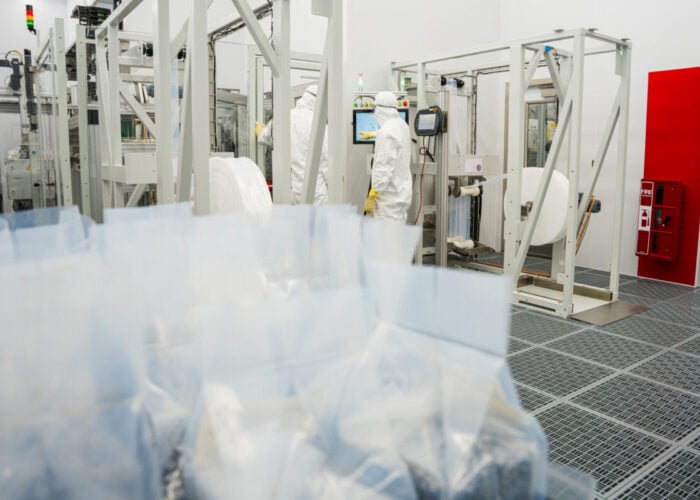
German polysilicon producer Wacker Chemie recorded declining sales and earnings from its polysilicon sector in Q1 2026, primarily due to poor performance in its solar-grade polysilicon business.
In the first three months of the year, Wacker’s polysilicon sector sales fell by 8% to €226 million (US$264.2 million), down from €245 million in the first quarter of 2025. EBITDA remained almost constant at €23 million (US$26.8 million), compared with €24 million last year.
Try Premium for just $1
- Full premium access for the first month at only $1
- Converts to an annual rate after 30 days unless cancelled
- Cancel anytime during the trial period
Premium Benefits
- Expert industry analysis and interviews
- Digital access to PV Tech Power journal
- Exclusive event discounts
Or get the full Premium subscription right away
Or continue reading this article for free
Wacker said the decline in its polysilicon sales was “primarily due to the decline in the solar-grade polysilicon business”.
The polysilicon business results compare with Wacker’s group-wide sales of €1.41 billion – a slight year-on-year decline – and group EBITDA of €173 million, which rose both year on year and sequentially as the Middle East conflict meant Wacker’s customers brought orders forward. Total income for the Wacker group was €15 million in Q1 2026.
“Given the continued weak market environment, we started the year off well. We were able to increase our earnings primarily due to cost savings and customer orders brought forward,” the company said.
Polysilicon market challenges
Hartel said Wacker would focus its polysilicon business on the semiconductor market, rather than solar-grade polysilicon, as part of a restructuring and cost-saving initiative started in 2025. He added that the effects of the war in the Middle East were impacting the company’s business.
“Demand in many of our customer sectors remains weak. Added to this are the effects of the conflict in the Middle East. The turmoil on the energy and commodity markets has led to significantly higher costs for energy, raw materials and logistics,” he said.
The wider solar-grade polysilicon industry has been heavily impacted by oversupply and low prices in recent years. Major Chinese producers have recorded financial losses and continued low selling prices, even after last year’s efforts to control production rates.
Daqo New Energy announced its Q1 results last week, which saw its revenues collapse from US$221.7 million in Q4 2025 to US$26.7 million in Q1 2026, and previous profits of US$15.4 million fall to a gross loss of US$139.4 million. Remarkably, Daqo’s polysilicon sales also fell by 88% and its production rate slightly increased.
Since mid-last year, reports have emerged that the leading Chinese producers have been collaborating to reduce production volumes and attempt to increase selling prices. The government has also formally met with the industry to try to curb oversupply.
Some industry observers have said that the leading Chinese firms are damaging the polysilicon sector by sustaining massive inventories beyond annual demand. Johannes Bernreuter told PV Tech last week that the “sector would be in a healthier place” if output followed sales more closely.