Chinese polysilicon manufacturer Daqo New Energy has published its financial results for the first quarter of 2026, which include a dramatic 88.3% quarter-on-quarter decline in polysilicon sales.
The company’s Q1 polysilicon sales hit 4,482MT, down from 38,167MT in the fourth quarter of 2026, and is the most significant quarter-on-quarter change amid a number of financial metrics that indicate largely consistent performance.
Try Premium for just $1
- Full premium access for the first month at only $1
- Converts to an annual rate after 30 days unless cancelled
- Cancel anytime during the trial period
Premium Benefits
- Expert industry analysis and interviews
- Digital access to PV Tech Power journal
- Exclusive event discounts
Or get the full Premium subscription right away
Or continue reading this article for free
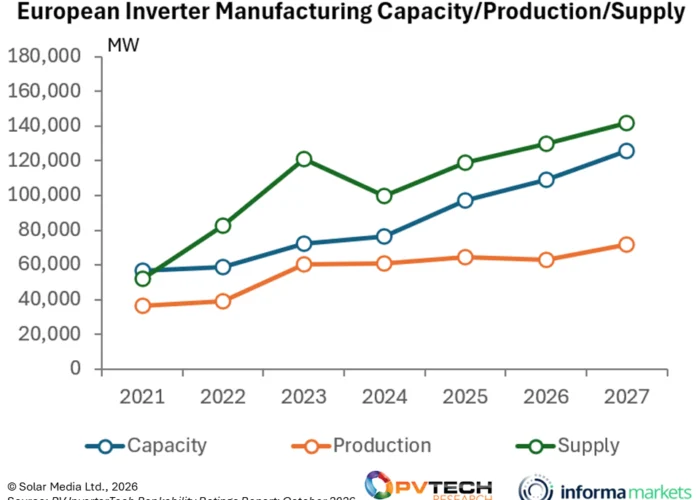
For instance, total polysilicon production increased marginally over this period, from 42,181MT to 43,402MT; polysilicon production cost ticked upwards from US$5.83/kg to US$5.95/kg; and polysilicon average selling price moved up by an almost identical amount, from US$5.83/kg to US$5.96/kg. The different trends in polysilicon sales and production are shown in the graph below.
The decline in polysilicon sales appears to be the main driving force behind a decline in revenue, which collapsed from US$221.7 million in Q4 2025 to US$26.7 million in Q1 2026. There was a similar decline in profits, from a gross profit of US$15.4 million to a gross loss of US$139.4 million, and loss attributable to shareholders, which rose from US$7.3 million to US$88.4 million.
The company’s leadership said that the decline in sales was a conscious decision, following the lead of several industry leaders that cut polysilicon production last year to tackle a significant decline in the sale price of modules, which was forcing many manufacturers to sell at a loss. Between February 2023 and May 2024, prices fell from US$32.7/kg to US$4.4/kg.
“With market prices for polysilicon experiencing a notable decline to be below production costs during the quarter, we adhered to the Chinese authorities’ self-regulation guidelines by declining to engage in below-cost sales,” explained Daqo CEO Xiang Xu. “We adopted a disciplined, wait-and-see approach pending further implementation of the national anti-involution policies we highlighted last quarter.”
Last year, Chinese polysilicon production declined for the first time in over a decade as manufacturers followed the instructions of the China PV Industry Association (CPIA) to cut production in response to these price pressures. Looking ahead, the CPIA expects this decline to impact solar deployment, anticipating a year-on-year decline in capacity additions in 2026, the first such decline since 2019.
However, the sheer scale of Daqo’s quarter-on-quarter decline in production has surprised industry experts; Bernreuter Research head Johannes Bernreuter told PV Tech this afternoon that “I first thought I had read the numbers incorrectly” upon seeing the results.
High inventory ‘doesn’t help the company or the industry much’
Looking ahead, PV Tech Research market research analyst Joe Hennessy said that the polysilicon environment in 2026 is “definitely different” to that of 2025, as manufacturers adapt to changes in price, production and sales.
“At this time last year, most companies were reducing production to adapt to this new landscape, but this quarter production was above guidance,” he told PV Tech today. “This likely aims to bring down average production costs so Daqo has a higher likelihood of selling, because if it’s only selling at above cost, it needs costs to go down, especially if prices won’t go up.”
However, such dramatic changes to polysilicon sales could itself have a destabilising impact on the polysilicon sector in general.
“Having that level of inventory that can only be sold when prices increase will potentially decrease prices when it is sold, because of the amount that is stockpiled,” said Hennessy, who went on to express doubts about Daqo’s high production volumes but low sales figures. “Having such a high inventory level doesn’t help the company or the industry much. If buyers were going to go elsewhere, Daqo wouldn’t be producing at that level.”
Bernreuter agreed with this sentiment, criticising the accumulation of products at a time when sales volumes are low.
“If Daqo’s and the Chinese polysilicon industry’s output in general followed the sales decline instead of further accumulating inventories, the sector would be in a healthier place,” he said.