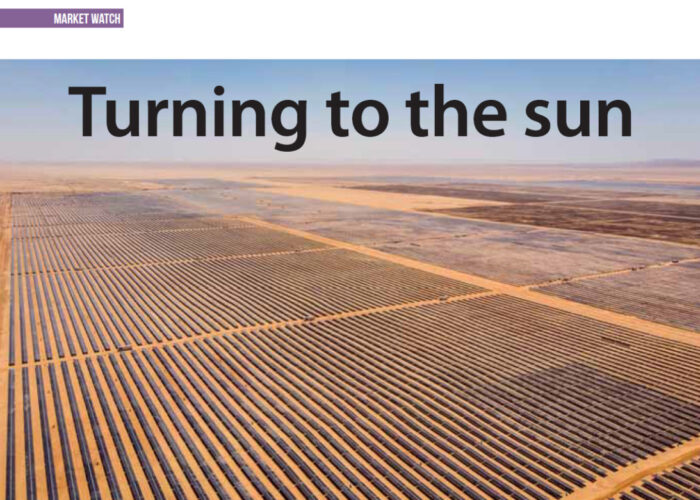
From China’s bullish manufacturers to Malaysia’s blossoming ecosystem and Taiwan’s downstream ambitions, Asia has come to shape the fortunes of global solar. José Rojo charts the continent’s dazzling ascent after visiting all three markets in late 2019.
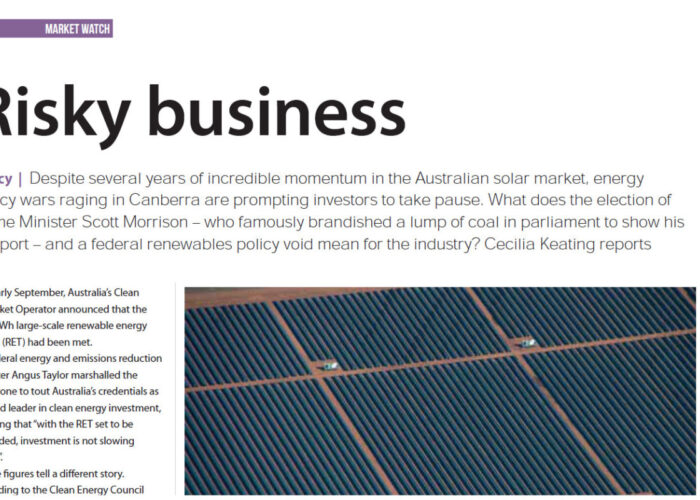
Despite several years of incredible momentum in the Australian solar market, energy policy wars raging in Canberra are prompting investors to take pause. What does the election of Prime Minister Scott Morrison – who famously brandished a lump of coal in parliament to show his support – and a federal renewables policy void mean for the industry? Cecilia Keating reports.
Simple economics are starting to overcome a reluctance to consider renewable energy in a region dominated for decades by powerful fossil fuel interests. Catherine Early reports.
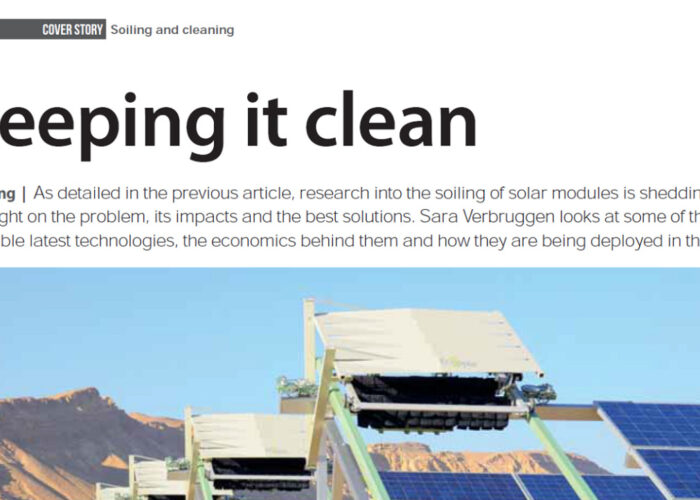
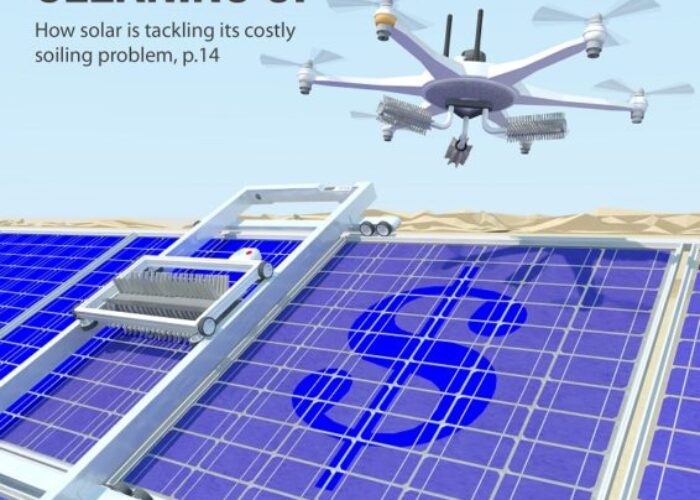
As detailed in the previous article, research into the soiling of solar modules is shedding new light on the problem, its impacts and the best solutions. Sara Verbruggen looks at some of the available latest technologies, the economics behind them and how they are being deployed in the field
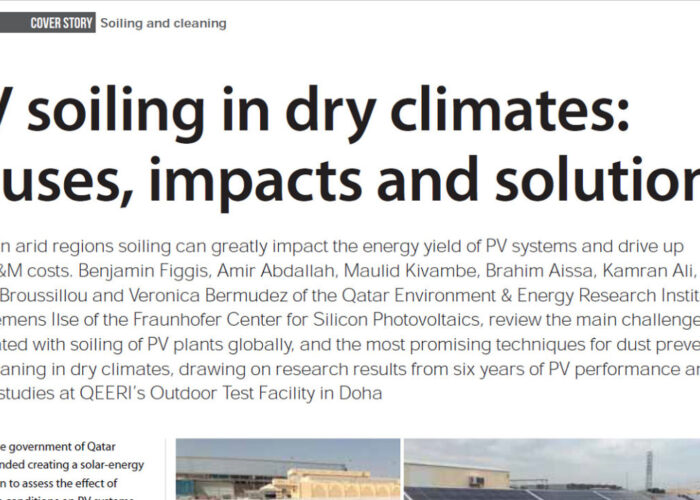
In arid regions soiling can greatly impact the energy yield of PV systems and drive up their O&M costs. Benjamin Figgis, Amir Abdallah, Maulid Kivambe, Brahim Aissa, Kamran Ali, Cédric Broussillou and Veronica Bermudez of the Qatar Environment & Energy Research Institute, and Klemens Ilse of the Fraunhofer Center for Silicon Photovoltaics, review the main challenges associated with soiling of PV plants globally, and the most promising techniques for dust prevention and cleaning in dry climates, drawing on research results from six years of PV performance and soiling studies at QEERI’s Outdoor Test Facility in Doha.
Welcome to the latest edition of PV Tech Power. As we head into a new decade, it would be easier to look back over the spectacular journey solar has walked throughout the 2010s. From nascent technology to a stalwart of power system the world over, the last 10 years will be remembered as the decade of solar’s maturation. But rather than reflect on the journey so far, this edition of the magazine continues to push the envelope and instead glances forward. Indeed, what immediately jumps out is the level of sophistication that can be identified as you flick through the pages of issue 21 of PV Tech Power. This edition’s cover story comes from the deserts of the Middle East, where researchers are getting to grips with the issue of soiling and what can be done to prevent it. And if it’s sophistication you’re seeking, look no further than the issue of bifaciality, which litters the pages of this volume of the magazine. Trade body SolarPower Europe offers a glimpse at how entire swathes of the solar ecosystem is going digital, taking in new developments such as AI and machine learning. Previous editions of this magazine have charted the rise and rise of floating solar, and this has prompted renewed calls for standardisation in the field, as Jose Rojo Martin learns. But this sophistication is not just seen in solar. While recent analysis has shown marked decreases in the price of lithium-ion batteries, longer-duration batteries continue to be of real interest, and our resident energy storage experts Andy Colthorpe and Alice Grundy provide a comprehensive review of new developments in this area.
Organic/inorganic lead halide perovskite solar cells (PSCs) have received global attention because of their excellent photovoltaic performance and ease of fabrication. PSC’s have reached over 24% power conversion efficiency demonstrating that the lead halide perovskites are the most promising class of materials for next-generation thin-film photovoltaics. The unprecedented increase in the device performance from 3.8% to 24% in less than 10 years is mostly due to compositional engineering of mixed cations, and anions, as well as improved processing protocols has made PSC the fastest development of a new material in the PV field. Though the efficiencies on Lab scale are staggering, the full potential of this burgeoning technology cannot be realized without addressing the following challenges: fighting the degradation of the material is the highest focus for the moment and has several fronts for improvements including within larger scale cells or modules. The other main challenge of the new class of material is the toxicity risks due to the presence of lead. The research community is actively working on the mitigation and reduction of the associated risks. The exceptional properties of this material combined alongside its inherent relative lower costs have already triggered the interests of industries and start-up worldwide while on a European regional level, EPKI for European Perovskite Initiative was formed gathering all the significant players in the field.
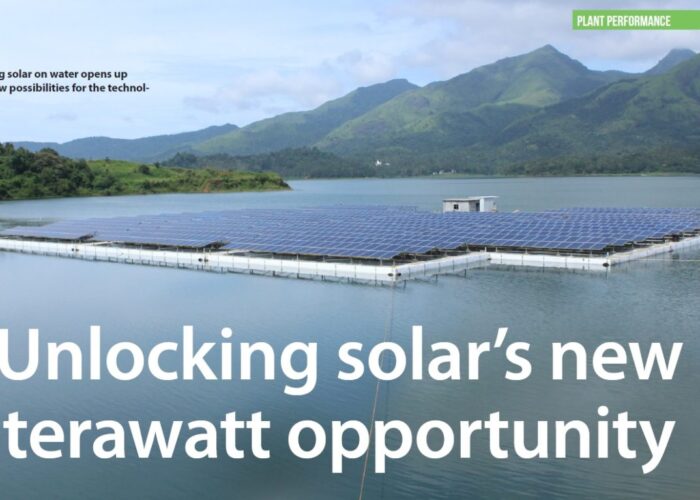
Floating solar has caught the industry’s imagination in recent years, opening up potentially limitless new opportunities for PV installations in land-constrained parts of the world. Ben Willis reports on the work underway to address questions about the performance and reliability of water-based solar installations.
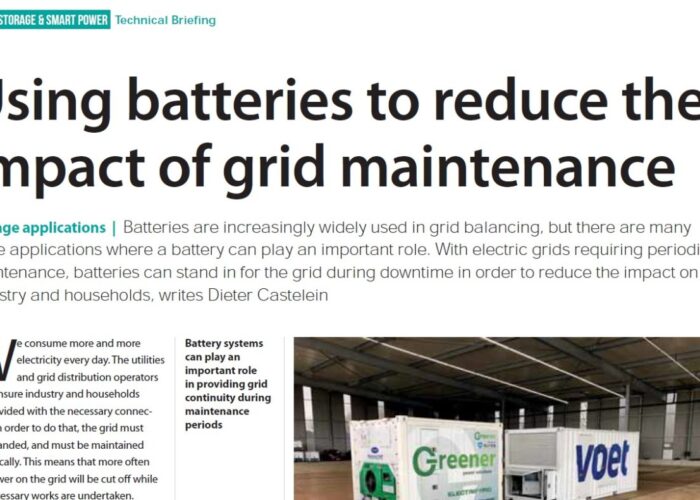
Batteries are increasingly widely used in grid balancing, but there are many more applications where a battery can play an important role. With electric grids requiring periodic maintenance, batteries can stand in for the grid during downtime in order to reduce the impact on industry and households, writes Dieter Castelein.
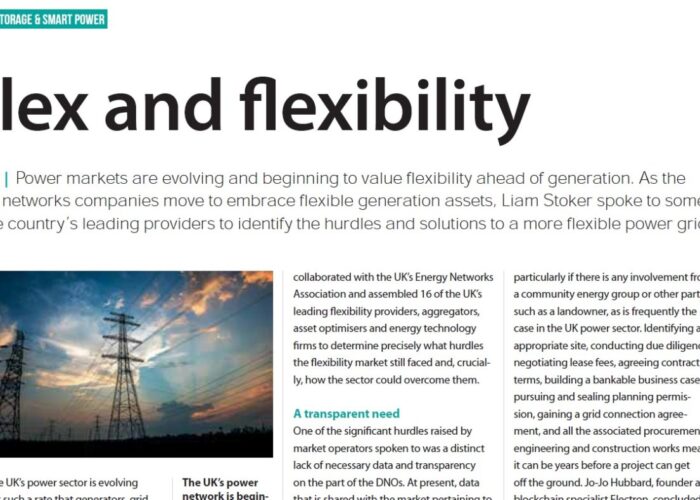
Power markets are evolving and beginning to value flexibility ahead of generation. As the UK’s networks companies move to embrace flexible generation assets, Liam Stoker spoke to some of the country’s leading providers to identify the hurdles and solutions to a more flexible power grid.