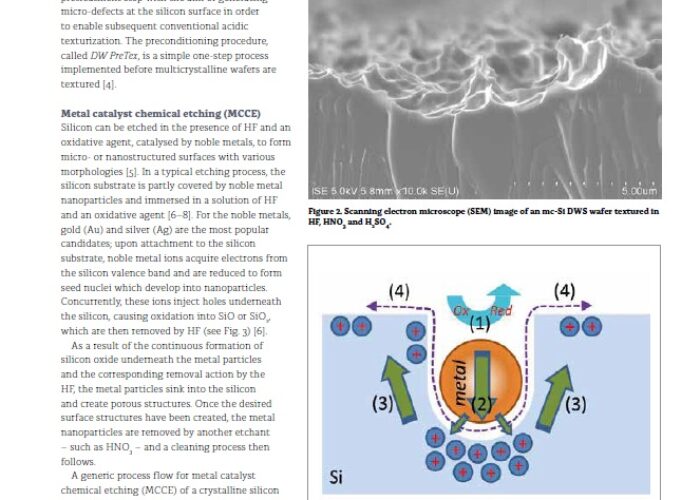
Optical confinement is essential in order to increase the amount of photogeneration in a crystalline silicon (c-Si) solar cell. Fraunhofer examines the compatible options for wafers created using diamond wire sawing.
The deployment of renewable energy, especially solar, is becoming ever more popular. It is estimated that with every 1% increase in PV cell efficiency, electricity costs would decrease by 7%; therefore, improving solar cell efficiency is very important for reducing the average electricity-generating cost of solar and driving it towards grid parity.
Bifacial PV technology raises new challenges for the characterization and modelling of solar cells and modules, as well as for the yield predictions of power plants, as the contribution of the rear side can significantly affect the performance of these types of device.
Nowadays, there is a worldwide production capacity of about 5GW of thin-film module technology. In total, an estimated cumulative installed capacity of 15 to 24GW exists (5-8% of 300GW installed
worldwide in 2016). But how serious is the threat of PID in this thin-film fleet?
By the end of 2017 it is expected that boron-doped multicrystalline silicon (p-type mc-Si) wafers will have been used in more than 60% of the world’s manufactured solar cells.
Since its first publication in 2015, the PERC+ cell concept, which is based on a passivated emitter and rear cell (PERC) design with a screen-printed Al finger grid on the rear, has been rapidly adopted by several solar cell manufacturers worldwide.
In 2015, estimated annual global volumes of electronic waste (e-waste) reached a record 43.8 million metric tons and global e-waste generation is expected to increase up to 50 million metric tons by 2018. Even though solar PV panels significantly differ from typical consumer electronic products, global regulators view PV panels increasingly in the context of e-waste regulations. Solar PV currently accounts for less than 1% of total annual e-waste volumes.
Welcome to the 38th edition of Photovoltaics International. There is every sign that 2018 is going to be a huge year for the industry as manufacturers continue investing in new tools and technologies. We will doubtless see many of the innovations whose evolution has been documented in these pages becoming increasingly mainstream.
Sticking with bifacial solar, Fraunhofer ISE takes a wide-ranging look at a number of challenges surrounding the technology’s leap to widespread deployment.
The Institute for Solar Energy Research Hamelin (ISFH) and Meyer Burger Technology AG present a novel bifacial module architecture.
The University of New South Wales, Trina Solar and BT Imaging give a suggestion for predicting the variation in multicrystalline cell performance by measuring the bulk lifetime of ingots.
We also have a look at PV recycling and lifecycle management from First Solar, PI Berlin’s assessment of PID issues in thin-film solar and TongWei presents a roadmap for PERC cells with 22% efficiency.
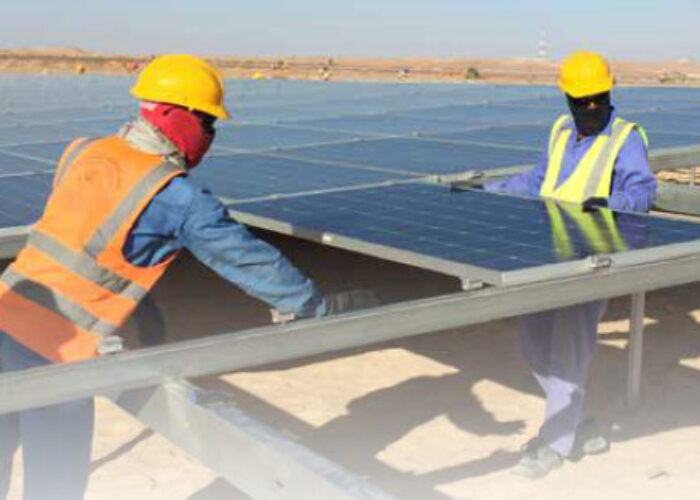
Abu Dhabi’s giant 1.2GW Sweihan PV plant made headlines last year for achieving a record low bid price. With construction well underway, Tom Kenning and John Parnell look at how the project is being executed.