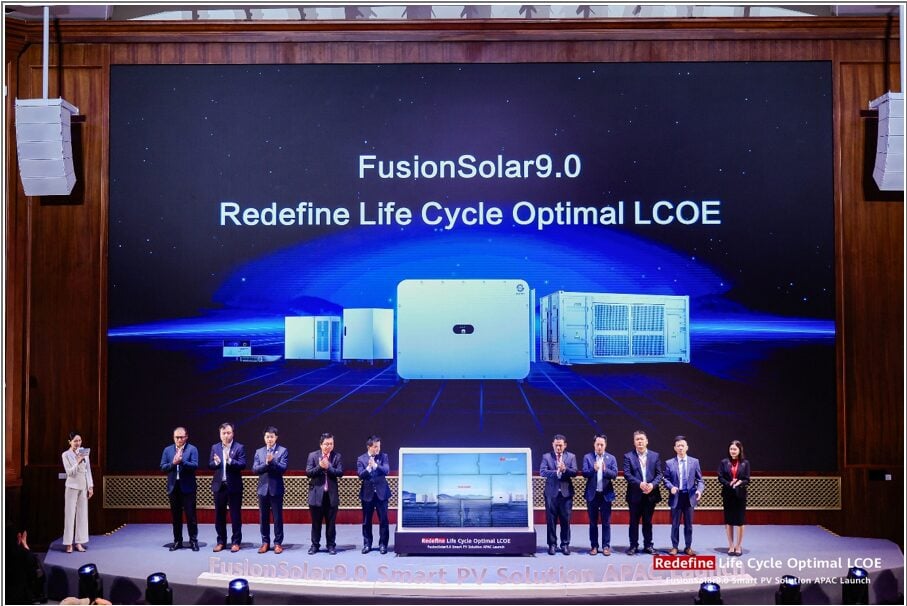
As the industry shifts from capacity-driven expansion to long-term performance and grid integration, Huawei Digital Power, a wholly owned subsidiary of Chinese inverter manufacturer Huawei, launched its FusionSolar9.0 smart PV solution.
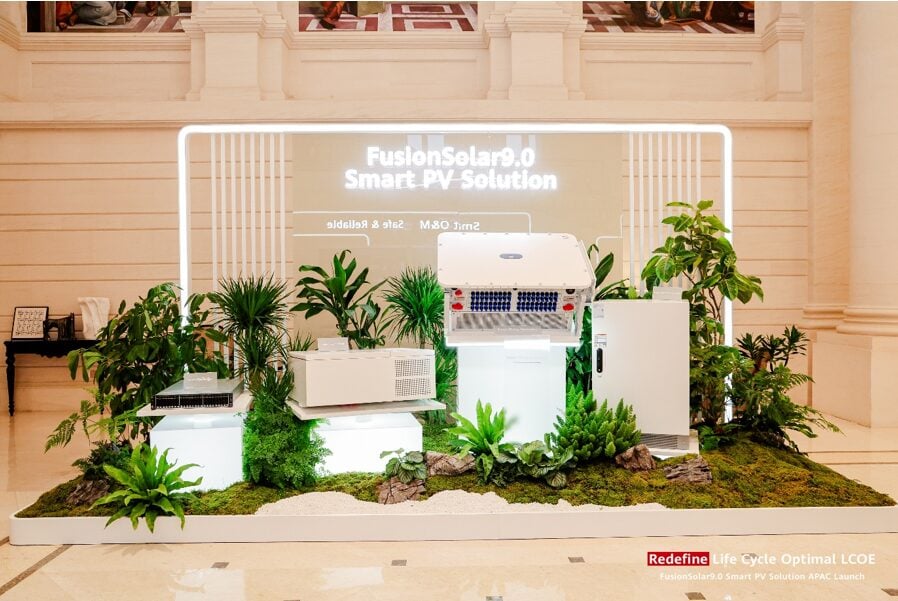
Designed for utility-scale and large commercial and industrial (C&I) applications, the solution features the SUN2000-506K smart string inverter alongside a new generation 3/7/11MW smart transformer station (STS). It introduces what Huawei describes as the industry’s first kV AC solution and a grid-forming smart string inverter, supporting PV arrays of up to 11MW.
Try Premium for just $1
- Full premium access for the first month at only $1
- Converts to an annual rate after 30 days unless cancelled
- Cancel anytime during the trial period
Premium Benefits
- Expert industry analysis and interviews
- Digital access to PV Tech Power journal
- Exclusive event discounts
Or get the full Premium subscription right away
Or continue reading this article for free
The system is built around five core pillars: improved energy yield through string-level optimisation, enhanced grid-forming capabilities, robust performance in harsh environments, smarter digitalised operations and maintenance (O&M) and system-wide lifecycle optimisation.
Huawei said it will also expand local technical and lifecycle service support to accelerate deployment. PV Tech spoke to Ricky Chen, President of Huawei Asia Pacific Smart PV & ESS Business, about the solution’s role in enabling higher-quality solar deployment.
PV Tech: In the context of the global energy transition, how should the power plant lifecycle be redefined to achieve a better levelised cost of energy (LCOE)?
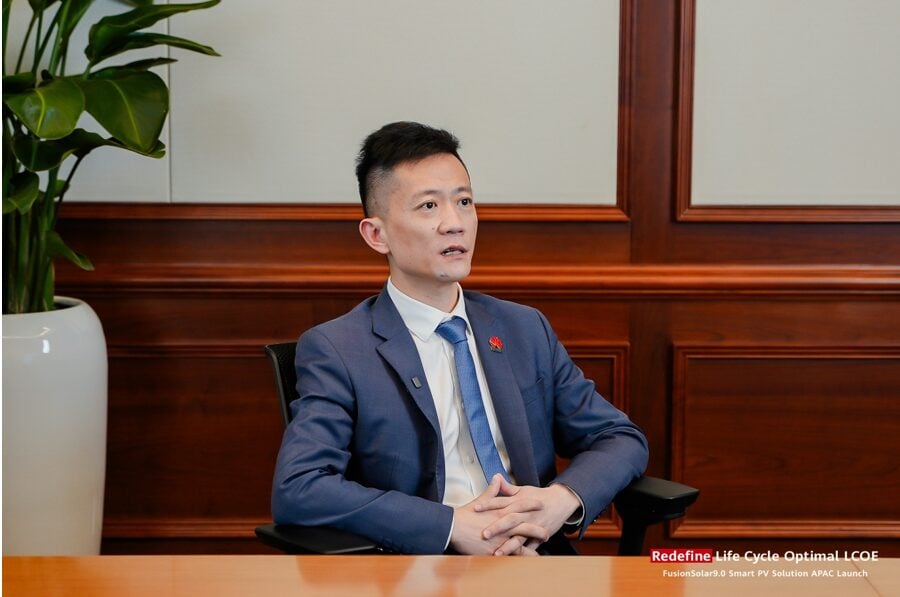
Ricky Chen: To achieve better LCOE, the industry must redefine the entire lifecycle of a power plant, not just focus on upfront costs. This means shifting to system-level, full-lifecycle optimisation — balancing investment, energy yield, operational efficiency and long-term reliability. Since LCOE is determined over 20-25 years, optimising the whole lifecycle is key to delivering lower cost and more stable returns.
PV Tech: What value does this full-lifecycle strategy bring to energy projects in the Asia-Pacific region?
Ricky Chen: This approach is especially valuable in Asia-Pacific, where markets face weak grids, harsh environments and cost pressure. FusionSolar9.0 helps address these challenges by enabling stable grid operation, improving energy output and reducing operational risks.
As a result, customers achieve lower total cost, higher energy yield and more predictable long-term returns, making projects more sustainable and bankable.
PV Tech: Huawei’s new generation 506kW inverter achieves voltage innovation and increases power density over 40%, effectively reducing costs, but also inevitably faces higher safety risks. Huawei has always emphasised safety and high quality. How does Huawei incorporate this DNA into the product during the R&D stage?
Ricky Chen: At Huawei, we always place high quality as our top priority. When we talk about safety, we are not looking at a single inverter — we design for the entire 25-year lifecycle of a power plant.
We have built an end-to-end safety and quality assurance system, ensuring that safety is embedded across the full process — from design, component selection and manufacturing to delivery and long-term operation.
At the R&D stage, we follow very strict standards. With over 20 years of integrated product development (IPD) experience, every step — from component selection to simulation and design — is based on requirements that exceed long-term reliability benchmarks. And in real-world applications, our inverters have proven their reliability across a wide range of harsh environments. Today, Huawei has accumulated around 800GW of inverter installations globally, with actual failure rates significantly lower than industry averages.
Beyond our own products, we also actively work with industry partners to drive higher safety standards, including contributing to new safety evaluation frameworks for energy storage systems.
So even as we increase power density and improve performance, we ensure that safety and quality are built into the product from day one and sustained throughout its entire lifecycle.
PV Tech: From the overall strategic perspective of Huawei Digital Power, what is the strategic significance of launching FusionSolar9.0 for Huawei’s market positioning in the global energy transition? Especially in the Asia-Pacific market, how does FusionSolar9.0 help achieve the goal of “building a zero-carbon society” and promote energy transition in this region?
Ricky Chen: From a strategic perspective, FusionSolar9.0 represents Huawei Digital Power’s flagship solution for large-scale renewable energy development and a key step in strengthening our position in the global energy transition.
At its core, FusionSolar9.0 uses technological innovation as the foundation to improve renewable energy integration and accelerate the transition toward a low-carbon society. By combining digital technologies with power electronics, we enable more efficient generation, smarter energy management and higher system value — supporting the broader vision of building a zero-carbon future.
For the Asia-Pacific region, markets face challenges such as grid instability, rapid demand growth and diverse environmental conditions. FusionSolar9.0 helps address these challenges by enabling higher renewable energy penetration, improving system reliability and supporting more stable and efficient power systems.