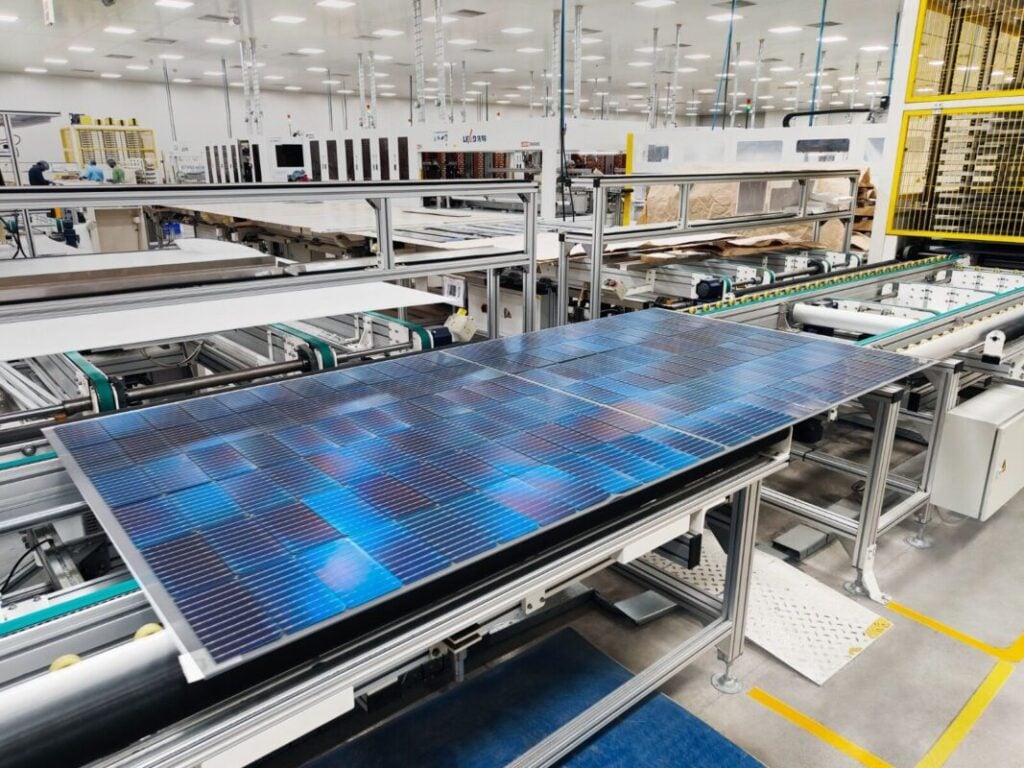
Indian PV manufacturer Premier Energies expects to begin construction of the first phase of its planned 10GW ingot and wafer manufacturing facility in Andhra Pradesh shortly.
Production is scheduled to begin in the first quarter of 2028, Vinay Rustagi, chief business officer at the company, told PV Tech.
Try Premium for just $1
- Full premium access for the first month at only $1
- Converts to an annual rate after 30 days unless cancelled
- Cancel anytime during the trial period
Premium Benefits
- Expert industry analysis and interviews
- Digital access to PV Tech Power journal
- Exclusive event discounts
Or get the full Premium subscription right away
Or continue reading this article for free
The confirmation follows reports by several Indian news outlets that Premier plans to invest around INR60 billion (US$628 million) over the next three years to establish ingot and wafer manufacturing capacity.
The investment forms part of Premier Energies’ broader INR125 billion capital expenditure programme, which includes expanding its solar cell and module manufacturing capacity as well as entering adjacent businesses including inverters, batteries and transformers.
The Andhra Pradesh government has approved the project and allocated 200 acres of land in Naidupeta, near Tirupati, where the company plans to establish 10GW of annual ingot production capacity and 10GW of wafer capacity. The investment is intended to position Premier Energies as a “fully integrated solar manufacturer” ahead of the Indian government’s requirement for domestic production of ingots and wafers from 2028.
Confirming the project timeline Rustagi said, “We expect to start construction of the first 5GW phase shortly and finish it by December 2027 to commence production in Q1 2028. The second phase of 5GW is proposed to be completed by end 2028. Our aim is to become a fully integrated manufacturer with 10GW plus capacity across ingots-wafers-cells-modules.”
The ingot and wafer investment forms part of a wider expansion that will increase Premier Energies’ manufacturing footprint, with the company planning to more than double its solar cell and module production capacities to 10.6GW and 11.1GW, respectively, while expanding into additional clean energy equipment manufacturing.
Premier Energies currently operates solar manufacturing facilities around Hyderabad in Telangana, producing 3.6GW of solar cells and 11.1GW of modules annually.
Asked whether the company is considering further expansion beyond Andhra Pradesh and Telangana, Rustagi confirmed that no decision has yet been made.
“While our existing plants are located around Hyderabad in Telangana, our new cell and ingot-wafer plants shall be based in Naidupeta, Andhra Pradesh. For our next phase of expansion, we are still examining options,” he said.
Premier Energies secures US$315 million solar module and cell orders
In other news, Premier Energies has secured orders worth INR30.11 billion (US$350 million) during the April-June quarter of fiscal year 2027, covering the supply of 1,846MW of solar cells and modules.
The orders, which will be delivered across FY2027 and FY2028, have been received from a mix of power producers, module manufacturers, engineering, procurement and construction (EPC) companies and other customers, according to the company.
Chiranjeev Saluja, managing director, Premier Energies, said, “Premier Energies is embarking on a high-growth strategy supported by booming solar demand and the Indian government’s policy commitment to Make-in-India. Timely implementation of ALMM-II policy, as recently announced, for domestic manufacturing of solar cells is a critical enabler of business growth. These new orders reflect the leadership position built by Premier Energies with investments in new technologies, scale and product quality.”
Premier Energies said the order inflow reflects customer confidence in its manufacturing capabilities, product quality and execution track record.
The new contracts come as the company expands its manufacturing footprint in India. Premier Energies recently increased its module manufacturing lines from 5.5GW to the current 11.1GW of annual nameplate production capacity, while its solar cell capacity is expected to rise from 3.6GW to 10.6GW by September 2026.