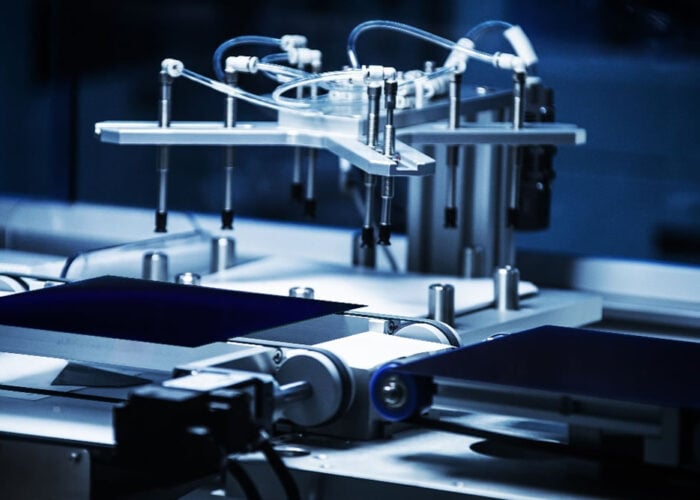
PSE AG has developed a new test stand, Degratest Labtool, designed for the testing of the light-induced degradation (LID) effect of silicon solar cells. The testing technology monitors and records degradation effects, and offers manufacturers and research institutions a fast and reliable tool for testing and developing solar cells. The LID test system was developed at ISC Konstance.
Problem
LID of silicon solar cells reduces the minority carrier lifetime and therefore the VOC and ISC of the solar cell. Due to losses in VOC and ISC, cell efficiency can decrease. Therefore investigations of the degradation behavior are quite important to characterise given cells in industry or for research departments.
Try Premium for just $1
- Full premium access for the first month at only $1
- Converts to an annual rate after 30 days unless cancelled
- Cancel anytime during the trial period
Premium Benefits
- Expert industry analysis and interviews
- Digital access to PV Tech Power journal
- Exclusive event discounts
Or get the full Premium subscription right away
Or continue reading this article for free
Solution
Degratest Labtool comes with an electronically controlled metal halide lamp, which produces artificial light close to the sun's spectrum. The heating of the test area is realised via a high precision temperature controller and can be adjusted from 10°C to 220°C. To determine the LID effect, the test stand first generates a defined initial state of the cells to be tested (annealing). The test stand records all important parameters such as radiation, temperature, measured voltage and temperature-corrected voltage during the test and instantly creates a graph of the results.
Applications
Degratest Labtool can simultaneously test up to four solar cells with a maximum size of 160x160mm².
Platform
Spectral quality of the lamp: Class B. Maximum irradiance in test area: 1000 Wm-². All controls of the test stand are performed in a graphical user interface (GUI).
Availability
Currently available.