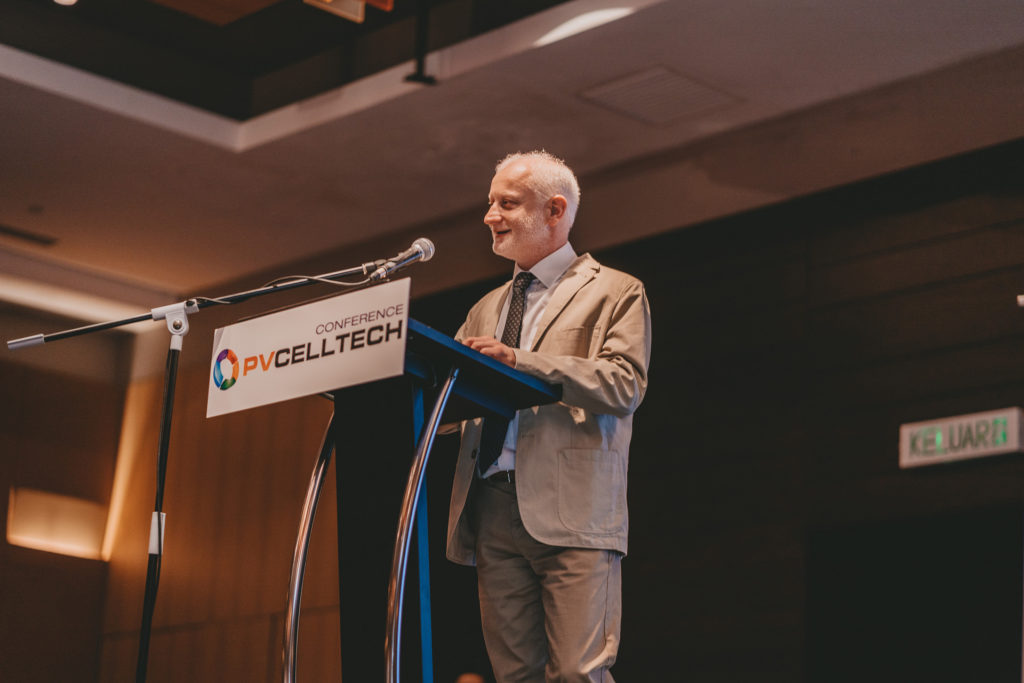
An increase in solar module prices is “hard to imagine unless there is a massive shortage in supply,” according to PV Tech head of research Finlay Colville, who spoke this morning at a solar industry event in London.
Addressing a standing-room-only crowd at London’s ExCeL Centre, Colville said the dynamics in the solar industry are such that module prices will continue the downward trend that has been in place for the last decade. “Frankly,” he said, “the solar industry doesn’t work on prices going back up. The solar industry works on prices that keep going down and then the overall market grows. It’s a kind of indirect elasticity, in market research terms.”
Try Premium for just $1
- Full premium access for the first month at only $1
- Converts to an annual rate after 30 days unless cancelled
- Cancel anytime during the trial period
Premium Benefits
- Expert industry analysis and interviews
- Digital access to PV Tech Power journal
- Exclusive event discounts
Or get the full Premium subscription right away
Or continue reading this article for free
The highest module prices are still in the US, where import tariffs are the strictest and manufacturers are keen to establish a foothold. Since the passage of the Inflation Reduction Act (IRA) in mid-2022, the US has seen a flurry of solar manufacturing announcements, including a number of large Chinese players. These same companies are increasingly looking to ship to the US, too.
“Everyone wants to be big in America,” Colville said. “The whole of China wants to be big in America. It gives the ultimate credibility from a global marketing perspective if you’ve got shipments to the US.”
Europe is a different story. Colville said that some of the lowest global pricing is currently in Europe, largely following a significant oversupply of modules from China into the continent last year; by some estimates, Europe was sitting on between 70-85GW of surplus modules in 2023. Many of these were pushed to European ports by the restrictive trade conditions on the other side of the Atlantic.
He predicted that this situation would repeat itself this year. “There’s no reason why Chinese suppliers wouldn’t keep flooding the market in Europe. They did flood the market last year and brought the pricing down; I genuinely believe from now until the end of the year an awful lot of product will start shipping again to Europe.”
Despite the EU’s recent passage of the Corporate Sustainability Due Diligence Directive (CSDDD) and forced labour ban policies, which are designed to limit access to goods produced using forced labour or with high carbon emissions, Colville said he currently sees “no barrier” for Chinese companies selling directly into Europe.
Upstream portions of the Chinese solar industry operate under the shadow of alleged forced labour in Xinjiang province, where a significant portion of the world’s polysilicon is produced, and the electricity supply makes heavy use of coal.

Nonetheless, Colville said: “There is nothing [to make] pricing go back up. Absolutely nothing.”
He continued: “The only other thing which might bring up pricing globally is if there is some earthquake in some part of China which cuts off a part of the supply chain. If you want pricing [to go up], create an earthquake near a polysilicon factory.”
AD/CVD could shift the landscape
Last week, a group of US-based solar manufacturers, including First Solar and Korean-owned Hanwha Qcells, petitioned the Department of Commerce (DOC) to open anti-dumping and countervailing duty (AD/CVD) investigations into solar supply coming from Chinese-owned companies in Southeast Asia.
Chinese companies had previously invested in capacity in Southeast Asia to avoid the US tariffs on products sourced from China, and have expanded their presence to comply with the developing laws.
However, if this most recent appeal is successful, the DOC could end up adding Malaysia, Thailand, Vietnam and Cambodia to the list of countries where stringent tariffs apply. The DOC already announced an updated version of this ruling earlier this year.
Colville said that “Probably, almost certainly, [the companies with capacity in Southeast Asia] won’t be able to ship any of it to the US, and that’s the only reason the capacity’s there.”
This could shift the dynamics of global supply and open up the European market to shipments from Southeast Asia, possibly raising module prices in the process.
Colville said: “Other markets in the world, like Europe, which say ‘we don’t want products from China’; bingo. There’s a whole Southeast Asian supply chain. Only problem is, you’re going to have to pay more.”
The outlook for module pricing will be part of Colville’s presentation at the upcoming UK Solar Summit, hosted by PV Tech‘s publisher Solar Media.
Ending his presentation, Colville asked whether Europe would double down on an ethical buying policy which would use the Chinese-backed supply chain in Southeast Asia, but would require its buyers to pay more for their modules.
Solar Power Portal’s publisher Solar Media will host the UK Solar Summit on 4-5 June 2024 in London. The event will explore the UK’s new landscape for utility and rooftop solar, looking at the opportunities within a GW+ annual market, and much more. For more information, go to the website.