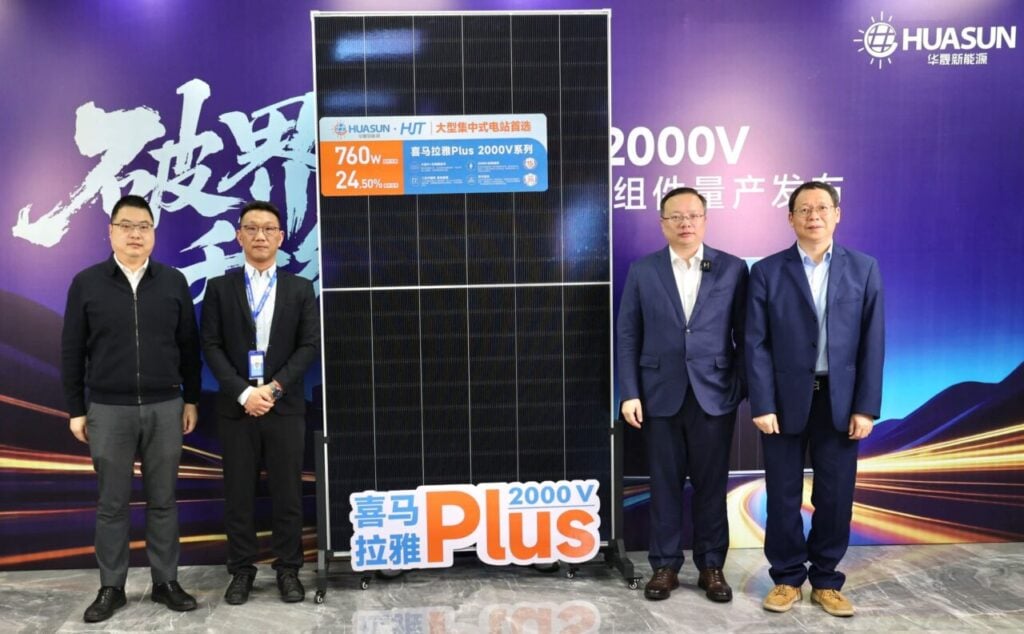
Chinese module manufacturer Huasun Energy has launched a new heterojunction module with a 760W output, a 2,000V system voltage and 24.5% module efficiency.
The Himalaya 760 HV HJT solar PV module is designed for large-scale utility and desert-based projects, with the 760W output enabling higher output and high-voltage operation to maximise project economics, according to the company.
Try Premium for just $1
- Full premium access for the first month at only $1
- Converts to an annual rate after 30 days unless cancelled
- Cancel anytime during the trial period
Premium Benefits
- Expert industry analysis and interviews
- Digital access to PV Tech Power journal
- Exclusive event discounts
Or get the full Premium subscription right away
Or continue reading this article for free
According to Huasun, the increase in system voltage from 1,500V to 2,000V allows for a reduced balance of system cost by nearly RMB0.1157/W (US$0.0163/W), cuts foundation pile demand by more than 5,000 units and significantly improves land-use efficiency. These results were achieved through a simulated 100MVA utility project in the Chinese province of Xinjiang.
Moreover, the new PV module also integrates other design upgrades, including a 132 half-cell dual-string architecture, large-size silicon wafers, negative spacing design and high screen coverage. With an active area ratio of 95.8%, the module achieves an approximate 20W power gain and a 0.66% efficiency improvement.
With the increase in voltage, the module adopts a butyl edge-sealing process for enhanced insulation without sacrificing efficiency, in order to ensure safety under ultra-high-voltage operation.
“760W is not an endpoint, but a new starting point,” Xu Xiaohua, chairman at Huasun, said. “This platform will continue evolving toward higher power, higher efficiency, and higher value for the global clean energy transition.”
The new solar PV module is fully compatible with existing high-efficiency production lines and only requires minor equipment adjustments for rapid and stable mass production, said the company.
2,000V system as the new standard
This year has been a year of change in terms of voltage system standards for the solar industry, with many companies – from module manufacturers to tracker and inverter suppliers – launching products with 2,000V, such as Huasun’s new module.
A move to 2,000V solar systems that has also been embraced by tracker companies in the past few months, such as with Array Technologies and FTC Solar, as well as NextPower (formerly known as Nextracker), with their new electrical balance of systems (eBOS) trunk connector.
This move from 1,500V (which was the standard up until this year) to 2,000V will allow for improving the efficiency of the system but also reduce the costs of a project, as Brian Nelson, renewables segment leader at engineering firm ABB, explained to PV Tech Premium earlier this year (subscription required).
The leap to 2,000V has also been covered on the latest edition of our journal, PV Tech Power, with a focus on the impact for utility-scale solar projects.