Researchers at Daejeon, South Korea-based Hanbat National University (HNU) have developed a predictive framework that enables more precise design of 2D perovskites by separating the effects of dielectric screening from structural distortion.
The findings, published in ‘Advanced Functional Materials’, demonstrate how changes to the dielectric environment, rather than structural changes alone, govern exciton behaviour in layered perovskites. The study, titled ‘Exciton Binding Energy Modulation in 2D Perovskites: A Phenomenological Keldysh Framework’, was led by HNU Department of Materials Science and Engineering Research lead professor Ki-Ha Hong.
Try Premium for just $1
- Full premium access for the first month at only $1
- Converts to an annual rate after 30 days unless cancelled
- Cancel anytime during the trial period
Premium Benefits
- Expert industry analysis and interviews
- Digital access to PV Tech Power journal
- Exclusive event discounts
Or get the full Premium subscription right away
Or continue reading this article for free
The study tackles a long-standing challenge in improving 2D perovskite materials by better understanding how they absorb and transport light. At the heart of this are excitons, pairs of negatively charged electrons and positively charged “holes” that form when sunlight hits the material. How tightly these pairs stay bound affects how efficiently solar cells can convert sunlight into electricity.
By uncovering what controls this behaviour, the researchers hope to help design more efficient and stable perovskite solar cells.
Isolating the role of dielectric screening
Unlike conventional 3D perovskites, 2D perovskites are made up of ultra-thin inorganic layers separated by organic molecules. These organic layers act like insulating barriers, allowing researchers to fine-tune how electric charges behave inside the material.
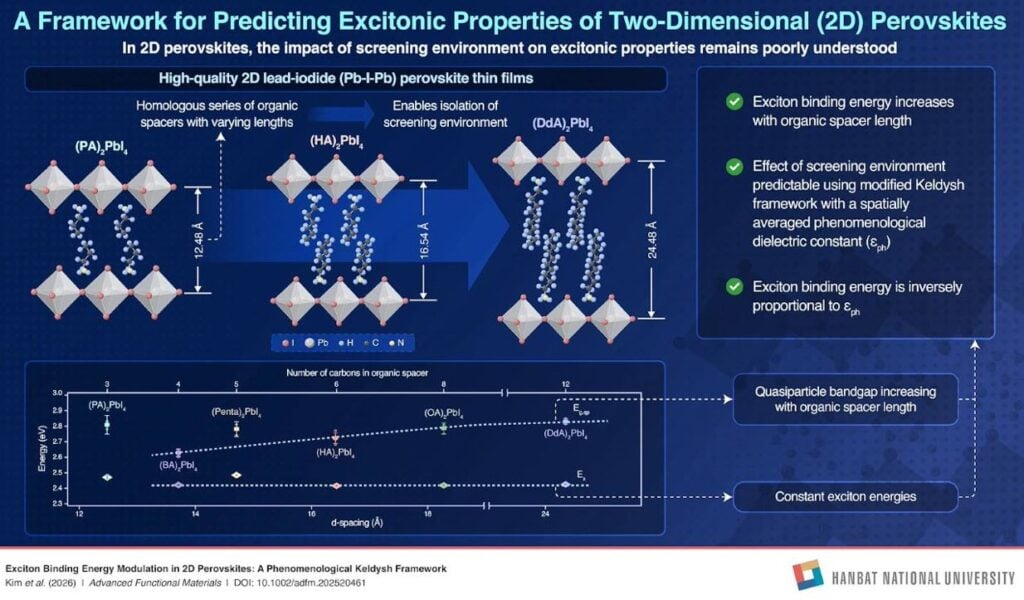
To understand how this affects solar cell performance, the researchers created a series of 2D perovskite films using different organic spacer molecules. While the molecules all had the same chemical group that bonds to the perovskite, they varied in length.
Changing the spacer length altered the distance between the active inorganic layers and the material’s electrical properties without significantly changing its overall structure. This allowed the team to pinpoint how these changes influence the movement and interaction of charge carriers generated by sunlight.
“Our study addresses a long-standing challenge in 2D perovskite research: when the organic spacer is changed, the dielectric environment and the inorganic lattice structure often change at the same time, making it difficult to determine which factor actually controls the excitonic properties,” explained Hong.
“To disentangle these effects, we used a homologous series of organic spacers and focused on a structurally consistent set of 2D perovskites in which the Pb–I framework remains nearly unchanged. This allowed us to isolate the role of dielectric screening in modulating the quasiparticle bandgap and exciton binding energy.”
The team initially investigated six spacer molecules before focusing on an even-numbered series in which the lead-iodide framework remained nearly unchanged, enabling dielectric effects to be studied independently.
Using ultraviolet photoelectron spectroscopy and low-energy inverse photoelectron spectroscopy, the researchers measured quasiparticle bandgaps, while UV-visible absorption spectroscopy was used to determine exciton energies.
The measurements showed that quasiparticle bandgaps increased as the organic spacer length increased, whereas exciton energies remained almost unchanged. This resulted in a larger difference between the quasiparticle bandgap and exciton energy, indicating a significant increase in exciton binding energy with longer organic spacers.
Modified model improves prediction of exciton behaviour
To explain the observations, the researchers applied the Keldysh model, a standard approach for describing excitons in 2D materials. However, the conventional model failed to fully capture the experimental results.
“Our model offers a practical design rule for predicting how organic spacer length controls excitonic properties of 2D perovskites,” concluded Hong. “This provides a molecular-level design rule for tuning exciton binding energy and energy levels in 2D perovskites, which can guide future design of light-emitting, photovoltaic and other optoelectronic materials.”
The team therefore introduced a modified phenomenological dielectric function that accounts for the finite thickness of the organic spacer layers. The revised model closely matched the experimental data, providing a validated framework for predicting excitonic properties and offering practical design rules for engineering next-generation 2D perovskite optoelectronic materials.