Last month, market analyst LevelTen Energy published its latest report into power purchase agreement (PPA) trends in Europe and North America, finding that solar PPA prices were moving in opposite directions in the two regions.
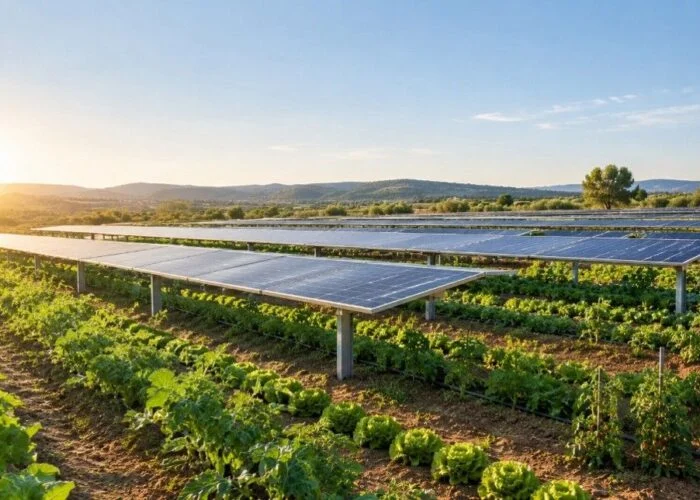
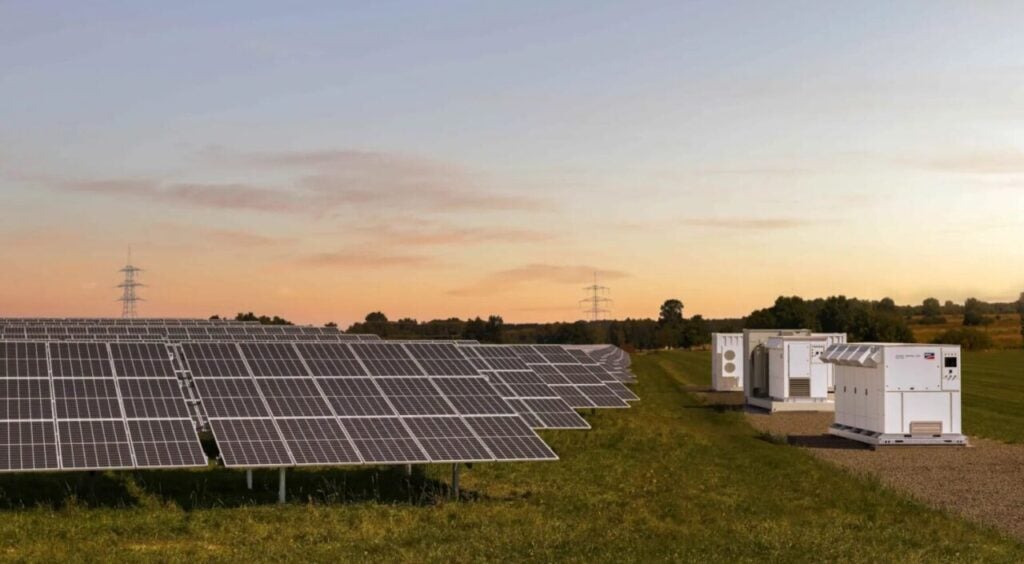
However, the most novel component of LevelTen’s European report was that, for the first time, the company posted figures on what it calls ‘hybrid’ PPAs, those that involve a renewable energy generation asset and a co-located battery energy storage system (BESS).
Try Premium for just $1
- Full premium access for the first month at only $1
- Converts to an annual rate after 30 days unless cancelled
- Cancel anytime during the trial period
Premium Benefits
- Expert industry analysis and interviews
- Digital access to PV Tech Power journal
- Exclusive event discounts
Or get the full Premium subscription right away
Or continue reading this article for free
The average price of a hybrid PPA signed in Europe in the second quarter of this year sat at €71.58/MWh (US$82.62/MWh), just ahead of blended PPAs, which consist of multiple generating technologies covered by a single deal, at €70.29/MWh, in LevelTen’s market-averaged continental index. Hybrid PPAs were also notably cheaper than wind PPAs—which reported an average price of €84/MWh—but more expensive than solar PPAs, which saw an average price of €56.58/MWh.
While hybrid projects are nothing new—particularly in Europe, where annual BESS installations have broken records for over ten consecutive years—the specialised tracking of renewable-plus-storage offtake deals is.
This marks a significant shift for the European renewable energy space more broadly, as such deals transition away from niche cases or pilot arrangements on the periphery of the European renewable energy finance space to one that could form a more integral part of the dealmaking landscape.
“There’s been a clear shift in the market as a whole towards hybridising,” explains Plácido Ostos, director of European analytics at LevelTen Energy, who speaks to PV Tech Premium exclusively about the launch of the hybrid deal tracker.
He explains that a combination of the threat of cannibalisation and the fall of battery installation costs means that the business case for standalone solar has weakened, while the business case for solar-plus-storage has strengthened. This has led to more hybrid deals being signed, to the point that such arrangements warrant specialised tracking from LevelTen.
“Cannibalisation has been hitting solar assets hard,” he explains. “That, together with the technical and cost evolution of the batteries—which has made the batteries more appealing and [hybridising] an asset, particularly a solar asset, much easier—hybridising a solar asset with a battery is a way to recover part of the lost value taken by the cannibalisation.”
Why hybridise?
“The main reason for you to hybridise is the drop in value of the solar asset,” explains Ostos, in reference to the falling costs of installing new solar projects that have been reported in many regions globally. Figures from the International Renewable Energy Agency (IRENA) suggest that solar PV and wind are the cheapest sources of power, as recently as May of this year.
The same is true for batteries. Ostos notes that “in the past you had to spend a lot of money because the capex of the battery was more expensive, and now it’s cheaper.” Indeed, figures from SolarPower Europe, produced in collaboration with Rystad Energy, show that more effective integration of solar and storage into Europe’s energy system could cut operating costs by as much as 49% by the end of the decade.
While the falling cost of both solar PV and BESS is a positive step for the accessibility of these technologies, and their successful deployment is a key facilitator of Europe’s energy transition, these trends mean that, when considered as standalone projects, solar and BESS assets are less lucrative now than in previous years for investors. As a result, the business case for investing in standalone projects, or looking to acquire power from standalone projects, is less compelling.
In this context, Ostos adds that some of the historic obstacles to the deployment of more co-located projects, such as the complexity of managing two assets at a single site, are no longer as influential on decision-makers as they once were.
“Once you acknowledge that, the problem of managing two assets in one, and so on, becomes less of a problem, because you need to find ways to bring value to that project,” he says. “The easiest one is hybridising with batteries.”
This shift in priorities is perhaps most evident in LevelTen’s own database. Ostos says that, in its most recent figures, standalone solar PPAs accounted for less than 60% of all deals made, down from a peak of 75%. Indeed, in the most recent data, “almost 30%” of offers tracked by LevelTen were for hybrid deals, meaning that renewable-energy-plus-storage now accounts for almost one-third of Europe’s clean energy dealmaking landscape.
Solar leads the way in hybrid dealmaking
While Ostos notes that “people are investing more heavily and confidently in batteries,” he acknowledges that solar-plus-storage deals still account for “the vast majority” of hybrid deals signed, highlighting the crucial role that both solar PV and BESS are playing in this transition.
“There are many reasons: first of all, we have some 70% of our offers were solar [so] solar was the most numerous type of offer in our database. It makes sense that they are hybridising with batteries,” he explains.

“The second reason is that storage in general, and batteries in particular, make money when they cycle. When you pair that with solar, you can ensure a daily cycle, which makes sense for batteries. For wind, on the other hand, you can have a windy week and a non-windy week, so it makes less sense [to add a battery from a cycling angle].”
Ostos also addresses the fact that hybrid PPAs are, on average, exactly €15/MWh more expensive than solar PPAs in the LevelTen figures, as standalone solar “will always be cheaper” owing to its low levelised cost of electricity (LCOE). However, this has led to a somewhat vulnerable scenario for Europe, which Ostos describes as “very solar-dependent” at present, and “very cannibalised”.
This reliance on solar power means that challenges such as curtailment are ever-present in the minds of investors and project managers, and they are keen to minimise these risks by investing in technologies such as co-located storage.
Figures from Aurora Energy Research estimate curtailment will increase by 55% in Spain between 2024 and 2030, and a mammoth 115% in the UK over this period, as both countries transition to a greater reliance on renewable energy, which will require a subsequent integration of more co-located solar-plus-storage projects into the energy mix. In this context, Ostos says he expects more hybrid deals in the future when asked if he anticipates more such deals being signed: “Probably yes.”
‘Hybrid is something that is transactable’ as industry looks ahead
Looking further ahead, Ostos is optimistic that hybrid deals will become more commonplace in the future, as the co-location of solar and storage creates a product that is more easily tradable than the outputs of standalone solar and storage.
“Hybrid is something that is transactable,” he says. “The industry is able to trade many different structures compared to standalone solar or wind. Standalone solar or wind, classically, were [traded] as-generated and only seldomly could you try to tweak the generation or the profile that was traded. But with a battery, that’s much easier.”
He adds that the hybrid index was developed not in a vacuum, as an idea of what the European renewable energy trading space could look like, but in response to industry trends. LevelTen’s hybrid index compiles price data from five different kinds of deals made in Europe, each reflecting a different way in which electricity generation and storage are traded, and tells PV Tech Premium that the company will continue to refine its index in conversation with industry, to make sure it effectively reflects the kinds of deals being signed.
“At LevelTen, and at every company, we react to the industry changes,” he says. “We’ve been trying to discover which are the standardised products. There are four or five, after talking with the rest of the industry for months and years.
“How will this evolve? We are fairly confident that these are the products that will hold the vast majority of the deals. If, for whatever reason, things change, we will have to adapt, of course.”
The relative novelty perhaps explains the sudden shift in average hybrid PPA prices in Europe between the second quarter of 2025, when LevelTen first started collecting the data, and the second quarter of 2026, covered in its most recent report. The average hybrid PPA price changed from around €75/MWh at the start of this period, to over €80/MWh by the end of 2025, before settling below €72/MWh in the second quarter of this year.
A price drop of almost €10/MWh in just six months is unheard of in the last few years, and compares to price changes of around €3/MWh for solar and around €2/MWh for wind over this period, according to LevelTen’s figures.
This means there is still plenty of room to grow for the hybrid index, both in the deals covered and in the mechanisms used to track deals involving different technologies, which have exponentially more moving parts than deals for their standalone equivalents.
“One thing that we have observed is that the ratio of the size of the battery versus the size of the solar asset is something that is pretty important in terms of price and value,” Ostos explains, describing some of the variables that could be assessed differently for the next hybrid price index. “It’s not the same to have a 50MW solar asset and hybridise with a 10MW BESS or a 50MW BESS.”