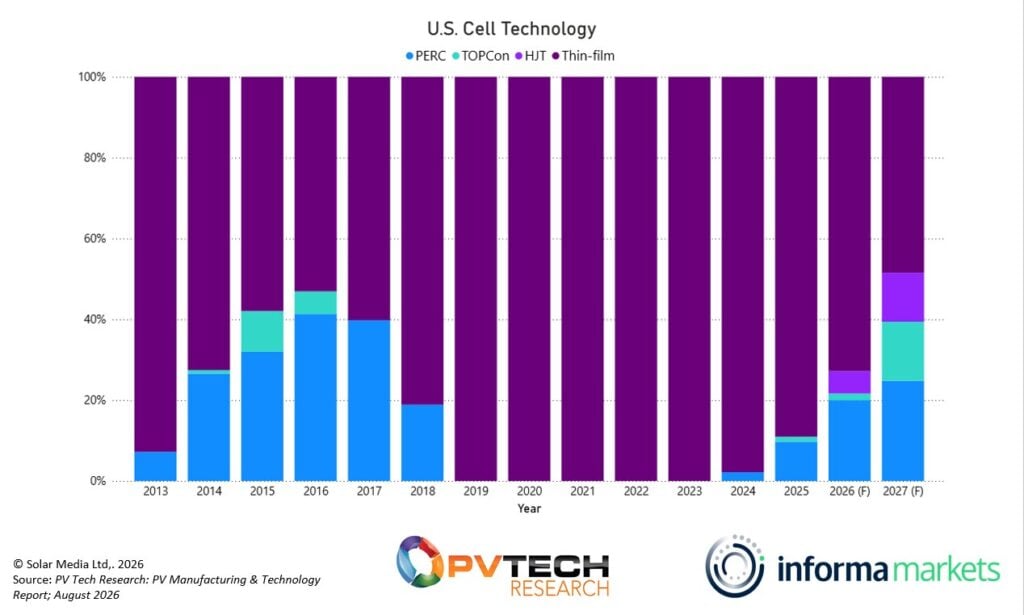
Welcome to the PV Chart of the Week from our colleagues at PV Tech Research. This week, we look at the technology breakdown of projected US solar cell production capacity.
Between 2013 and 2018, the US had an annual nameplate capacity comprising different solar PV technologies, including thin-film, PERC and TOPCon, before all the crystalline silicon nameplate capacities were shut down in 2019.
Try Premium for just $1
- Full premium access for the first month at only $1
- Converts to an annual rate after 30 days unless cancelled
- Cancel anytime during the trial period
Premium Benefits
- Expert industry analysis and interviews
- Digital access to PV Tech Power journal
- Exclusive event discounts
Or get the full Premium subscription right away
Or continue reading this article for free
Production of crystalline silicon solar cell technology resumed for the first time in 2024 on US soil, which was for PERC solar cells.
This was followed in 2025 by the first production of TOPCon solar cells, and last month, solar PV manufacturing giant Canadian Solar began producing heterojunction (HJT) cells at its facility in Jeffersonville, Indiana. Once fully operational, the facility is expected to have an annual nameplate capacity of 6GW.
Earlier in the year solar cell manufacturers ES Foundry and Suniva expanded their respective US solar cell capacity, with a 2GW and 4.5GW facility, respectively. Both solar cell production facilities are located in South Carolina.
Moreover, several companies have announced plans to build solar cell capacity, with some already starting construction of their facilities. This is the case of T1 Energy, which expects to start production of TOPCon solar cells at its G2 Austin facility in the first quarter of 2027. The company recently signed a 641MW module supply agreement with independent power producer Clearway Energy that will use domestic solar cells.
PV Tech Research forecasts that thin-film cell production will remain the leading technology in 2027, with a market share slightly above 50%, courtesy of First Solar’s US-based cadmium-telluride thin-film production. This also means that in only four years, the share of crystalline silicon solar cells will go from nothing to nearly half.
The state of the US solar supply chain will be explored in detail at our annual PV CellTech USA conference in San Francisco on 13-14 October 2026. For full agenda and booking details, click the link above.