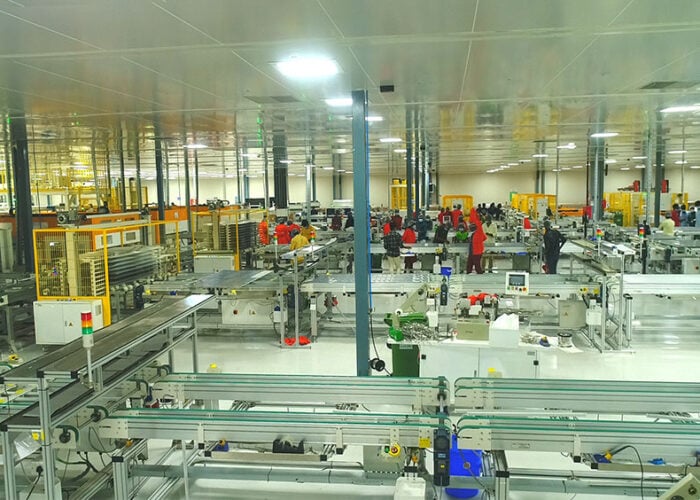
Solar power module manufacturer Schott Solar has been awarded the certificate for quality and sustainability in manufacturing by Italy’s largest energy supplier, Enel.
These certificates are not given out freely, with extensive examination of manufacturing techniques and compliance with standards carried out before a decision is made. Enel testers also visit the sites in order to observe whether or not the manufacturing sites meet their demands with respect to quality and sustainability.
Try Premium for just $1
- Full premium access for the first month at only $1
- Converts to an annual rate after 30 days unless cancelled
- Cancel anytime during the trial period
Premium Benefits
- Expert industry analysis and interviews
- Digital access to PV Tech Power journal
- Exclusive event discounts
Or get the full Premium subscription right away
Or continue reading this article for free
It is only when these strict procedures are carried out without reason for complaint that Enel awards the certificates.
The certificate is valid for three years; after this period of time has passed a new assessment is made. Schott Solar had already been reviewed based on the quality management systems DIN EN ISO 9001 and 14001 and therefore already met some of the initial demands for certification at Enel.
“We have come to know Schott Solar as a reliable manufacturer of high-quality cells and modules and as a valuable strategic partner. By issuing our certification, we are merely passing on this complement to Schott Solar,” said Luigi Tedone, responsible for Strategy and Supply Services at Enel.
“Our modules must be able to stand up to numerous stress tests: extreme shifts in temperature, permanent exposure to moisture and high wind loading. Our tests are also more stringent than the applicable testing criteria of the International Electro-technical Commission (IEC) require. According to our information, the tests that the IEC advocates are insufficient in reliably simulating a period of 20 years. High returns can only be achieved with modules that are capable of producing high yields on a reliable basis for over 20 years and still continue to generate electricity even beyond this time frame,” says Michael Harre, Chief Sales Officer for Schott Solar.
Back in 2008, Schott signed a long-term contract with the subsidiary Enel.si, and through this deal the company has agreed to supply high-quality crystalline modules to Italy.