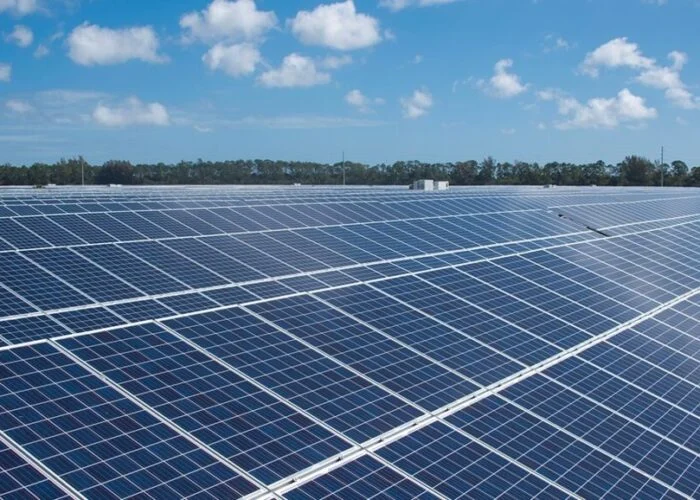
In another example of the rust-tech industrial base converting to clean-tech manufacturing, Skyline Solar has partnered with the Cosma International unit of global automotive supplier Magna International to start pilot commercial production of the reflective racking, mounting, and other structural components of Skyline’s high gain solar (HGS) system.
Try Premium for just $1
- Full premium access for the first month at only $1
- Converts to an annual rate after 30 days unless cancelled
- Cancel anytime during the trial period
Premium Benefits
- Expert industry analysis and interviews
- Digital access to PV Tech Power journal
- Exclusive event discounts
Or get the full Premium subscription right away
Or continue reading this article for free
The initial manufacturing is taking place at a Cosma metal-stamping facility previously used for auto parts production in Troy, MI, on the same campus as the Magna unit’s engineering center, where the two companies’ teams have worked together on product design and materials optimization.
Skyline CEO Bob MacDonald told PV-Tech that his company started taking shipments of the HGS structural hardware from the pilot line about a month ago. The decision on where to locate the first volume production factory will be made this quarter, he said, from a “short list” of Cosma facilities with common capabilities in Alabama, Iowa, Kentucky, Maryland, Ohio, South Carolina, and Tennessee.
Once ramped, the capacity of that first volume production line will be 25-30MW, according to MacDonald, or about 1000 units per month. There will be enough floorspace for more lines at the chosen site, so “it can be ramped up to significantly higher volumes at that line.”
“Our manufacturing facilities are well-suited to produce structural reflective racking and mounting systems required by a number of today’s solar manufacturers,” stated Horst Prelog, president of Cosma International.
“The design (of the HGS structure) has been specifically detailed so that it can fit into their standard plants,” MacDonald explained, noting the auto industry’s prowess at large-volume-scale metal-forming and assembly.
He described the process used at Cosma for manufacturing the parts for the HGS system. It begins with “stamping out all the metal components, loading them onto an assembly fixture on the same workstations that would normally be welding together the chassis of a car, those robotic stations are spot-welding those stamped components together. That’s basically it. There are fewer processes than standard automotive assembly.”
Skyline expects “to provide more specifics over the coming months” regarding its solar cell and moduling partners, MacDonald said, adding that “monocrystalline (silicon) still remains the workhorse for us for the foreseeable future.”
The Mountain View, CA-based CPV firm said it expects final product (with parts made at the Cosma pilot line) to begin shipping during the current calendar quarter.
Shortly after announcing its HGS architecture in May, Skyline completed its first demonstration plant with the Santa Clara Valley Transit Authority in San Jose. Since then, the venture-backed company “has largely focused on getting the foundation in place for volume production and getting project financing in place for deployments in 2010,” MacDonald told PV-Tech.
PHOTOS OF COSMA PILOT LINE COURTESY OF SKYLINE SOLAR