In this interview with PV Tech Premium, Enervest CEO Ross Warby explains how the engineering demands of floating solar on a live water utility reservoir differ from conventional ground-mount design, and why Australia’s floating solar market has the fundamentals to scale but has lacked local reference projects to do so.
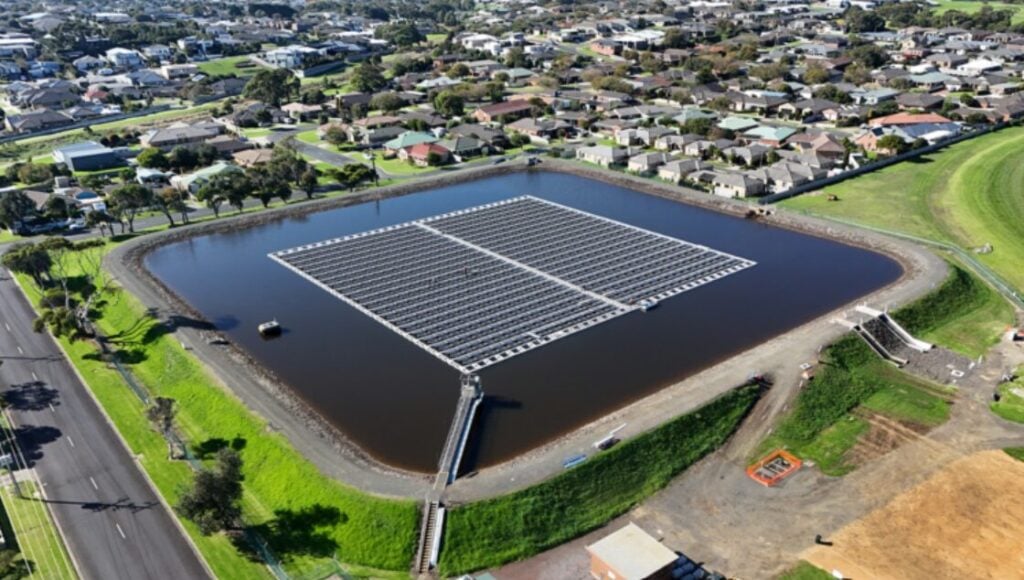
When Melbourne-based developer Enervest completed the installation of a 500kW floating solar array at Wannon Water’s Brierly Basin reservoir in Warrnambool, Victoria, last month, it delivered what the company described as “one of Australia’s largest floating solar installations” on a water utility asset.
Try Premium for just $1
- Full premium access for the first month at only $1
- Converts to an annual rate after 30 days unless cancelled
- Cancel anytime during the trial period
Premium Benefits
- Expert industry analysis and interviews
- Digital access to PV Tech Power journal
- Exclusive event discounts
Or get the full Premium subscription right away
Or continue reading this article for free
But for Enervest CEO Ross Warby, the project is as much about what it demonstrates for a nascent market as what it achieves for the client.
“While Enervest has grown into a broader energy developer, our origins in commercial and industrial solar PV have shaped how we approach development—grounded in experience, working closely with communities and focused on delivering long-term value,” Warby tells PV Tech Premium.
“This project with Wannon Water reflects that legacy, bringing together proven expertise, strong partnerships and a practical, innovative approach to infrastructure.”
That framing matters because, as Warby is candid about, floating solar is not part of the strategic direction in which Enervest is heading. Commercial solar sits within the company’s legacy portfolio rather than its forward pipeline; Enervest has since shifted toward a larger-scale own-and-operate model, acquiring battery storage assets as part of a broader pivot in its business.
The Brierly Basin project is, in that sense, a capstone of one chapter rather than the opening of another. Yet the engineering and market lessons learned are relevant well beyond Enervest’s own trajectory.
Engineering on water
Floating solar differs from ground-mount installation in ways that extend far beyond the obvious differences between water and land.
As Warby explains, every major design decision at Brierly Basin was shaped by the dynamic nature of a live water utility asset, one that fluctuates in level, generates wind-driven wave action and must continue operating through construction and thereafter.
The anchoring approach at Brierly Basin avoids any penetration of the reservoir lining.
“Rather than driving piles or using ballasted frames as you would on land, the Brierly Basin system uses a gravity anchor arrangement—concrete anchor blocks placed on the reservoir bed, connected to the floating pontoon structure via mooring lines,” Warby explains. “This approach avoids any penetration of the reservoir lining or bed and is fully reversible.”
Getting power from water safely requires careful design. As Warby says: “We specified string inverters located on the land surface rather than on the floating array itself.”
“This decision deliberately keeps high-voltage equipment away from the water surface. DC cabling from the panels runs back to shore via a floating cable management system, essentially a dedicated cable walkway that floats on the water surface and articulates with the array as water levels change.”
Maintenance access was structured in two stages: by boat from shore to the array, then via built-in walkways incorporated into the pontoon structure, allowing technicians to move safely across the array surface for inspection, panel cleaning, connector checks and any remedial work. Site-specific constraints at Brierly Basin added further complexity.
“The reservoir embankment is rock-faced, so the team designed a custom launch ramp to slide the floating panels into the water without damaging them,” Warby notes.
“The reservoir also remained fully operational throughout construction, which meant Wannon Water’s team had to actively manage water levels day-to-day to keep the installation process on track, a level of coordination you simply don’t have on a land-based solar project.”
Maintaining a system on water
Warby is measured about the operations and maintenance (O&M) profile of floating solar relative to ground-mount.
“Maintaining a floating solar system can be more complex than maintaining a ground-mount array of equivalent capacity, largely from the fact that it is water-based,” he says.
“That said, vegetation management is not a factor in this scenario, where it is a key item in ground-mount systems. Other maintenance items are, for the best part, the same or interchangeable with that of a ground-mount system.”
Indeed, modules still require cleaning and regular inspection, and the pontoon structure requires maintenance as much as ground-mount framing does, expected practice across all PV arrays. However, there are genuine operational advantages to the water-based environment.
“Panels over water run cooler, which supports better energy yield, and at a water treatment facility, rainfall does a reasonable job of keeping panels clean,” Warby notes.
As previously reported by PV Tech, reduced evaporation from the covered water surface is an additional benefit that conventional solar economics do not capture, a point identified as one of the technology’s distinguishing characteristics in water-scarce environments.
It is also worth noting that the technology is well-established at scale globally, including on saltwater, so the underlying fundamentals are proven. Warby draws on that global track record while acknowledging the local gap.
“Floating solar is a well-established technology globally, operating at significant scale, including on saltwater, so the fundamentals are proven,” he says.
“As with any early-stage market locally, Brierly Basin will also serve as a valuable reference point for the Australian sector, and we’re committed to sharing operational learnings to support future projects industry-wide.”
Market potential and the barriers to scale
Warby is direct about why the floating solar market has not grown as fast as its fundamentals might suggest.
“The opportunity is significant. Australia has hundreds of water utility sites with suitable reservoirs, treatment ponds or lagoons, sitting adjacent to energy-intensive operation,” he says.
“Many of the fundamentals stack up well on paper, but the market hasn’t scaled as fast as it could, and the honest answer is that economics, regulation and risk perception have all played a role.”
Floating solar carries a cost premium over ground-mount, reflecting the engineering complexity of a water-based environment. But Warby argues the economics work in the right context.
“The numbers work when you’re displacing retail electricity for on-site operations, as Wannon Water is doing at Brierly Basin,” he notes.
The 500kW Brierly Basin system comprises 1,260 bifacial modules and is expected to generate more than 600,000kWh annually, with a net positive business case value of more than AU$500,000 (US$351,805) over its operating life.
For water utilities with high pumping loads and constrained land, the combination of avoided electricity costs and available water surface area creates a viable investment case that land-scarce sites cannot easily replicate.
The more solvable barrier, in Warby’s assessment, is the absence of local reference projects.
“Until now, Australia’s floating solar installations have mostly been small pilots,” he says.
“My view is that the market will accelerate as reference projects like Brierly Basin demonstrate reliable long-term performance, and as the regulatory frameworks mature. The fundamentals—energy costs, available water surface area, and decarbonisation obligations for public utilities—are all moving in the right direction.”
Warby also identifies an adjacent sector he argues is underappreciated: agricultural irrigators, particularly in the cotton industry.
“On-site water storage at these farms is prolific and the related energy usage to pump the water is notable,” he says.
“This sector presents less rigour and therefore faster deployment, offsetting evaporation and energy costs alike, as well as reducing widespread localised infrastructure stress in these regions that would typically all irrigate at similar times.”
The co-benefits of reduced evaporation and avoided peak network demand charges give the economics of agricultural floating solar a profile distinct from utility applications, and one that Warby suggests may prove more straightforward to deploy at speed.
For Enervest, the Brierly Basin project closes a chapter rather than opening one. The company’s evolution toward battery storage ownership and operation at the grid scale represents a departure from the commercial and industrial solar origins that projects such as Brierly Basin embody.
Warby is clear that sharing operational learnings from Brierly Basin is part of the company’s commitment to the sector it is stepping back from, even as its own focus has shifted.
What the project leaves behind is a template: a site-specific engineering approach that accommodates a live utility asset, a financial case grounded in avoided retail energy cost and a set of O&M practices calibrated to a water environment.
Whether that template accelerates Australia’s floating solar market will depend less on any single project than on whether the regulatory frameworks and reference data it contributes can reduce the perception of risk that has, until now, kept the market in pilot territory.