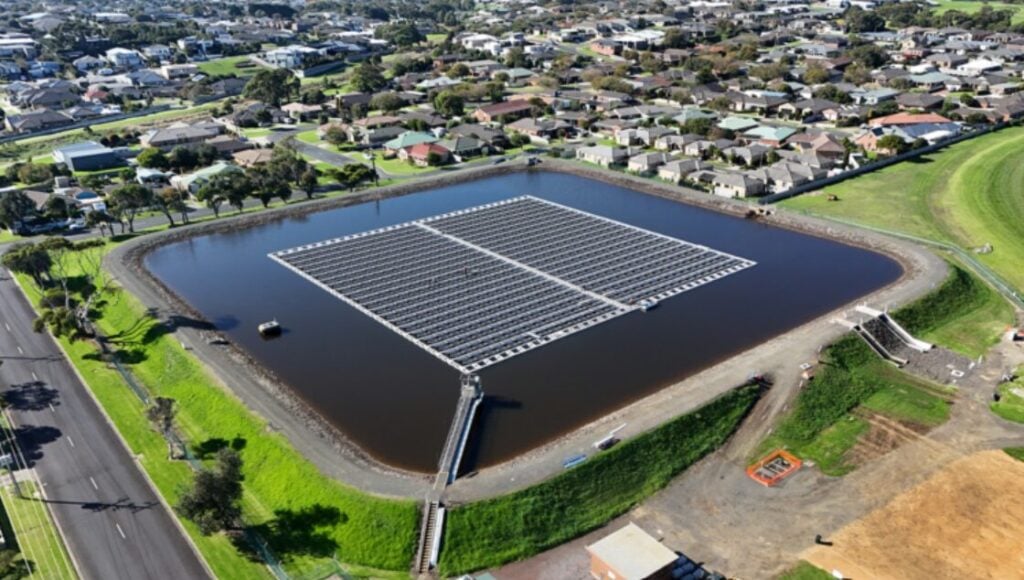
Melbourne-based developer Enervest has delivered what is claimed to be one of Australia’s largest floating solar installations, built to offset the energy costs of pumping drinking water in regional Victoria.
Built on behalf of Victorian water utility Wannon Water, the 500kW floating solar array at the Brierly Basin reservoir in Warrnambool has been completed, with developer Enervest delivering the AU$2 million (US$1.4 million) project after construction began in March 2026.
Try Premium for just $1
- Full premium access for the first month at only $1
- Converts to an annual rate after 30 days unless cancelled
- Cancel anytime during the trial period
Premium Benefits
- Expert industry analysis and interviews
- Digital access to PV Tech Power journal
- Exclusive event discounts
Or get the full Premium subscription right away
Or continue reading this article for free
The system comprises 1,260 bifacial solar modules and will generate more than 600,000kWh of renewable energy each year. The modules capture sunlight from above and reflected light from the water surface, improving the array’s efficiency.
According to the companies, the pontoons on which the modules are mounted are made from high-density polyethene.
The installation is designed to offset the energy costs associated with pumping water from the basin to Wannon Water’s treatment plant, which serves customers across Warrnambool, Allansford and Koroit.
Pumping water uphill to the treatment facility is one of the utility’s most energy-intensive operations, making on-site generation at the basin a more attractive investment than at gravity-fed sites.
The 500kW floating array is Wannon Water’s largest system to date. The authority already operates a 250kW floating solar array at the Warrnambool Water Treatment Plant and two 100kW floating solar arrays at the Hamilton Water Treatment Plant.
Wannon Water managing director Steven Waterhouse said the project would reduce energy costs associated with water pumping.
“Projects like this help us use energy more efficiently and keep costs down, which means better value for our customers,” Waterhouse said.
The floating solar system supports Wannon Water’s goal of reaching net zero emissions by 2030 by reducing greenhouse gas emissions by more than 600 tonnes each year.
Growing floating solar activity
The Warrnambool project sits within a broader pattern of activity in Australia for floating solar, spanning water utilities, agriculture and international technology partnerships.
Australia has seen increasing interest in floating solar technology as water utilities, mining operations and irrigation districts recognise the dual-use potential of water surfaces for renewable energy generation.
In 2025, the Australian Renewable Energy Agency (ARENA) launched an AU$13 million research programme to test the technology’s viability at scale across the agricultural sector.
The ‘Novel Energy and Evaporative Storage Technologies for Irrigators’ (NEESTI) initiative, led by economic consultancy AgEcon Australia, with support from the Cotton Research and Development Corporation.
It aims to deliver technical, economic, policy, and legal frameworks to establish a sustainable Australian floating solar market for cotton growers and other irrigators, addressing both water security and emissions reduction.
The programme notes that nearly half of on-farm water storage volume is lost annually to evaporation, and that relocating just half of Australia’s current 16.6GW of ground-mounted solar modules to water storages could save 296 gigalitres of water per year.
On the technology side, Norwegian floating solar specialist Ocean Sun entered the Australian market in early 2025 through a partnership with Canopy Power Australia.
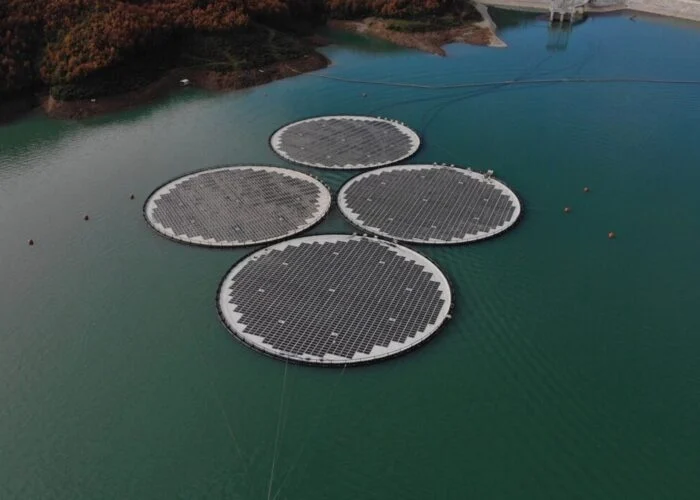
Under the agreement, the two companies will accelerate the deployment of floating solar solutions across Australia’s water bodies, with Ocean Sun deploying its circular membrane-based floater system of 70 metres in diameter, providing 700kWp of generation capacity per unit.
Ocean Sun said the membrane design allows solar modules to be in direct thermal contact with the water, improving heat dissipation and delivering an energy yield up to 10% higher than both ground-mounted and pontoon-based floating systems.