Against the backdrop of global energy transition and complex geopolitical dynamics, how are Chinese renewable energy enterprises carving out new growth paths amid ongoing shifts and uncertainties?
Dr. Lu Chuan, chairman of CHINT Green Energy, and concurrently chairman and CEO of Astronergy, recently shared his insights in an interview with PV Tech. Faced with turbulent overseas markets, fierce competition in solar cell technologies and the intricacies of full-stack development spanning solar PV and energy storage, Lu noted that CHINT remains committed to a prudent strategic approach, prioritising proven technologies and robust execution capabilities to pursue differentiated growth.
Try Premium for just $1
- Full premium access for the first month at only $1
- Converts to an annual rate after 30 days unless cancelled
- Cancel anytime during the trial period
Premium Benefits
- Expert industry analysis and interviews
- Digital access to PV Tech Power journal
- Exclusive event discounts
Or get the full Premium subscription right away
Or continue reading this article for free
Agile iteration and adaptive global supply chain deployment
Global demand for PV and energy storage solutions continues to surge. To satisfy growing localisation demands in key regional markets, CHINT has rolled out a pragmatic and flexible global operations strategy.
“Our primary approach is to adapt to local markets,” Lu stressed. For core products largely mass-produced in China, CHINT is scaling up localised production of critical components through technology licensing and joint manufacturing with local partners. These locally sourced parts are later assembled into finished products.
In terms of new capacity expansion, CHINT’s manufacturing facility in Türkiye is currently under construction. Upcoming overseas capacity will go beyond PV cells and modules to include policy-sensitive product categories such as energy storage power conversion systems (PCS) and integrated energy storage systems. Building on its established footprint in Türkiye and Thailand, CHINT is actively forging joint venture ties with local enterprises. This approach allows the company to roll out regional-specific capacities compliant with local policies and market needs, ensuring proximity to end markets and full adherence to regional industry standards.
No blind pursuit of tech trends; field-validated data guides iteration
Intense competition in the PV sector has intensified the rivalry between back contact (BC) and TOPCon cell technologies, fuelling widespread discourse over the industry’s future direction. Lu takes a pragmatic, data-driven mindset toward this technological contest, arguing that no subjective judgment should label one technology as inherently superior to the other. Instead, real-world, field-validated performance data should serve as the fundamental benchmark for technological selection and upgrading.
Astronergy has built dedicated field-testing bases in Haining, Jiaxing of Zhejiang Province, alongside the Nanhu Laboratory, forming a comprehensive experimental and simulation system for PV modules. The team carries out regular, scenario-based comparative tests on BC and TOPCon modules on a monthly basis, ensuring that every technology iteration is grounded in authentic field performance data rather than theoretical speculation.
“No technology is absolutely superior or inferior—only technology that best fits specific application scenarios. Market performance and field-verified data are the ultimate criteria,” Lu stressed.
Long-term field monitoring data of the experimental base highlights distinct performance disparities between the two technologies across different scenarios. In conventional overhead residential PV installations, BC technology exhibited a power generation efficiency roughly 2% lower than its TOPCon counterpart, while the efficiency gap narrows to 1% for rooftop installations. On the cost front, BC modules benefit from lower silver consumption, yet command higher end-market prices. As such, their overall cost-performance profile varies drastically by actual application scenarios and requires rigorous case-by-case evaluation.
Looking at the current industry landscape, Lu holds the view that TOPCon and BC penetration will not trigger any drastic short-term market reshuffle. For one thing, the industry has imposed strict controls on new capacity additions. Most BC capacity expansion currently relies on the retrofitting of existing production lines, yet prevailing industry profit pressures render large-scale retrofitting investments unfeasible for the majority of market players.
For another, continuous technological iteration is underway for both technical routes. The gaps in power generation efficiency and comprehensive costs between BC and TOPCon may shift substantially within a year, making trend-driven blind capacity expansion an inadvisable strategy at this stage.
Meanwhile, cost-centric industry competition is accelerating the iteration of PV panel bracket technologies. Sustained high costs of aluminium frames have expedited the adoption of alternative solutions, including composite and steel frames. The industry’s cost-reduction competition has extended beyond core cell technology optimisation to refined upgrades of all auxiliary components, ushering in a new phase of comprehensive and refined technological iteration.
Say no to ‘patchwork’ integration: defining true full-stack capabilities
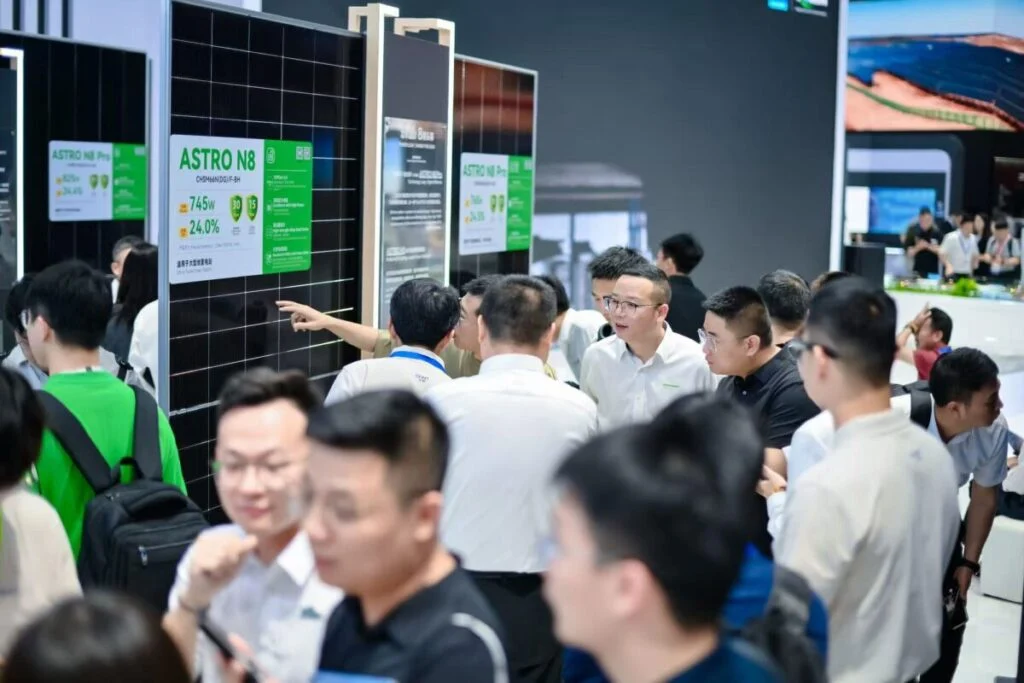
At the recently concluded 2026 SNEC PV Power Expo, numerous PV module manufacturers unveiled energy storage offerings, with nearly all touting “full-stack capabilities” and “integrated solutions” as their core selling points. The full-stack integration concept has since dominated industry discourse and market publicity.
Lu, however, argues that genuine differentiated competitiveness stems not from marketing gimmicks, but from solid practical capabilities built through large-scale project delivery, continuous trial and error and data-driven technological iteration.
“The industry may appear to converge on identical technical routes and solution frameworks, yet substantial hidden challenges lie in actual implementation,” Lu pointed out. “Only through hands-on practice and accumulated operational experience can enterprises uncover the replicable, standardised core logic behind high-quality solutions.”
Boasting years of expertise in R&D and manufacturing of inverters, storage systems and transformers, Lu said CHINT has maintained deep engagement across the renewable energy industrial chain, giving it in-depth insights into the complexities of developing reliable integrated solutions. As he explained, a truly premium integrated solution depends on independent system design optimisation, full-chain cost-reduction innovation and targeted resolution of scenario-specific pain points — rather than simplistic hardware “patchwork”. Even with partial hardware outsourcing, self-developed and self-controlled system solution capabilities can sustain their solid core competitiveness. This is the key advantage that sets CHINT apart from trend-chasing peers that rely on superficial assembly models, Lu added.
According to Lu, industrial differentiation is never rooted in prevailing tech trends or marketing concepts, but in executable delivery and upgrading capabilities. All core competitive edges grow into irreplicable industrial strengths only through real-world project validation, feedback-based optimisation and continuous empirical technological refinement—a fundamental development philosophy that CHINT has consistently upheld, Lu concluded.