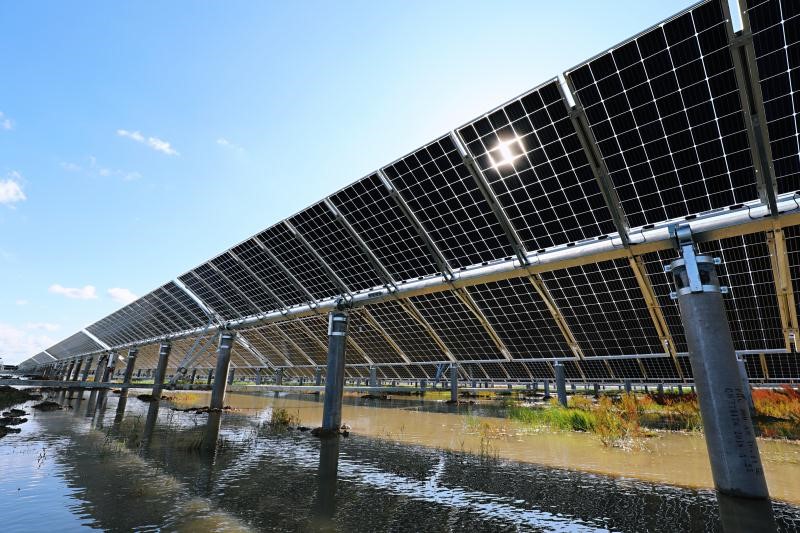
The US government has moved once more against bifacial solar’s exemption from Section 201 tariffs, ordering its withdrawal whilst accepting the reprieve must stay until last year’s court injunction is lifted.
Last Friday, the US Trade Representative (USTR) said it wants to remove the exclusion of two-sided solar components from import levies set by the Trump administration in 2018, the second time it has attempted to scrap the reprieve in the space of a few months.
Try Premium for just $1
- Full premium access for the first month at only $1
- Converts to an annual rate after 30 days unless cancelled
- Cancel anytime during the trial period
Premium Benefits
- Expert industry analysis and interviews
- Digital access to PV Tech Power journal
- Exclusive event discounts
Or get the full Premium subscription right away
Or continue reading this article for free
The government office had initially opted to spare bifacial from Section 201 duties in June 2019 but u-turned in October 2019, announcing it would axe the exemption after concluding the levy amnesty would pave the way for a sharp rise in bifacial imports.
In a victory for plaintiffs Invenergy Renewables, US PV body SEIA, Clearway Energy Group, EDF Renewables and AES Distributed Energy, a judge at the US Court of International Trade blocked the USTR’s move, slapping a preliminary injunction on the order to scrap the exemption.
In its fresh attempt last Friday, the USTR acknowledges that the injunction remains an obstacle. Its decision to withdraw will only come into force “if the Court lifts the preliminary injunction but in no case earlier than May 18, 2020,” the office said.
“By disincentivizing domestic producers' production of bifacial solar panels … the bifacial exclusion is hindering the domestic industry's adjustment to import competition,” the USTR argued.
Solar reps ‘disappointed’ following raft of WTO spats
Contacted today by PV Tech, the US Court of International Trade had not clarified when it will next convene to rule on the preliminary injunction by the time this article was published.
Its move to block the USTR’s decision last December rested on a belief Trump’s administration had u-turned without giving renewable players and other affected parties sufficient time to adapt. Since that date, on 27 January 2020, the USTR issued a new consultation to grant stakeholders another chance to comment.
Trump’s bifacial crackdown has dragged the solar technology into a broader trade war pitting the US against large Asian states. The country’s moves to subsidise its own PV makers and tax foreign rivals have triggered World Trade Organisation spats with India and China.
US federal agencies themselves have cast doubts on the effectiveness of Section 201 duties, with an USITC report finding in February they have failed to kickstart a US upstream turnaround. While US manufacturers have hailed the import barriers, their downstream counterparts at association SEIA have said the measures have caused “devastating harm” to the industry.
Last week, following the USTR’s latest attempt to undo bifacial’s exemption, the SEIA conveyed its “disappointment”.
“The industry initially sought this exclusion because there is, and will be for the foreseeable future, an acute shortage of domestic panels used in utility-scale solar projects,” said the SEIA’s general counsel John Smirnow, adding that the association will work with the administration to find “constructive ways” to support US solar manufacturers.