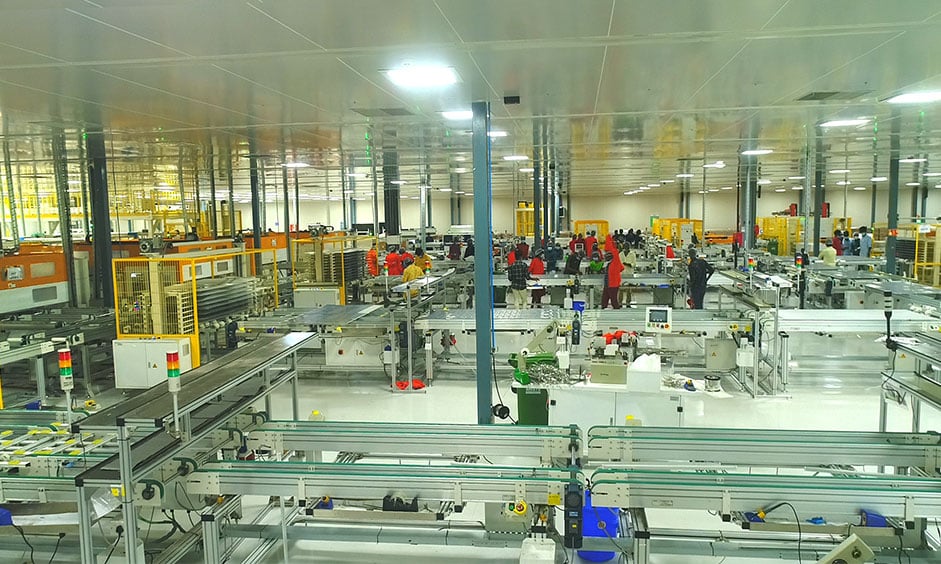
Indian PV manufacturer Vikram Solar has commissioned its new solar module manufacturing facility at Gangaikondan in the southern state of Tamil Nadu, with the first module rolling off the production line.
The plant will manufacture its Hypersol N-Type tunnel oxide passivated contact (TOPCon) G12R modules, offering power outputs of 615W-640W and module efficiencies of up to 23.69%. In January 2026, the manufacturer transitioned its module portfolio to the G12R format citing “performance, reliability and bankability.”
Try Premium for just $1
- Full premium access for the first month at only $1
- Converts to an annual rate after 30 days unless cancelled
- Cancel anytime during the trial period
Premium Benefits
- Expert industry analysis and interviews
- Digital access to PV Tech Power journal
- Exclusive event discounts
Or get the full Premium subscription right away
Or continue reading this article for free
The greenfield Gangaikondan facility, spanning around 600,000 square feet, forms part of Vikram Solar’s strategy to expand its domestic manufacturing footprint and establish a vertically integrated solar manufacturing base in India.
According to the company, the Gangaikondan campus will eventually house module, cell, wafer and ingot manufacturing, supporting its plans to localise the solar value chain.
The company said the new plant has been designed as a highly automated manufacturing facility, incorporating digital production monitoring, automated quality inspection and full module traceability to improve manufacturing efficiency and product quality.
“Having crossed 10GW in cumulative global module deployments earlier this year, we are building capacity against demonstrated demand. As we progressively add cell, wafer, and ingot production at this site, we are building an integrated manufacturing platform aligned with India’s domestic content framework strengthening the supply chain,” said Gyanesh Chaudhary, managing director, Vikram Solar.
The commissioning follows the recent launch of Vikram Solar’s Vallam manufacturing facility and represents another step in the company’s manufacturing expansion in Tamil Nadu.
The manufacturer did not disclose the annual nameplate manufacturing capacity of the Gangaikondan facility in its announcement. PV Tech has contacted the firm for further details.
In April, Vikram Solar surpassed 10GW of cumulative global solar module deployments, doubling deployments from 5GW to 10GW in two years. Of the total, around 1.5GW was exported to international markets.
Headquartered in Kolkata, the company plans to install 9GW of solar cell manufacturing capacity by FY2027, expanding that by a further 3GW by FY2028 and add 12GW of wafer and ingot manufacturing capacity by FY2029-30.
In June, Vikram Solar was reportedly planning to invest INR270 billion (US$2.8 billion) in a vertically integrated solar manufacturing hub in West Bengal, covering ingot, wafer, cell and module production, although the company has yet to confirm the reports.