Indian solar manufacturer Waaree Energies has issued a clarification in response to a US Customs and Border Protection (CBP) investigation that found “substantial evidence” the company evaded antidumping and countervailing (AD/CVD) duties on crystalline silicon PV cells from Vietnam and Malaysia.
The clarification relates to CBP’s 23 June 2026 final determination in Enforce and Protect Act (EAPA) Consolidated Investigation No. 8163, which Waaree downplayed, stating that the findings are limited in scope and do not constitute a final ruling.
Try Premium for just $1
- Full premium access for the first month at only $1
- Converts to an annual rate after 30 days unless cancelled
- Cancel anytime during the trial period
Premium Benefits
- Expert industry analysis and interviews
- Digital access to PV Tech Power journal
- Exclusive event discounts
Or get the full Premium subscription right away
Or continue reading this article for free
In its determination, CBP said Waaree failed to declare certain imported solar products as subject to these duties. CBP concluded that these actions amounted to evasion of US trade rules.
As a result, CBP said it will suspend or continue suspending the relevant entries until liquidation instructions are issued, rate-adjust previously extended entries and reclassify them under interim measures and continue reviewing the importer’s continuous bonds in line with its enforcement policies.
However, Jignesh Rathod, CEO, Waaree Energies, told PV Tech: “Following a detailed investigation, including an on-site verification of Waaree’s manufacturing facility in India, CBP expressly confirmed that Waaree did not export to the US solar modules manufactured using Chinese-origin solar cells; Waaree fully cooperated throughout the investigation; CBP drew no adverse inference against the Company; and CBP declined the petitioner’s request to make an evasion finding covering all of Waaree’s imports.”
Waaree said the CBP determination applies only to a limited set of historical import entries and is not a final ruling.
Rathod added: “Under applicable US law, Waaree has the right to seek a de novo administrative review and, thereafter, judicial review before the US Court of International Trade. The Company is currently evaluating all available legal remedies with its US trade counsel.”
The company reiterated that its US business continues to operate normally with no impact on manufacturing, deliveries, or commercial operations, and added that it will continue to cooperate with relevant authorities and provide updates as required under applicable laws and regulatory requirements.
In September 2025, Waaree stated that it did not expect any additional duties on its solar cell imports into the US. At the time, the company said it was fully cooperating with the investigation and working with US CBP to ensure transparency and take corrective action where required.
Business as usual for Waaree?
Waaree Solar Americas, the US arm of Waaree Energies, has secured a 236.22MW “Made-in-America” module supply contract for a utility-scale solar project in Flemingsburg, Kentucky.
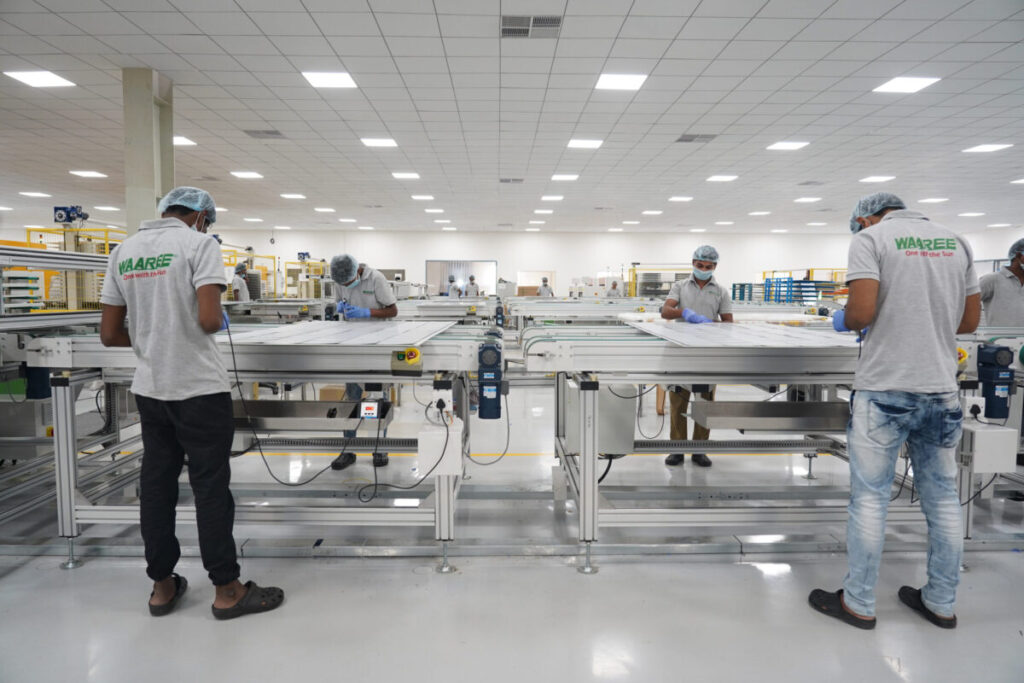
Under the terms of the agreement, the company will supply n-Type G12R modules in 615Wp and 620Wp variants. The modules will be produced at its manufacturing facility in Brookshire, Texas.
The project adds to the company’s utility-scale deployment portfolio in the US, where it is increasing manufacturing and supply activity.
Sunil Rathi, executive director, Waaree Group, said, “Our Made-in-America modules combine advanced technology, superior quality and dependable execution- attributes that have become increasingly important as the US solar industry continues to scale. The US remains a key strategic market for Waaree, and this contract further strengthens our order book while reinforcing our long-term commitment to supporting America’s clean energy transition through world-class domestic manufacturing.”
Waaree Solar Americas reported a consolidated order book of around INR530 billion (US$5.5 billion) across its global operations.
The Kentucky project is part of the state’s utility-scale solar development pipeline and is scheduled to use domestically manufactured modules supplied from the Texas facility.
Waaree, which operates a 1.6GW solar module facility in Texas and is expanding capacity to 3.2GW, also acquired the US assets of Meyer Burger, framing the deal as part of its long-term push to strengthen its American manufacturing footprint.