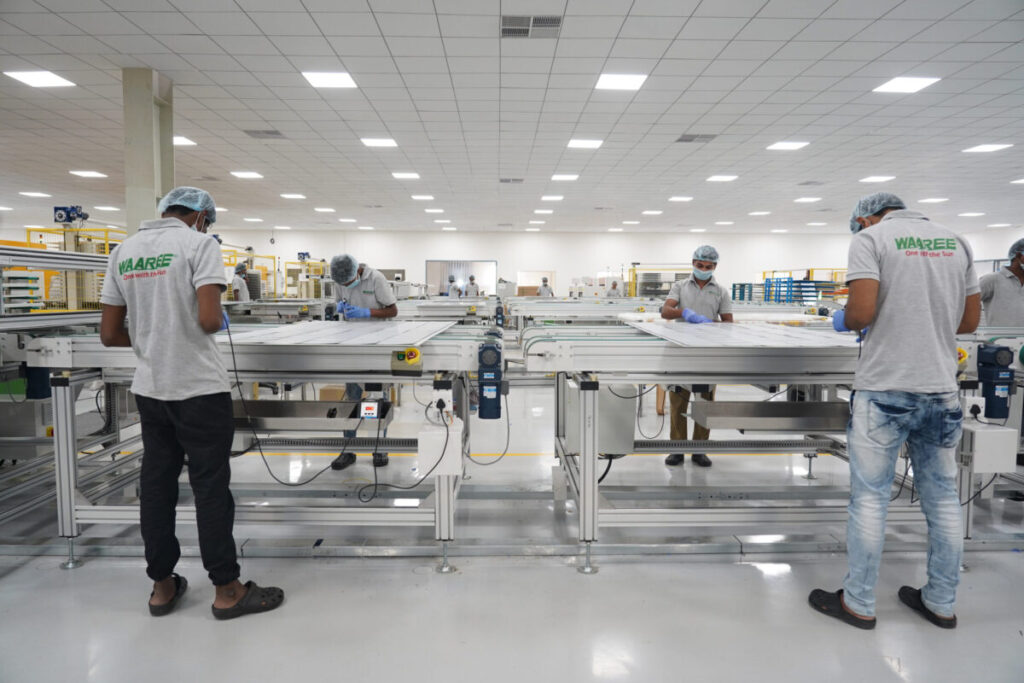
After the US Department of Commerce announced preliminary countervailing duties on Indian PV producers yesterday, several were quick to issue statements downplaying the significance of the move. But the sharp initial fall in share price seen by a few of the big Indian players – notably Vikram, Waaree and Premier Energies – on the back of the duties was illustrative of the importance of the US to India’s rapidly growing base of PV producers, as rival Chinese producers have increasingly found themselves shut out of this lucrative market.
The countervailing duties announced yesterday saw suppliers from India, Indonesia and Laos respectively hit with general tariffs of 125.87%, 104.38% and 80.67%. The duties are only preliminary and constitute the first part of a wider investigation that is also probing claims of dumping. Preliminary anti-dumping duties (ADD) are expected as early as next week.
Try Premium for just $1
- Full premium access for the first month at only $1
- Converts to an annual rate after 30 days unless cancelled
- Cancel anytime during the trial period
Premium Benefits
- Expert industry analysis and interviews
- Digital access to PV Tech Power journal
- Exclusive event discounts
Or get the full Premium subscription right away
Or continue reading this article for free
“The latest duties likely shut Indian manufacturers out of the US market, while lower production costs in Indonesia and Laos could keep sourcing viable,” said Matthew Hales, a research associate at BloombergNEF specialising in trade policy. “But higher duties loom, as a preliminary anti-dumping duty (ADD) is expected before 2 March 2026. And the situation for exporters is expected to go from bad to worse – BNEF expects the final AD/CVD rates due later in the year to be significantly higher than preliminary levies, as was the case in the last investigation on Southeast Asian solar producers.”
In the short term, Hales said the duties on the three countries’ PV producers would have a minimal impact on US deployment, as developers managed to stockpile 76GW of equipment in 2025. Eventually, once these stockpiles are used up, Hales said developers may opt to stomach the tariffs on goods from producers they believe comply with the new foreign entity-of-concern (FEOC) tax credit qualification rules.
For the suppliers themselves, the impact is open to debate. Moustafa Ramadan, head of PV Tech Research, said that although Indian manufacturers had been targeting the US end market for some time, a fact that prompted the petition and investigation in the first place, strong domestic demand will help cushion the blow.
“We do not see these duties affecting the Indian trend of exponential growth, as most manufacturing in the country is clearly driven by domestic consumption,” he said.
Aaron Hall, president of solar and storage supply chain platform Anza, said that while the CVD and anticipated AD duties had effectively made the US commercially unviable for producers in the target countries, it was not unexpected.
“While the determination is new, the outcome was largely anticipated, and most suppliers have already pivoted their cell sourcing to other countries in Southeast Asia, such as the Philippines, as well as parts of the Middle East and North Africa. Imports from these three countries had already declined significantly ahead of the preliminary ruling.”
Hall said he expected manufacturers to continue evaluating relocation of cell production and equipment to jurisdictions with lower or no trade exposure.
“That dynamic has characterised much of the AD/CVD cycle over the past several years,” he said. “Indian manufacturers in particular have increasingly focused on their domestic market. Given that their primary path to serving the US market would be through third-party OEM cell providers, the additional duties further erode their competitiveness by increasing input costs and reducing supply chain control.
“Modules using Indonesian cells represented the majority of recent imports among the three countries, making Indonesia the most materially affected in volume terms. That said, many larger players had already begun adjusting their manufacturing footprints in anticipation of these outcomes,” Hall added.
‘Whack-a-mole’
The latest round in the seemingly never-ending cycle of AD/CVD actions by the US, of course, begs the question of where might next be in its crosshairs. Turkey and other parts of the Middle East and North Africa region, for example, are growing in significance as PV manufacturing destinations and would undoubtedly stand to benefit from any supply vacuum in the US market created by this latest AD/CVD action. But how long before they or any others become caught in the solar tariff net?
“In the long run, the US game of tariff whack-a-mole – imposing prohibitive duties on each new solar import source – may leave few cost-competitive sourcing options,” BloombergNEF’s Matthew Hales said.
“Malaysia, Laos and Turkey all face low enough tariffs to keep import costs manageable for now – unless targeted by new AD/CVD investigations. But, in the last week, tariffs on solar equipment have swung sharply three times. That volatility may prove enough of a headache for developers to tilt procurement decisions toward higher-cost US-made solar modules.”
Ultimately, the question of which country is next in line for AD/CVD action may become academic, pending the outcome of the potentially much more consequential Section 232 polysilicon investigation. This was instigated last year to consider the national security implications of imported polysilicon and its derivatives, such as wafers and cells.
A Department of Commerce deliberation on Section 232 could eliminate the need for any future solar AD/CVD investigation, as it could have a far wider reach across the supply chain and geography. When the investigation was launched, it was suggested that Commerce could, or should, impose tariffs on the entire PV supply chain, not just polysilicon. Furthermore, these tariffs could be set at a global level, rather than targeting only China or any other individual country.
Addressing this, Hall said: “As for potential future AD/CVD cases, the recently announced Section 232 polysilicon and derivative products action is widely viewed as an attempt to address the broader ‘whack-a-mole’ dynamic that has characterised trade enforcement in solar. Given the increasing number of manufacturing jurisdictions and the evidentiary requirements needed to demonstrate material injury, additional country-specific cases may be more complex and slower to materialise, if they emerge at all.”
Additional reporting by Jonathan Touriño Jacobo.