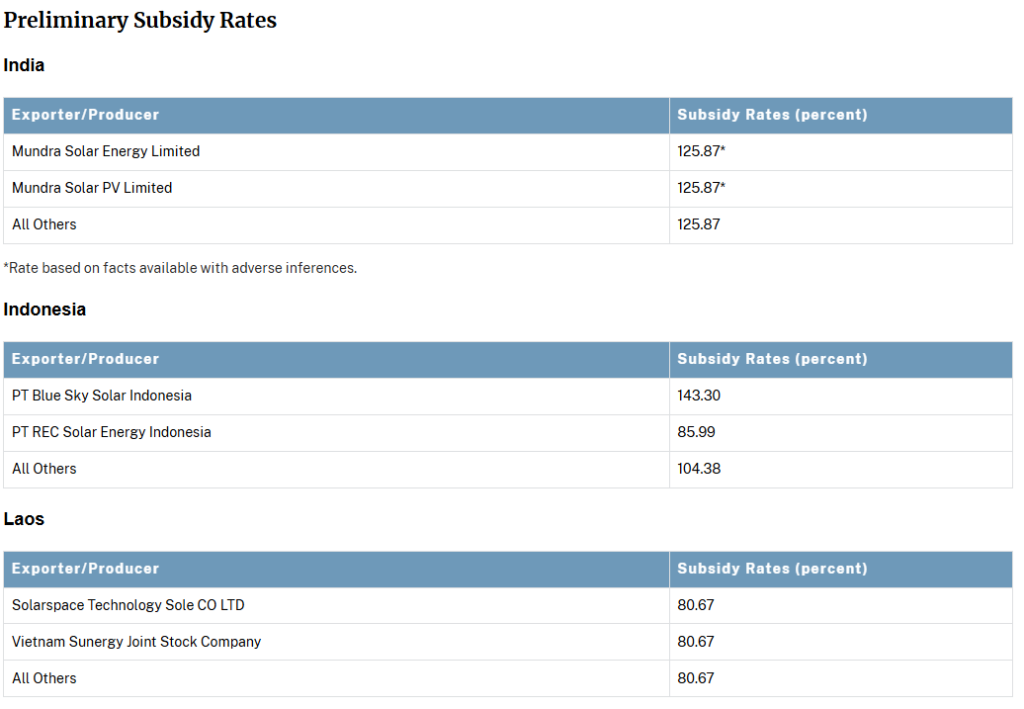
The US Department of Commerce (DoC) has proposed a 125.87% preliminary countervailing duty (CVD) on imported Indian solar cells.
Several Indian PV manufacturers PV Tech spoke with sought to downplay the likely impact of new US import tariffs, but share prices of a number of them fell in trading today.
Try Premium for just $1
- Full premium access for the first month at only $1
- Converts to an annual rate after 30 days unless cancelled
- Cancel anytime during the trial period
Premium Benefits
- Expert industry analysis and interviews
- Digital access to PV Tech Power journal
- Exclusive event discounts
Or get the full Premium subscription right away
Or continue reading this article for free
Waaree Energies, which is the Indian manufacturer with the most module capacity sold in the US last year, according to data from PV Tech Research, has been preparing for this situation in the past few years by both setting a domestic manufacturing footprint and sourcing upstream supply chain from countries not impacted by duties.
“The company’s diversified sourcing strategy remains a core strength, and it continues to further strengthen the same, including through its announced investments in Oman aimed at securing fully traceable, non-Chinese polysilicon supply.
“In addition, the company has been progressively strengthening its U.S.-based manufacturing footprint as part of its long-term strategy to support localised production and serve customers in the United States market,” said Abhishek Pareek, group head finance at Waaree Energies.
Pareek added that the Indian manufacturer currently has an annual nameplate capacity of 2.6GW for modules in the US, including capacity acquired from the struggling Swiss manufacturer Meyer Burger. By the end of the company’s current financial year, Pareek said it expects to further expand the annual nameplate capacity to 4.2GW.
“The company remains committed to expanding localised manufacturing in the United States along with diversifying its supply chain across geographies to further strengthen our supply chain resilience. At this stage, the Company does not anticipate any material adverse impact on its ability to service its U.S. order book.”
Another Indian manufacturer that also diversified its supply chain for the US market is Vikram Solar, which said that the “direct financial impact on us is limited”.
“Our US order strategy was not structured around sourcing Indian cells; we already operate with a diversified supply chain for that market, including sourcing from geographies with lower tariff exposure,” added Gyanesh Chaudhary, chairman and managing director at Vikram Solar.
Chaudhary said that the company’s growth strategy remains anchored in India, “where demand remains structurally strong”.
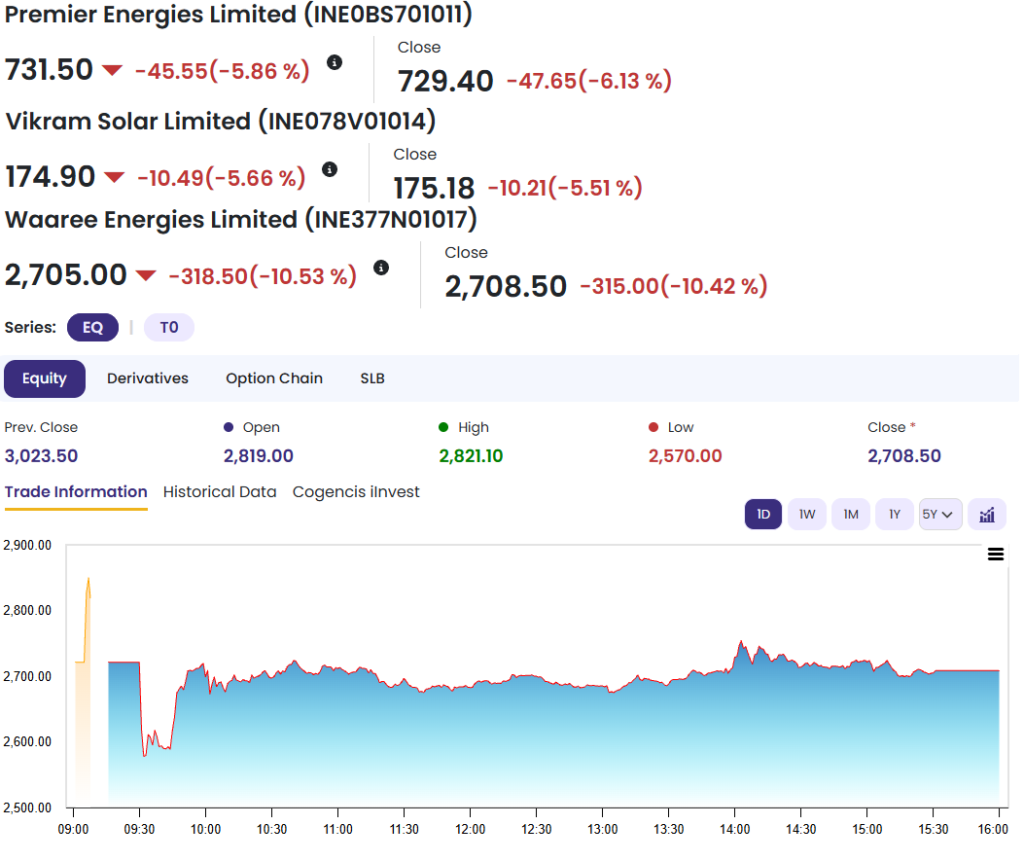
But despite these reassurances, stocks of several Indian solar manufacturers plunged on the National Stock Exchange of India during trading today. Waaree Energies opened the day with a 15% dip, before stabilising at a 10% loss. Premier Energies opened with a 12% dip before closing the day at a 6% decrease in its share’s value, while Vikram Solar’s shares value decreased by 5% on Wednesday 25 February.
Laos hit with 80.67% CVD preliminary rate
Laos and Indonesia, the other two countries involved in the latest solar anti-dumping (AD) and countervailing duty investigation by the US, have been hit with similar levels of duties. In Laos’ case, the DoC has suggested an 80.67% subsidy rate for the import of solar cesll from that country, while Indonesia has been hit with a 104.38% preliminary duty.
However, two companies in Indonesia have received a different rate. The DoC suggested a 143.3% subsidy rate to PT Blue Sky Solar Indonesia and 85.99% to PT REC Solar Energy Indonesia.
Other manufacturers named in the preliminary affirmative determination are Mundra Solar in India and Solarspace and VSUN in Laos, however all three companies have the same rate as other companies in their respective countries, as shown below.
A final determination on the CVD investigations is scheduled to be issued on 6 July 2026, while a preliminary AD determination is scheduled for 21 April 2026.
The investigation of crystalline silicon photovoltaic cells, whether or not assembled into modules (solar cells), was initiated by the Alliance for American Solar Manufacturing and Trade – which comprises First Solar, Hanwha Qcells and Mission Solar – in July 2025.
At the time, the group cited a number of alleged illegal subsidies that enable producers in these three Asian markets to undercut producers based in the US. Additionally, it identified dumping margins – the difference between the price of goods in the exporting market and the artificially lowered price in the importing country – of 89.65% for products coming from Indonesia, 213.96% for Indian products and 245.79-249.09% for products from Laos.
“Today’s finding is an important step toward restoring fair competition in the US solar market,” said Tim Brightbill, co-chair of Wiley Rein’s International Trade Practice and lead attorney for the Alliance. “American manufacturers are investing billions of dollars to rebuild domestic capacity and create good-paying jobs. Those investments cannot succeed if unfairly traded imports are allowed to distort the market.”
Additional reporting from Shreeyashi Ojha. The original version of this story has been updated with details of Indian PV producers’ share prices.