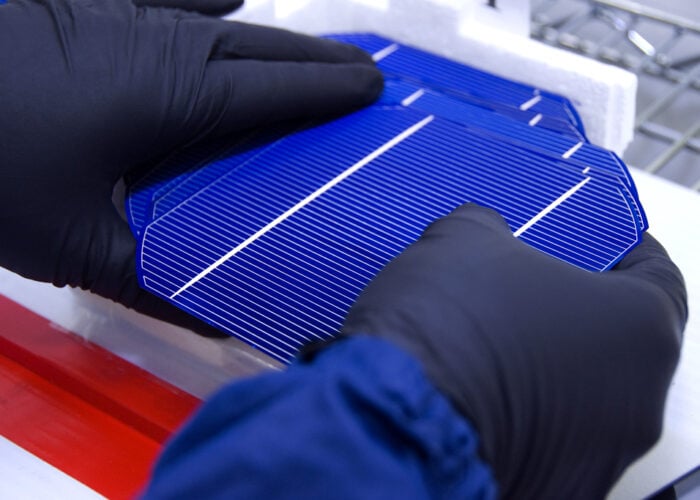
Leading PV manufacturer, Trina Solar, has started mass production of high-efficiency PERC (passivated emitter rear cell) technology with the expected availability of both multicrystalline and monocrystalline ‘Honey’ modules available in Europe this year and a global roll-out in 2016.
The ‘Honey Plus’ (PC05A (II)), a multi-crystalline module deploying PERC cell technology, is expected to have an average power output of 275W with improved low-light performance. Trina said the average solar cell efficiency was 18.7% on initial volume production levels. The Honey Plus modules are expected to available in the second quarter of 2015 onwards.
Try Premium for just $1
- Full premium access for the first month at only $1
- Converts to an annual rate after 30 days unless cancelled
- Cancel anytime during the trial period
Premium Benefits
- Expert industry analysis and interviews
- Digital access to PV Tech Power journal
- Exclusive event discounts
Or get the full Premium subscription right away
Or continue reading this article for free
Meanwhile, Trina Solar said that the ‘Honey M Plus’ (DC05A (II)), a monocrystalline module would have an average power output of 285W and average cell efficiency of 20.4%.
The high-efficiency monocrystalline modules would be available in the second-half of 2015 in Europe first, with a worldwide launch scheduled in 2016, Trina said.
Zhiguo Zhu, module business unit president of Trina Solar said: “Our Honey Plus and Honey M Plus modules use our leading PERC technology, which recently broke the world record for efficiency. Launching these new products once again demonstrates our efforts to apply and commercialise our advanced cell technology to high efficiency modules. Our outstanding track record in product development and performance is thanks to our professional scientific research, strict quality controls and reliability testing. Our deep commitment to R&D and to delivering high quality products ensures our leading position in a very competitive PV industry. We continue to develop our technology to provide customers with a diversified product portfolio that meets the needs of residential, commercial and utility end users.”
Trina Solar noted that the PERC cell technology for the Honey modules would use an advanced five-busbar frontside contact technology for lower overall series resistance as well as increased cell-to-nodule ratio and enhanced reliability.