Indian renewable energy major Adani Green Energy (AGEL) reported a 48% year-on-year increase in operational capacity to 17.24GW, driven predominantly by solar.
For FY25–26, Adani Green Energy added 5.1GW of greenfield renewable capacity, with core EBITDA rising 23% year-on-year to INR108.6 billion (US$1.1 billion), while revenue from power supply increased 22% year-on-year to INR116.02 billion.
Try Premium for just $1
- Full premium access for the first month at only $1
- Converts to an annual rate after 30 days unless cancelled
- Cancel anytime during the trial period
Premium Benefits
- Expert industry analysis and interviews
- Digital access to PV Tech Power journal
- Exclusive event discounts
Or get the full Premium subscription right away
Or continue reading this article for free
According to the firm, the 5.1GW addition is the highest greenfield renewables capacity expansion globally by any company outside China.
Growth was driven primarily by solar deployment, which accounted for 3,412MW of the new capacity, including 2,974MW at Khavda in Gujarat and 438MW in Rajasthan. The remainder included 683MW of wind and 956MW of hybrid capacity, both heavily concentrated at Khavda, putting it on track toward its 50GW target by 2030.
With a total operational portfolio of 19,294MW, Adani Green Energy generated 106% of its annual electricity under power purchase agreements (PPAs).
Additionally, the 48% hike in operations capacity 48% was driven primarily by the addition of 4,187MW of solar capacity, alongside 462MW of wind and 981MW of hybrid assets.
The solar portfolio delivered a capacity utilisation factor (CUF) of 23.7%, supported by 99.1% plant availability. Meanwhile, hybrid assets, posted a CUF of 34.8% with 98.5% availability.
Khavda anchors next phase of solar scale
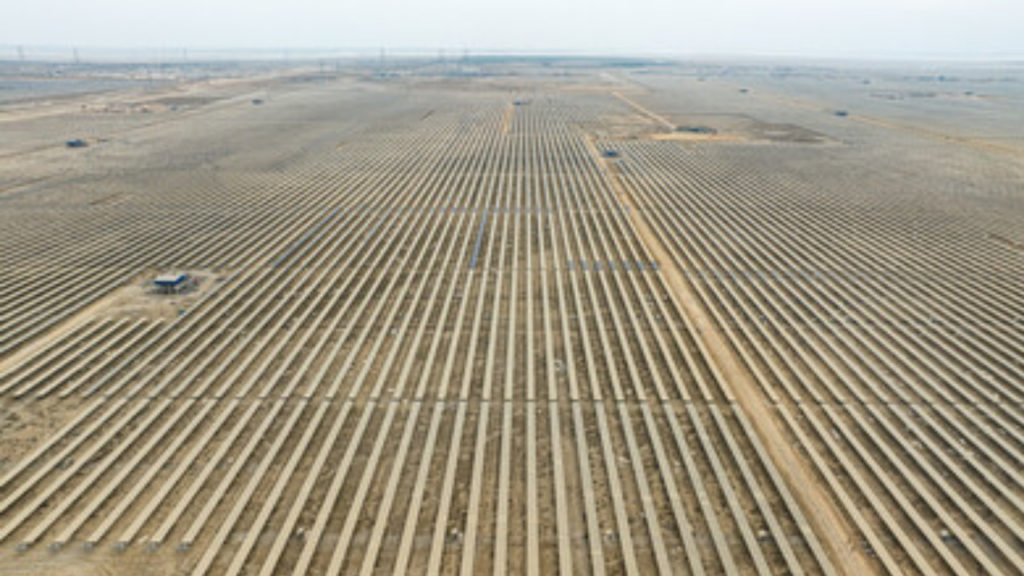
Khavda Renewable Energy Project, dubbed “the world’s largest renewable energy plant,” is emerging as the central pillar of the company’s growth strategy, particularly in solar.
The site, also called Gujarat Hybrid Renewable Energy Park, was first announced by the Indian government in 2020. Spread across 538 square-km, Khavda already hosts 9.4GW of operational solar, wind, and hybrid capacity. AGEL is targeting 30GW at Khavda by 2029.
The site will deploy automation technologies such as waterless robotic cleaning systems to reduce resource usage and improve efficiency, alongside advanced bifacial solar modules and trackers to maximise output, the firm said.
Last month, Adani Green Energy operationalised 951MW of renewable capacity across Rajasthan and Gujarat, with 251MW commissioned at Baiya village in Jaisalmer and 700MW at Khavda Renewable Energy Park.
These latest additions took the company’s total operational portfolio to 18.93GW. Earlier this year, AGEL brought online a further 510.1MW at Khavda, including 300MW of solar, with capacity delivered through its subsidiaries.
Khavda remains central to AGEL’s scale-up strategy. In September 2024, the company signed a 25-year PPA with Maharashtra State Electricity Distribution Company for 5GW of capacity from the site and partnered with TotalEnergies to develop an additional 1.1GW solar PV portfolio backed by a US$444 million equity investment.
AGEL had earlier commissioned an initial 1GW at Khavda in March 2024 and secured US$1.36 billion in debt financing in late 2023 to support 2.1GW of solar PV, taking its construction financing framework to US$3 billion at the time.
Furthermore, to strengthen grid reliability at the site, AGEL has installed 1,376MWh of battery energy storage system (BESS) capacity, with a target of more than 10,000MWh by FY27.