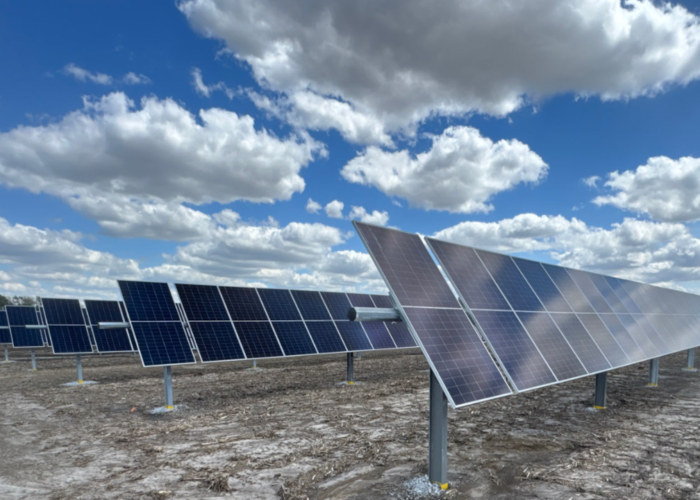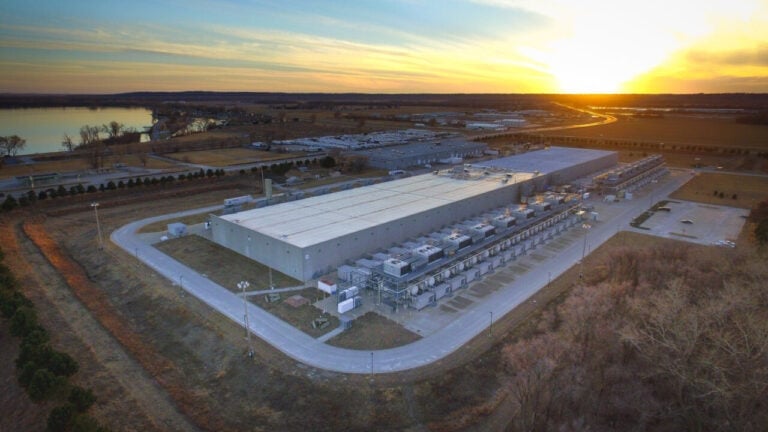
Google has finalised its acquisition of US renewable energy developer Intersect Power, as part of its plan to power its data centre expansions in the US.
The tech giant has completed its US$4.75 billion purchase of asset manager TPG Rise Climate’s share of Intersect, closing a transaction that began in December 2025.
Try Premium for just $1
- Full premium access for the first month at only $1
- Converts to an annual rate after 30 days unless cancelled
- Cancel anytime during the trial period
Premium Benefits
- Expert industry analysis and interviews
- Digital access to PV Tech Power journal
- Exclusive event discounts
Or get the full Premium subscription right away
Or continue reading this article for free
In tandem with Google’s assumption of Intersect, the company’s lead shareholders, including TPG, Google, Climate Adaptive Infrastructure (CAI), and Greenbelt Capital Partners, have spun off Intersect’s grid-tied power business into a new independent power producer (IPP), IPX Power. The new entity will focus on co-located solar and battery energy storage system (BESS) projects, primarily across Texas and California.
“Google’s recognition of Intersect’s unique capabilities underscores the strength of its platform,” said Jamie Gilbert, business unit partner at TPG Rise Climate.
The acquisition is a significant step in the role that big tech firms are playing in the US power sector. Big tech companies like Google, Amazon and Meta have been the biggest corporate buyers of power—particularly solar power—in the US over recent years, as they look to secure power for their expansive data centre operations.
“We brought together the TPG ecosystem to address the hyperscalers’ most significant challenge in meeting today’s data centre capacity demands—readily available power at scale,” said Ed Beckley, a managing partner at TPG Rise Climate. “Throughout our investment period, we developed the capabilities within Intersect to efficiently build new clean power generation alongside new data centre load.”
As their electricity demand has grown, so-called ‘hyperscalers’ have become more involved in the energy sector, with Amazon buying the 1.2GW Sunstone solar-plus-storage project outright from recently bankrupt developer Pine Gate Renewables in January.
Buying Intersect is a step up from this. It gives Google a “scalable model for meeting growing compute demand”, TPG said, and will allow the co-location of power sources with data centres. The company has said it will invest US$40 billion in building three data centres in Texas through 2027, and in its earnings call earlier this month CEO Sundar Pichai said the company would spend US$185 billion on AI-related capital expenditure this year.
Last week, big tech bosses gathered at a White House meeting with president Donald Trump where he announced a ‘ratepayer protection pledge’, which will require companies to provide, build or buy their own energy to power data centre development. Google, Amazon, Meta, Microsoft, Oracle, OpenAI and xAI have all signed the pledge, which, in principle, will see them coordinate arrangements with grid operators, state governments and utilities.
The pledge could result in more fossil fuel production for data centres, particularly gas turbines, alongside energy storage, and is ultimately non-binding and relies predominantly on publicity and pressure to encourage hyperscalers to follow its guidelines. Indeed, discussing the pledge, Trump said of big tech firms: “They need some PR help.”
PV Tech Premium analysed the impact that the pledge could have on solar PV earlier this week.
After five editions of Large Scale Solar USA, the event becomes SolarPLUS USA to mirror where the market is heading. The 2026 edition, held in Dallas, Texas, on 24-25 March, will bring together developers, investors and utilities to discuss managing hybrid assets, multi-state pipelines, power demand increase from data centres and AI as well as the co-location of solar PV with energy storage in a complex grid. For more details and how to attend the event, visit the website here.