A significant shift in photovoltaic inverter manufacturing is set to unfold in the coming years, and beneath this lies a profound transformation in manufacturing geography. In the short-term, this could appear as a downturn in the global market; however, it is all an effort to reshape existing manufacturing structures as supply chains are relocated and built in regions beyond China.
Western markets are executing a decisive pivot toward regional production, with Europe emerging as an unexpected leader in the reshoring movement, a stark contrast to the solar module sector where Chinese manufacturers are still dominant. Leveraging insights from our in-house market research team and the PV InverterTech Bankability Ratings Report, this article uses analysis of the leading 30 companies in the utility-scale PV inverter market.
Try Premium for just $1
- Full premium access for the first month at only $1
- Converts to an annual rate after 30 days unless cancelled
- Cancel anytime during the trial period
Premium Benefits
- Expert industry analysis and interviews
- Digital access to PV Tech Power journal
- Exclusive event discounts
Or get the full Premium subscription right away
Or continue reading this article for free
The shifting global manufacturing landscape
Global manufacturing capacity for PV inverters has undergone dramatic changes since 2021. China’s dominance reached its peak in 2024, when Chinese manufacturers controlled almost 85% of global manufacturing capacity, a share that had grown steadily from already substantial levels in preceding years. This concentration represented the culmination of years of aggressive capacity expansion within China’s borders.
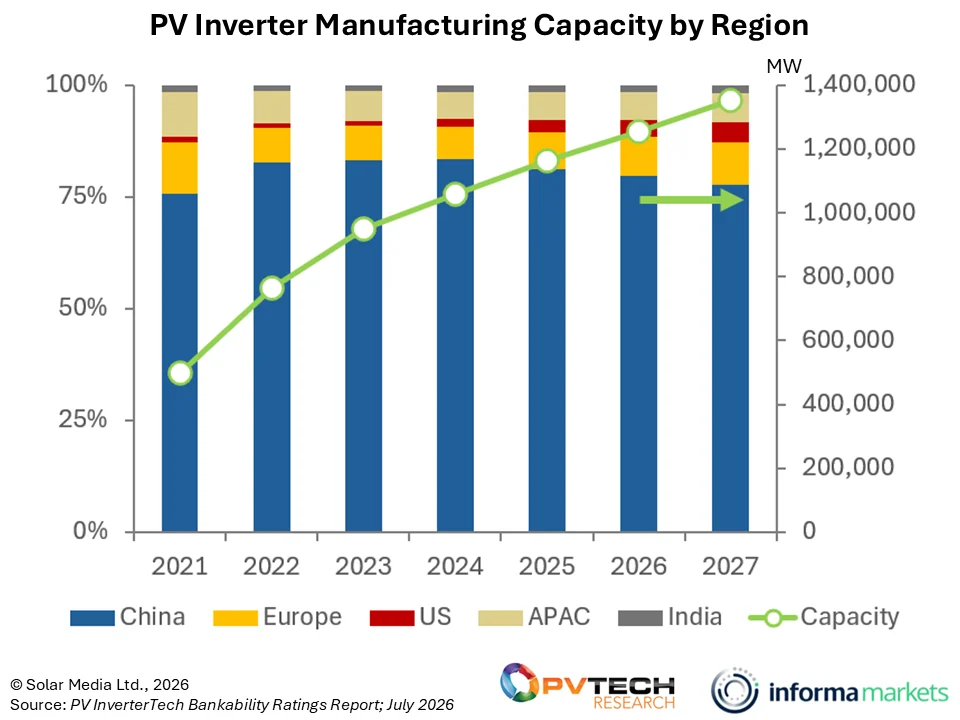
However, 2024 marked an inflection point. Anticipating sweeping policy changes across Western markets, manufacturers began a strategic repositioning. The European Union’s Net-Zero Industry Act (NZIA), adopted in March 2024, mandated that at least 40% of the EU’s annual deployment needs for net-zero technologies, including solar inverters, be manufactured domestically by 2030.
This provided long-term regulatory certainty for manufacturers investing in European production facilities and created preferential treatment for EU-manufactured equipment in public procurement. European manufacturers commenced significant capacity expansions on home soil.
Now in 2026, the transformation has become obvious. Europe has achieved over 100GWac of solar and energy storage inverter manufacturing capacity, establishing itself as one of the largest inverter manufacturing regions in the world outside of China. This surpasses the US (40GW) and India (20GW), positioning Europe as the clear upcomer in global production capacity.
Europe’s PV inverter capacity boom
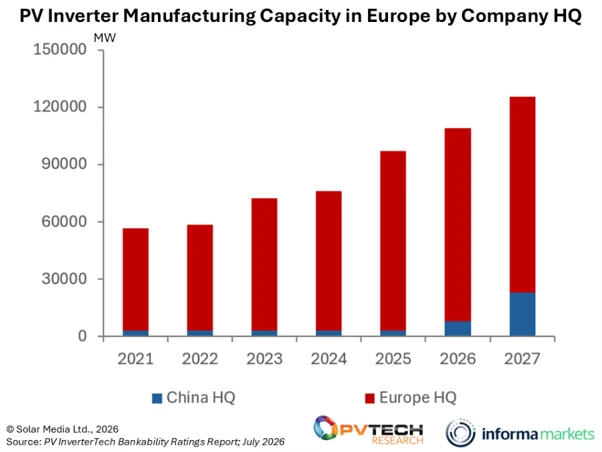
What distinguishes Europe’s inverter manufacturing expansion from other sectors, particularly solar modules, is the composition of its manufacturing base. As of 2026, over 90% of Europe’s 100GW manufacturing capacity comes from European-headquartered companies.
Germany’s SMA Solar owns the largest facility, with 40GW of capacity in Germany, while Spain’s Power Electronics follows with a 25GW factory in its home country. This reflects a meaningful shift in industrial capacity rather than a simple relocation of Chinese production facilities.
Major European players like SMA Solar continue to maintain strong positions in the global market, leveraging decades of engineering expertise and established customer relationships. These companies have capitalised on favourable policy environments and growing demand for supply chain resilience to expand their production footprint significantly.
The EU has constructed a policy framework that discourages Chinese inverter imports while incentivising domestic production. In May 2026, the European Investment Bank (EIB) implemented financing restrictions on projects involving equipment from “high-risk countries,” effectively limiting access to preferential financing for projects using Chinese inverters.

Simultaneously, energy projects incorporating Chinese inverters became ineligible for EU subsidies, creating economic incentives for developers to source from European or allied manufacturers.
These measures also address cybersecurity concerns that have become increasingly prominent in Brussels. With over 60% of inverter imports into Europe previously originating from China, policymakers identified critical infrastructure vulnerabilities in the energy sector’s dependence on single-source suppliers from geopolitically sensitive regions.
Unlike approaches that simply invite foreign manufacturers to relocate, Europe’s strategy explicitly favours the expansion of domestic industrial capacity.
This stands in sharp contrast to European solar module manufacturing, where Chinese companies establishing facilities in Europe, such as Trina Solar’s 1.5GW heterojunction (HJT) module assembly line in Spain and DAS Solar’s planned 3GW facility in France, dominate the limited European production landscape. European PV module manufacturers have struggled with cost competitiveness, enduring several notable bankruptcies, including Norwegian Crystals and Dutch manufacturer Exasun.
The limited Chinese footprint in European inverter production
While Chinese manufacturers Huawei and Sungrow dominate global inverter sales, their direct manufacturing presence in Europe remains surprisingly modest, particularly when compared to their market share.
Huawei has operated a 3GW facility in the Netherlands since 2015, providing a European production base for over a decade. However, the company has announced no known plans to expand this capacity, suggesting a strategic decision to maintain rather than grow its European manufacturing footprint.
Sungrow’s Poland facility represents the most significant recent Chinese investment in European inverter manufacturing. Announced in February 2026 with a €230 million (US$261.7 million) commitment, the facility is located in the Wałbrzych Special Economic Zone and features a planned capacity of 20GW for inverters and 12.5GWh for energy storage systems annually.
Expected to become operational within 12 months and create 400 jobs, this marks Sungrow’s first European manufacturing facility; its other plants are located in China, India and Thailand.
When Sungrow’s facility reaches full production in 2027, it will increase the Chinese-headquartered share of European manufacturing capacity from less than 10% in previous years to approximately 20%. Even with this substantial addition, European companies will retain roughly 80% of regional manufacturing capacity, a remarkable achievement in an industry where Chinese manufacturers have achieved near-total dominance in other regions and product categories.
Europe’s approach to inverter manufacturing reflects a broader industrial strategy centred on four key pillars: supply chain resilience to reduce dependency on geopolitically sensitive suppliers, cybersecurity protection for critical energy infrastructure through EU-regulated equipment, local job creation with facilities generating thousands of high-quality positions across the continent and allied supplier networks that incorporate manufacturers overseas alongside European producers.
This strategy balances security concerns with economic efficiency and technological access.
Outlook
As the global PV inverter market faces an expected decline in shipments through 2025 and 2026, European manufacturers appear well positioned to withstand the downturn. Their dominant position in a large and growing regional market provides volume stability, while policy support offers protection from low-cost competition. Chinese manufacturers, despite their global dominance, face the challenge of serving European markets either through limited local production capacity or exports subject to increasing restrictions.
The question of who will lead European and US markets in coming years appears increasingly answered: in inverters, at least, Western manufacturers are successfully reclaiming their home markets. Whether this model can be replicated in other solar technologies, where cost gaps are more substantial, remains an open and critical question for the future of Western solar manufacturing.
The European inverter story demonstrates that with appropriate policy support, technological competitiveness, and strategic commitment, Western manufacturers can successfully compete with Chinese producers even in renewable energy equipment markets.
As trade policies and localisation requirements continue to reshape global manufacturing geography, Europe’s inverter sector may serve as a template for other technologies and regions navigating the complex intersection of climate goals, industrial strategy and geopolitical competition.
All data and analysis shown in this article come from our in-house market research. Full details on how to subscribe to our PV InverterTech Bankability Ratings Report can be found here.