The European Solar Manufacturing Council (ESMC) has called on the European Parliament, European Council and individual member states to rebuild the European PV industry across its entire value chain.
The council has argued in favour of this in an open letter, sent to the European Parliament’s Industry, Research and Energy (ITRE), Internal Market and Consumer Protection (IMCO) and International Trade (INTA) committees. The ESMC quotes figures from the Fraunhofer Institute for Solar Energy Systems (ISE), saying: “A European solar PV manufacturing value chain at 30GW per year would create around 80,000 jobs and add €4 billion (US$4.48 billion) to EU GDP.”
Try Premium for just $1
- Full premium access for the first month at only $1
- Converts to an annual rate after 30 days unless cancelled
- Cancel anytime during the trial period
Premium Benefits
- Expert industry analysis and interviews
- Digital access to PV Tech Power journal
- Exclusive event discounts
Or get the full Premium subscription right away
Or continue reading this article for free
The position paper and joint letter, signed by European manufacturers from eight member states, Switzerland and the UK, set out three demands: a strict ‘Made in Europe’ definition for the EU’s Industrial Accelerator Act (IAA), adequate market protections and investment and operating support to scale the value chain and attractive private investment.
A strict ‘Made in Europe’ definition
The ESMC calls for the EU’s IAA to include a strict definition of the ‘Made in Europe’ moniker that would cover the entire solar hardware value chain, to be established in the next five years. This would include European-made production equipment used to manufacture PV components. The marking would be an opt-in for companies of EU origin rather than an automatic extension for free-trade-agreement partners such as Switzerland.
The proposed coverage of the entire PV supply chain is a backing of the European Parliament committees’ current research, and an evolution from the ESMC’s April 2026 statement, in which the council suggested awarding ‘Made in Europe’ status to projects that include at least three components made in Europe.
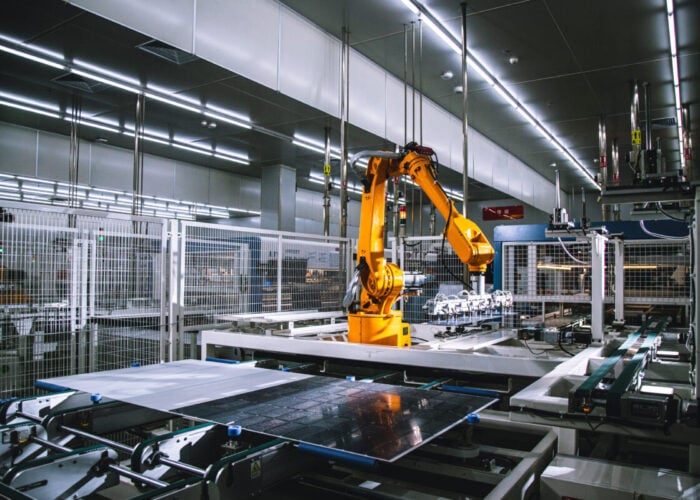
The potential for European equipment manufacturing machinery is a key part of the ESMC’s argument. The position paper submitted to the European committees states there at 38 specialist European machine builders that are capable of manufacturing the necessary production equipment for the PV sector.
In several elements of the PV supply chain, the paper says, these European entities are the only viable alternatives to Chinese offerings. It states that many of the European companies with potential for the sector currently serve the semiconductor industry, and argues that it is this competence in technology that will underpin any resurgence in PV production.
Market protection
The joint letter and supporting position paper call for market protection against overcapacity, foreign subsidies and dumping, elements that the ESMC cite as being under examination by the European Commission with regards to a new trade instrument.
The instrument being considered targets overcapacity, specifically citing Chinese exports in the electromechanical and PV sectors, which the ESMC says are at prices so low as to be “unsustainable and fragile”, referring to Fraunhofer ISE figures that show that Chinese PV modules are sold at an average price of €0.09/W, compared to production costs of €0.16-0.17/W.
Chinese manufacturers have, similarly, sought to cut production, with the China Photovoltaic Industry Association (CPIA) announcing earlier this year that it expects 2026 capacity additions to reach a maximum of 240GW, down from 315GW in 2025.
This, combined with new rules on module efficiency, could significantly reduce Chinese module output this year, but the ESMC has called for a new market instrument to go beyond this and provide more robust security for European manufacturers. The emerging trade instrument would go beyond existing anti-dumping frameworks and could impose broader market restrictions based on macro production figures.
The figures supplied in the position paper estimate the additional cost to wholesalers sourcing all-European PV power would be around €0.25, a markup that, the authors claim, would soon become irrelevant to power purchasers, due to the gradual cessation of below-cost pricing by Chinese manufacturers.
“Measured against the hundreds of billions of Euros of damage caused by recent supply shocks, this is an insurance premium, not a subsidy,” the letter says.
Investment and operational support
The industry council calls for investment and support across the full PV value chain, which it says would help attract private capital.
“Investors are not waiting for subsidies, they are waiting for a market. European projects, sites and technology are ready. Give European-made polysilicon, wafers and cells a guaranteed place in European demand, and the capital will flow, otherwise it will go elsewhere,” said Carsten Rohr, co-chair of the ESMC.
The position paper lists more than 100 European PV manufacturing facilities, citing over 75 module assembling plants, but notes few EU companies currently produce solar cells or build cell capacity at the necessary gigawatt-scale. There is currently only one ingot and wafer project within the EU, and one polysilicon producer, the ESMC says.
The recent increase in output of Italian cell and module manufacturer 3Sun has been influential a growth in the Turkish PV manufacturing sector, which saw its module annual nameplate capacity more than double between 2022 and 2026, from under 10GW to more than 20GW. Although not an EU member state, Turkey has had favourable trade terms with the continent since 1995 in the form of the EU–Turkey Customs Union.
In July this year, the Spanish Ministry of Ecological Transition (MITECO) awarded more than €160 million to 40 clean energy manufacturing projects, including three in the solar PV sector.
However in late 2025, the Dutch government cancelled its funding of SolarNL after just two years, a programme that was an attempt to establish domestic solar manufacturing in the country.