Solar PV module prices broadly fell in Europe in August 2026, as demand dipped below its historic average, according to PV wholesale platform sun.store.
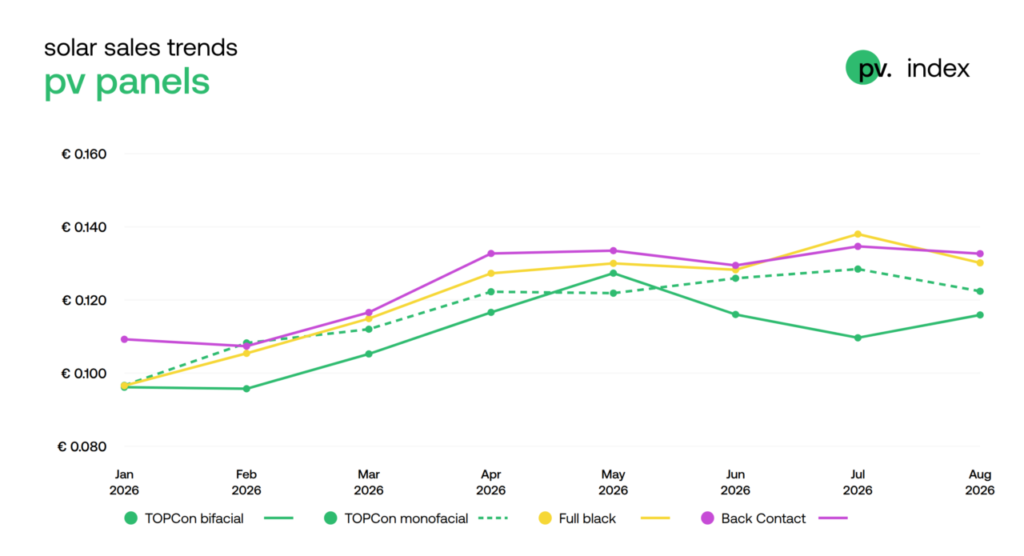
According to sun.store’s monthly PV Index report, back contact (BC), full black and monofacial TOPCon module prices all fell to varying degrees in August, while bifacial TOPCon modules increased in price. BC was an average of €0.133/Wp in August, around 1.5% lower than July’s prices; full black fell almost 6% to €0.130/Wp; monofacial TOPCon reached €0.122/Wp, a 4.7% drop.
Try Premium for just $1
- Full premium access for the first month at only $1
- Converts to an annual rate after 30 days unless cancelled
- Cancel anytime during the trial period
Premium Benefits
- Expert industry analysis and interviews
- Digital access to PV Tech Power journal
- Exclusive event discounts
Or get the full Premium subscription right away
Or continue reading this article for free
Bifacial TOPCon modules rose by 6% to €0.116/Wp in August, though it still remained the cheapest option, particularly for utility-scale solar projects. “TOPCon bifacial and monofacial are priced apart, which matters for anyone specifying on price alone,” the PV Index report said.
Premium BC and full black modules are generally reserved for smaller residential and corporate installations. The gap between premium module types and standard utility-scale TOPCon modules has widened since the early months of 2026, and all prices have risen substantially since late 2025, as shown in the graph below.
When it comes to suppliers, major Chinese firms dominate the European landscape. Over the three months to August 2026, the PV Index said Trina Solar was the top supplier, followed by Aiko, JA Solar, JinkoSolar and LONGi.
Demand for solar modules in Europe has dipped below historic averages over the last two months, according to PV Index’s Purchasing Managers Index (PMI). The index shows that buyer demand for solar modules hit 65 in August. The PMI surveys buyer sentiment in the European PV industry based on future intentions. It has run at an average of 68 since it began.
43% of surveyed buyers planned to buy more modules in September than August, 43% expect no change and 14% plan to buy fewer modules in the coming month.
Inverter dynamics shift
“Premium modules are still setting the pace, but the demand signal has cooled from the spring. Buyers holding out for lower standard-module pricing are being rewarded; those specifying premium categories are not,” the report said.

The index also covers solar inverters. String inverters declined in price by over 20% in August, with a slightly greater fall in smaller 1-20kW systems, down to €41.40/kW, than systems larger than 20kW (€24.26/kW).
“The easing in the string and on-grid series is mostly a shift in the mix of models trading, rather than a cut to any single product,” the index report said. It said July carried a “heavier weighting of premium three-phase inverters” from European manufacturers such as SMA and Fronius, which are pricier than Chinese and other alternatives, while August saw a move towards “competitively priced and larger commercial-scale models” from companies including GoodWe, Solis and SolarEdge.
Hybrid inverter prices diverged between sizes. Smaller 1-20kW systems stayed almost flat, declining by just 1%, while larger systems above 20kW rose by 11.1% month-on-month.
The top string inverter suppliers were China’s Huawei and Sungrow, followed by Germany’s SMA, Chinese GoodWe and Israeli SolarEdge.
Hybrid inverters were dominated by Chinese suppliers, led by Deye, Solis, Huawei, GoodWe and Sungrow.