Australian AI infrastructure developer Firmus Technologies has signed a 12-year wholesale energy supply agreement with Gunvor Group, including 1.5GWh of battery storage and 1.2GW of renewables by 2032.
The deal covers 600MW of firm electricity for its planned South Australian “AI Factory” campuses, linked to the development of 1.2GW of new renewable energy generation and 1.5GWh of battery storage.
Try Premium for just $1
- Full premium access for the first month at only $1
- Converts to an annual rate after 30 days unless cancelled
- Cancel anytime during the trial period
Premium Benefits
- Expert industry analysis and interviews
- Digital access to PV Tech Power journal
- Exclusive event discounts
Or get the full Premium subscription right away
Or continue reading this article for free
Firmus describes itself as vertically integrated from model to grid, combining proprietary energy and cooling technology with AI cloud services. The company is registered in Sydney and provides AI cloud services across the Asia Pacific region.
The agreement underpins the first phase of Project Southgate, Firmus’ programme to develop large-scale AI Factory campuses in regional South Australia at Tailem Bend and Stirling North. Together, the two sites represent 2.7GW of planned capacity.
Under the commercial structure, Gunvor will support the development of generation and storage assets required to supply Firmus’ load, with the battery storage component providing firming capacity to make the renewable energy supply dispatchable.
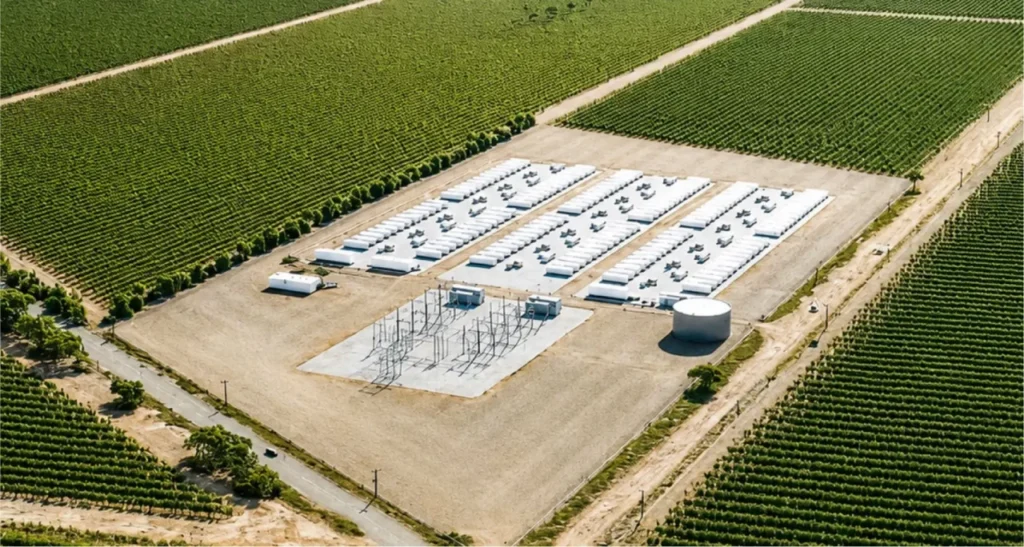
The deal includes a long-term offtake agreement for GreenPoint Energy’s Koolunga battery energy storage system (BESS), a 200MW/800MWh grid-forming system near Brinkworth in South Australia’s Mid North.
Firmus describes Koolunga as representing more than half of its initial firming capacity commitment, making the battery storage system a central rather than supplementary element of the energy supply architecture.
The grid-forming specification indicates that the Koolunga BESS will provide synthetic inertia and fast frequency response, alongside energy arbitrage, contributing to system stability in a region that already hosts some of the highest renewable energy penetration in any connected grid globally.
The agreement also contains a demand response commitment under which Firmus will reduce its electricity consumption for up to 220 hours per year when wholesale prices exceed agreed thresholds.
Firmus framed this as a deliberate concession to reduce pressure on wholesale prices during periods of grid stress, effectively treating its load as a grid asset rather than a pure consumer.
Firmus Co-CEO Oliver Curtis said the South Australian locations reflect both energy fundamentals and a strategic commitment.
“We’re building our AI Factories in regional South Australia because they’re the right locations for large-scale AI infrastructure and the energy investment that goes with it. Our South Australia energy agreement puts our commitments into practice, backing new renewable energy generation, major battery storage and flexible energy use that supports the grid,” Curtis said.
South Australian Premier Peter Malinauskas welcomed the announcement, describing it as evidence that the state’s clean energy transition is attracting industrial investment.
“South Australia is leading the clean energy transition, and this project demonstrates how that leadership is attracting the industries of the future,” Malinauskas said.
To read the full article, including more analysis of the energy storage aspect of the deal, please visit Energy-Storage.news.