New details have emerged regarding a plan to establish six Renewable Energy Zones (REZs) in the Australian state of Victoria, unlocking 10GW of additional capacity for renewables.
Having previously announced plans to establish REZs in the state, a new directions paper published by the Victorian State Government this week reveals how the AU$540 million project – part of a wider AU$1.6 billion clean energy package included within the state’s budget – will not only boost network capacity in the state but establish a new body to oversee the REZ’s development.
Try Premium for just $1
- Full premium access for the first month at only $1
- Converts to an annual rate after 30 days unless cancelled
- Cancel anytime during the trial period
Premium Benefits
- Expert industry analysis and interviews
- Digital access to PV Tech Power journal
- Exclusive event discounts
Or get the full Premium subscription right away
Or continue reading this article for free
The directions paper, which can be read here, outlines three key actions to be undertaken to further develop REZs in the state. These are:
- The preparation of an initial REZ development plan that includes immediate network investments, as well as medium-term projects to be planned and developed further;
- The creation of VicGrid, a new body to plan and develop REZs and map planning and investment for them, and;
- The release of a full implementation plan, currently slated for July 2021, which will outline more precise details around the REZs’ development and financing.
The locations of the six REZs have now been confirmed for Ovens Murray, Murray River, Central North, Western Victoria, South West and Gippsland.
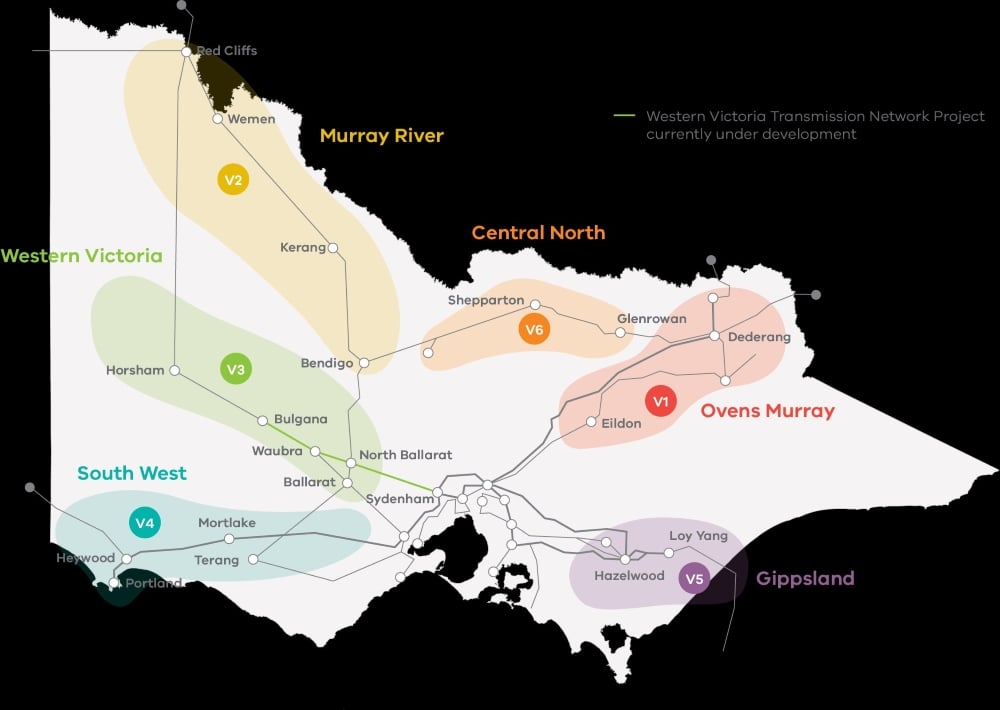
Those zones are committed to meeting a set of objectives, namely ensuring that communities, including traditional owners, are engaged in the process; provide for the orderly, planned development of renewable energy resources; efficiently and effectively expand the grid and connect new generation, and reduce network congestion and costs.
In creating an additional 10GW of capacity for renewables, Victoria’s total renewable energy capacity across its REZs is expected to top 16GW by 2040, tripling Victoria’s renewable capacity today.
Mark Gepp, the MP for Northern Victoria, said the plan would help create thousands of clean energy jobs in the state and deliver significant economic benefits.
“Renewable energy creates jobs. Construction jobs, engineering jobs and management jobs. As Victoria works to rebuild and be stronger than ever before, renewable energy will be at the heart of our economy and jobs creation.”
“VicGrid will be a major game changer for the way renewable energy works in Victoria. It will see the benefits – from jobs to reliability – spread evenly across our state,” Lily D’Ambrosio, minister for energy, environment and climate change, added.
With grid congestion a prominent issue, REZs have emerged as a workable solution to maximising the grid capacity open for renewable energy generators. They have also proven incredibly popular with developers – the first of Australia’s zones, planned for New South Wales, opened for applications last year and was more than nine-times oversubscribed, prompting the hasty creation of a second REZ, even larger than the first.