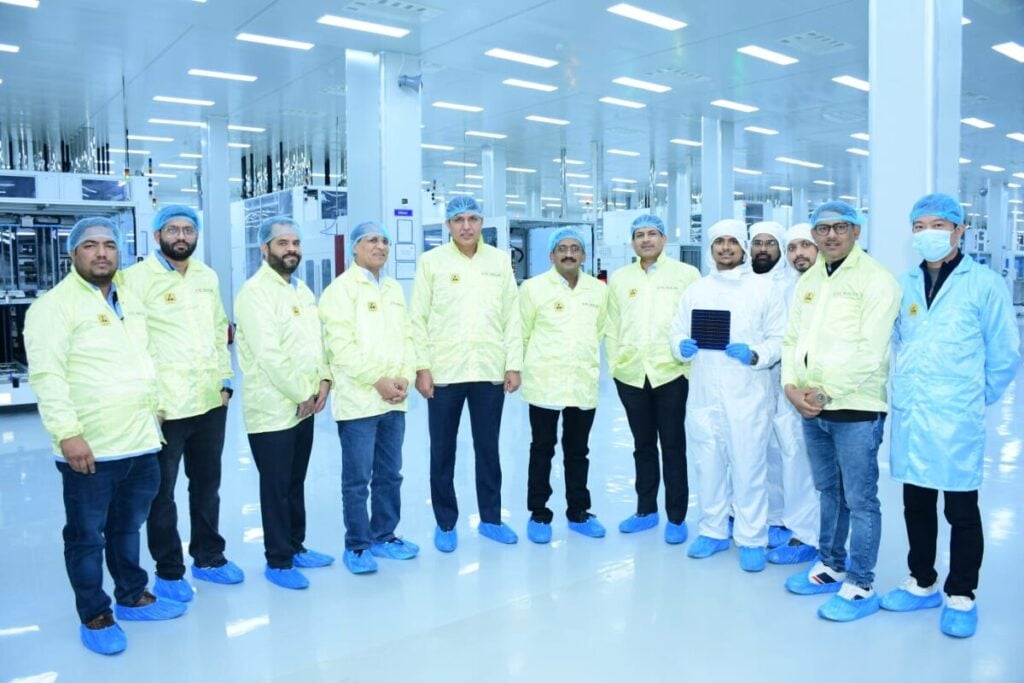
Indian rooftop solar provider Fujiyama Power has announced plans to commission its 1GW solar cell manufacturing plant in Dadri, Uttar Pradesh.
The newly inaugurated in-house solar cell manufacturing facility will produce mono passivated emitter rear cell (PERC) solar cells compliant with India’s domestic content requirement (DCR). Backed by a total investment of INR3 billion (US$32.7 million), the plant is intended to strengthen Fujiyama’s supply-chain resilience, reduce reliance on imported solar cells and enhance cost control across its manufacturing operations.
Try Premium for just $1
- Full premium access for the first month at only $1
- Converts to an annual rate after 30 days unless cancelled
- Cancel anytime during the trial period
Premium Benefits
- Expert industry analysis and interviews
- Digital access to PV Tech Power journal
- Exclusive event discounts
Or get the full Premium subscription right away
Or continue reading this article for free
Pawan Kumar Garg, chairman, Fujiyama Power, said, “The project has been completed within a short period of six months. By bringing solar cell production in-house, we are improving visibility and control across the value chain, reducing reliance on imported cells and improving supply reliability for our solar panel operations.”
“As our business is primarily focused on the domestic market with negligible export exposure, this integrated facility also insulates us from global trade uncertainties and tariff-related disruptions,” Garg added.
Greater Noida-based Fujiyama Power operates four manufacturing facilities across Himachal Pradesh, Uttar Pradesh and Haryana, with 1.6GW of solar module capacity, including 1.2GW at Dadri.
The newly added 1GW solar cell capacity will be used entirely for captive consumption. The facility will allow Fujiyama to address subsidy-driven consumer demand and will be financed through a mix of internal accruals and debt.
India is ramping up domestic solar manufacturing as it targets 500GW of non-fossil capacity by 2030, including around 300GW of solar. In 2025, the country’s solar cell capacity rose from 9GW to 25GW in 2025, with annual installations exceeding 24GW.
To curb low-cost imports especially from China, the government has imposed a 25% Basic Customs Duty on solar cell imports and introduced measures such as safeguard duties and the PLI scheme to support domestic manufacturing. Industry forecasts put India’s solar cell capacity at 100GW by 2027-28.