This year’s COP30 summit saw over 40,000 attendees from 193 countries meet in Belém, Brazil, to discuss the global energy transition and the steps being taken towards altering the global energy mix.
Chief among the agreements made at the summit was a push towards “global mutirão”, meaning “collective efforts”, which took the form of a voluntary plan to curb fossil fuel emissions and an emphasis on delivering a “just transition”. Leading Chinese solar module manufacturer LONGi was present for the 12-day summit, and hosted a “green tech for a shared future” event, where founder and chief technology officer Li Zhengou emphasised that the integration of a number of renewable energy technologies will be essential if the world is to meet its climate change goals.
Try Premium for just $1
- Full premium access for the first month at only $1
- Converts to an annual rate after 30 days unless cancelled
- Cancel anytime during the trial period
Premium Benefits
- Expert industry analysis and interviews
- Digital access to PV Tech Power journal
- Exclusive event discounts
Or get the full Premium subscription right away
Or continue reading this article for free
“We must confront the challenge of volatility in renewable energy,” he said, referring to the integration of three pillars—solar PV, battery energy storage systems (BESS) and hydrogen—that LONGi considers essential to meeting the world’s energy transition targets.
The combination of clean electricity generation from solar PV sources, the deployment of power through green hydrogen and the balancing and stability services of BESS will deliver what the company called a “renewable infinity” approach, driving a more prosperous and interconnected energy system
This will lead into what the company calls a new energy era of “beyond solar”, but that is not to say that solar PV will not have a role to play. Indeed, LONGi expects the development of back contact (BC) cell technology to accelerate, and such cells to become more commonplace in the years to come, and expects growth in sectors beyond traditional power plants, such as the integration of PV projects into building facades and transportation infrastructure.
Fourth climate action white paper, first TNFD report
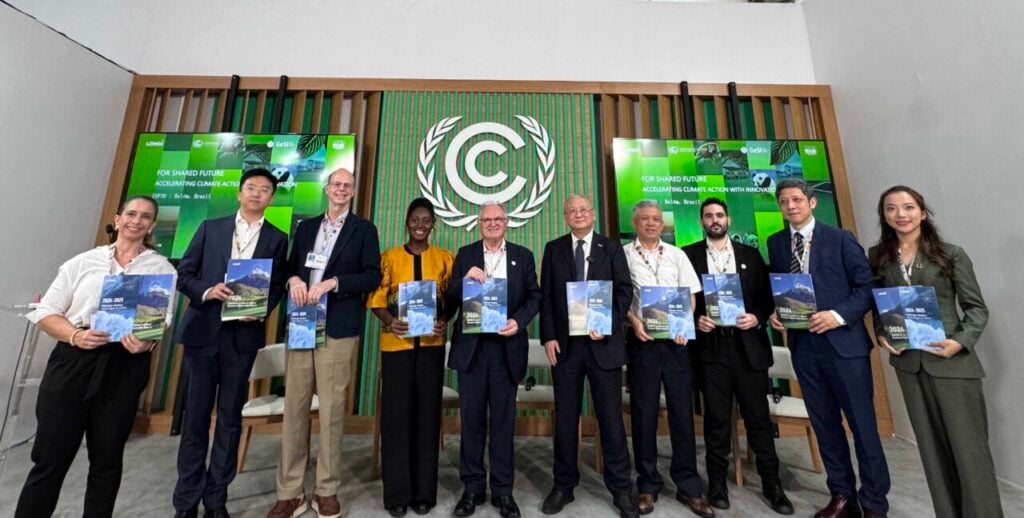
The company also released two reports over the course of the event, beginning with its ‘2024-2025 Climate Action White Paper of LONGi’. This is the fourth annual report from the company covering this topic, and at the launch event, Li Zhengou highlighted four key takeaways from the piece: building an open innovation ecosystem; advancing energy equity and accessibility, deepening global cooperating mechanisms and improving green development policies.
“Addressing climate change is a systemic project requiring global collaboration,” he said during the event. “The value of an enterprise is reflected not only in its economic benefits but also in its contributions to our planetary home.”
As part of the launch, LONGi announced plans to reduce its Scope 1 and 2 carbon emissions by 60% compared to 2020 levels, and reduce Scope 3 emissions by 52%. Its total emissions have already fallen by 37% between 2023 and 2024, and while emissions have increased by 23.8% between 2020 and 2024 due to the overall expansion of the business, the company pointed to “substantial progress” in energy efficiency and green electricity usage across its operations.
It also aims to install charging facilities at all operational sites by 2030, demonstrating how its clean energy work goes beyond just electricity generation.
Meanwhile, the company launched its first Taskforce on Nature-related Financial Disclosures (TNFD) report at the event, following a joint biodiversity initiative completed by the company and the International Union for Conservation of Nature (IUCN). With the launch of this report, LONGi has become a TNFD Adopter, meaning that the company now complies with TNFD principles of minimising nature-related risk, and aiming for net zero loss of biodiversity and zero deforestation by 2050.
Delivering a clean supply chain
The company also launched its ‘Supply Chain Green Partner Empowerment Program’ at the summit, an initiative that provides carbon footprint verification for 50 equipment suppliers that are currently active in LONGi’s manufacturing supply chain.
LONGi aims to reduce the carbon footprint of its supply chains by moving equipment delivery from road to rail and water, and noted that, in 2024, low-carbon transportation accounted for 79.3% of all finished product transportation.
Indeed, LONGi’s own products have a low carbon footprint, with its silicon wafers, modules and hydrogen energy products obtaining 53 carbon footprint certificates in 2024. Its leading Hi-MO 9 series of modules has an average carbon footprint of less than 350kgCO2e/kW, a milestone that has been certified by organisations in France and South Korea, among others.
Empowering vulnerable communities
Elsewhere during the conference, LONGI launched its ‘Green Energy Empowering Vulnerable Communities in Brazil’ project in tandem with the UN Refugee Agency. The initiative will see LONGi provide BC technology to “marginalised vulnerable groups” in Brazil, including refugees, indigenous communities and climate-affected households in states such as Pará and Roraima.
The BC systems donated by LONGi will be deployed on schools, community hospitals and other local facilities, and LONGi will deliver “skills training and sustainable livelihood projects” to equip local communities with the skills necessary to operate these systems into the future.
“Our comprehensive partnership with LONGi transcends traditional models, integrating sustainable energy technology solutions with a steadfast commitment to a greener and more inclusive future,” said Andrew Harper, special adviser on climate action to the UNHCR.