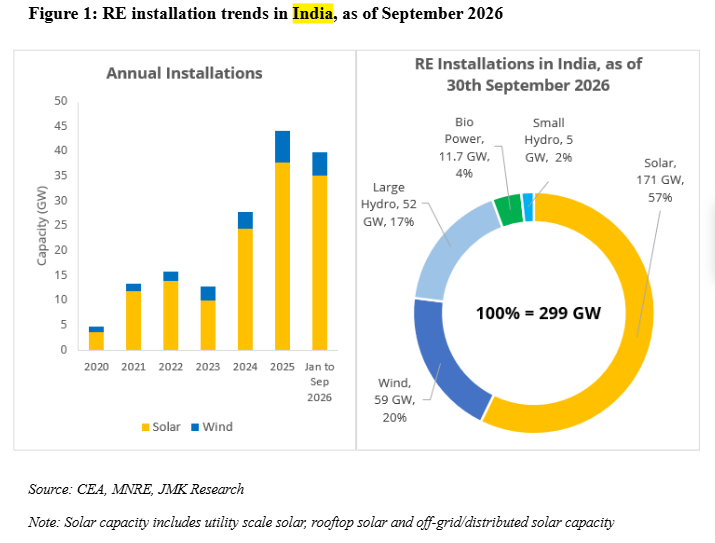
India added approximately 35.2GW of solar capacity between January and September 2026, with utility-scale projects accounting for the largest share of installations, according to a report by JMK Research.
Utility-scale solar accounted for 24.4GW of additions between January and September 2026, while rooftop solar contributed 9.8GW, according to the report. Solar capacity additions increased by around 19.5% year on year during the period.
Try Premium for just $1
- Full premium access for the first month at only $1
- Converts to an annual rate after 30 days unless cancelled
- Cancel anytime during the trial period
Premium Benefits
- Expert industry analysis and interviews
- Digital access to PV Tech Power journal
- Exclusive event discounts
Or get the full Premium subscription right away
Or continue reading this article for free
Cumulative renewable energy capacity in India reached approximately 299.2GW as of September 2026, with solar accounting for around 57% of the total, making it the largest contributor to the country’s renewable energy capacity mix, the report said. The solar figures include utility-scale, rooftop and off-grid and distributed installations.
Utility-scale solar installations accounted for approximately 24.4GW of the capacity added during the first nine months of 2026. Additions were highest in the first quarter, at 12.12GW, before declining to 6.87GW in the second quarter and 5.4GW in the third quarter.
The quarterly figures indicate a slowdown in utility-scale solar capacity additions as the year progressed, with installations in the third quarter less than half the level recorded in the first quarter.
Rooftop solar contributed approximately 9.8GW of new capacity between January and September 2026, including around 34% of the total during the third quarter alone. Cumulative rooftop solar installations reached approximately 33.4GW by the end of September.
Off-grid and distributed solar installations added around 1,041MW during the nine-month period, accounting for approximately 3% of total solar capacity additions.
In August 2026, JMK reported that India’s renewable energy capacity had reached 288GW as of June 30, 2026, accounting for approximately 54% of the country’s total installed power capacity. Solar accounted for 56% of the renewable energy mix, at around 162GW, followed by wind at 20% (57GW) and large hydro at 18% (52GW). Bioenergy and small hydro accounted for the remaining 6%.
The report also noted that approximately 149GW of solar, wind, hybrid and storage projects were in the pipeline as of June 2026, with commissioning expected over the following four to five years. A further 48GW of projects were in the bidding stage.
Gujarat leads state-wise solar and wind additions
Gujarat led India’s combined solar and wind capacity additions during the first nine months of 2026, with approximately 12.9GW installed, followed by Rajasthan at around 9GW and Maharashtra at approximately 3GW, according to JMK Research.
The five leading states — Gujarat, Rajasthan, Maharashtra, Tamil Nadu and Andhra Pradesh — collectively accounted for around 76% of combined solar and wind capacity additions during the period. Gujarat and Rajasthan together contributed approximately 55% of the total.
The report did not provide a separate state-wise breakdown of solar-only additions in the figures supplied.
JMK Research expects India to add another 10-12GW of combined solar and wind capacity in the fourth quarter of 2026, taking total solar and wind additions beyond 50GW for the calendar year.
The forecast suggests continued momentum in renewable energy deployment through the end of the year. However, the projected fourth-quarter figure covers both solar and wind and does not specify the expected contribution from solar alone.
In a separate joint report published in August 2026, the Institute for Energy Economics and Financial Analysis (IEEFA) and JMK reported that India’s solar module manufacturing capacity had reached 233GW as of June 2026, following the addition of 24GW during the second quarter.
Solar cell manufacturing capacity stood at approximately 42GW, while ingot and wafer manufacturing capacity remained at 8.12GW. Of the total module capacity, 193.14GW was enlisted under the Approved List of Models and Manufacturers (ALMM), while 27.23GW of cell capacity was enlisted under ALMM List-II.