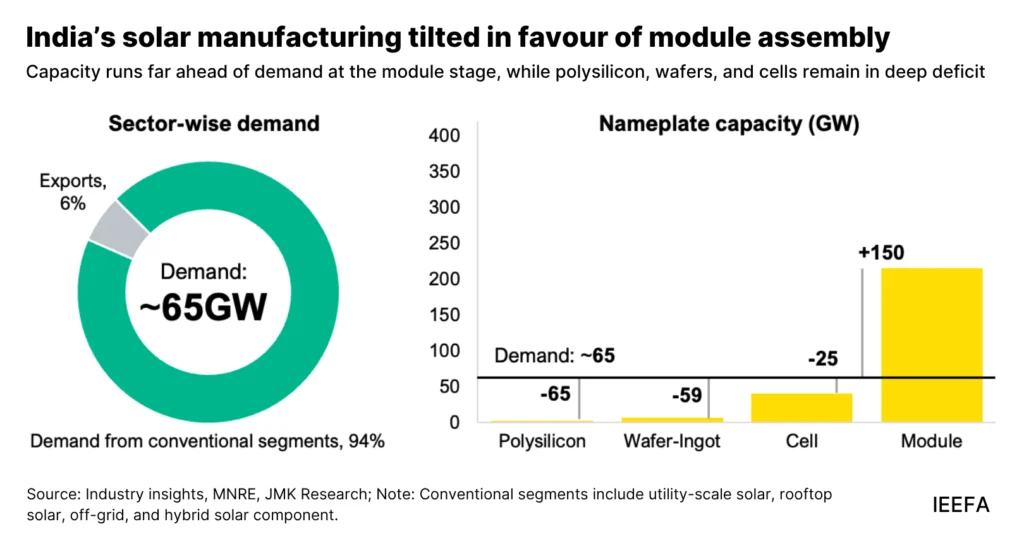
India’s solar module manufacturing capacity has reached approximately 233GW, but factories are operating at an estimated 35–40% utilisation as module manufacturing expansion continues to outpace demand, according to a joint report by the Institute for Energy Economics and Financial Analysis (IEEFA) and JMK Research & Analytics.
The report, ‘Assessing overcapacity risk in India’s solar PV manufacturing market’, estimates that approximately 135GW of additional module capacity backed by firm investment commitments and near-certain commissioning schedules is in the pipeline.
Try Premium for just $1
- Full premium access for the first month at only $1
- Converts to an annual rate after 30 days unless cancelled
- Cancel anytime during the trial period
Premium Benefits
- Expert industry analysis and interviews
- Digital access to PV Tech Power journal
- Exclusive event discounts
Or get the full Premium subscription right away
Or continue reading this article for free
Utilisation is already below the 50–65% level that industry stakeholders identify as generally required for sustainable operations. The report warns that continued capacity additions could put further pressure on utilisation, margins and investment returns, increasing the risk of stranded assets, particularly among standalone manufacturers.
As of June 2026, module nameplate capacity was nearly seven times greater than cell capacity and 116 times that of ingot-wafer capacity, leaving domestic supply of upstream segments such as cells, wafers and polysilicon underdeveloped and the domestic supply chain dependent on imported inputs, predominantly from China.
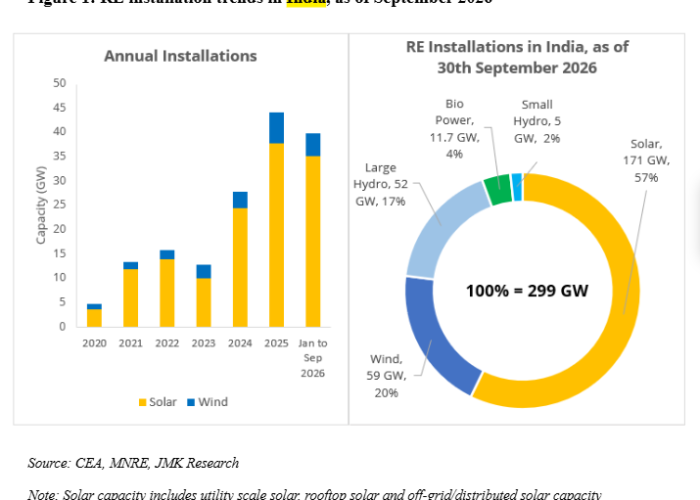
The manufacturing build-out comes as India’s renewable energy market continues to expand. The country reached 288GW of cumulative renewable energy operational capacity by June 2026, with solar accounting for 56% of the total.
However, the report says the growth in solar deployment is unlikely to absorb the module capacity already commissioned or announced.
Module surplus expected to persist through 2030
JMK Research models two potential manufacturing scenarios for FY2030. The first is based on capacity backed by confirmed investments and credible commissioning timelines, while the second includes all capacity announced by Indian manufacturers.
Under both scenarios, module capacity remains ahead of demand. Under the second scenario, nameplate module capacity is forecast to be more than five times annual solar PV demand.
Cell manufacturing is expected to reach marginal overcapacity under the confirmed-investment scenario, while wafer-ingot capacity would almost reach the demand threshold. Polysilicon remains the most difficult upstream segment to develop, with domestic capacity unlikely to expand meaningfully beyond production-linked incentive (PLI) commitments by FY2030.
The imbalance has been driven in part by the economics of module manufacturing. According to the IEEFA and JMK Research report, module facilities require approximately INR1.5–1.7 billion/gigawatt (US$16–18 million/gigawatt) and can be commissioned in 8–15 months.
Meanwhile, cell manufacturing requires INR5–7 billion/gigawatt (US$53–74 million/gigawatt), and integrated ingot-wafer facilities require upwards of INR7–10 billion/gigawatt (US$74–106 million/gigawatt), with commissioning timelines of 18–24 months.
Module manufacturing also involves less process complexity and lower technology and capital requirements, while cells and wafers require greater process expertise and longer investment cycles.
Policy sequencing reinforced the downstream concentration. The Approved List of Models and Manufacturers (ALMM) List-I for modules became operational in March 2021 and remained the only binding domestic content requirement for nearly five years. ALMM List-II for cells was notified in July 2025 and became operational from June 2026, while List-III for wafers is proposed for June 2028.
This created a stronger early demand for domestically-produced modules while cells continued to compete with lower-cost imports, directing investment towards the former segment.
Integrated manufacturers have also been able to absorb part of their module output through captive downstream operations, reducing the effectively addressable market for standalone manufacturers.
Domestic demand faces near-term constraints
Solar manufacturing expansion is also occurring against a weaker near-term renewable energy tendering environment.
Despite India’s annual renewable energy bidding target of 50GW, tenders were issued for approximately 24GW of renewable energy capacity in FY2026, compared with nearly 45GW in FY2025. This represents a decline of around 47%.
The report attributes the slowdown to project realisation challenges including land acquisition delays, grid connectivity constraints and delays in power supply agreement (PSA) execution.
Open-access and residential solar demand has continued to grow, but the contraction in utility-scale tenders is significant because utility-scale projects have traditionally represented the largest share of the market.
New demand sources offer limited relief
The report identifies data centres, exports and green hydrogen and ammonia as the main potential sources of incremental solar module demand through 2030.
Together, these segments could create approximately 17–22GW of additional solar demand by 2030, according to JMK Research.
Data centres could provide an annual solar demand opportunity of around 2–3GW by 2030. Information technology-sector load is projected to increase from approximately 1.5GWac in 2025 to 7–8GWac by 2030, with annual electricity consumption rising from around 13TWh currently to 40–57TWh by the end of the decade.
Green hydrogen is identified as the largest single avenue for additional demand because of the dedicated renewable capacity required for production.
The report nevertheless says these emerging demand segments are unlikely to fully absorb the planned scale of manufacturing expansion, leaving export markets critical to improving utilisation.
US export dependence creates new risk
India’s module exports remain heavily concentrated in the US. The country exported approximately 4.5GW of modules in FY2026, with the US accounting for around 97% of total export volume.
Outside the US, exports stood at around 128MW, with Bangladesh, the UAE and Kenya among the smaller secondary markets. Indian module exports to the US peaked at approximately US$1.94 billion in FY2024 before falling 44–47% over the following two years.
The decline follows a sharp tightening of US trade policy. Preliminary determinations announced by the US Department of Commerce (DOC) in February and April 2026 resulted in combined duty exposure exceeding 200% for most Indian manufacturers. Final determinations, originally scheduled for July 2026, have been deferred to October 2026, while final anti-dumping/countervailing duties (AD/CVD) orders are scheduled by late October 2026. The eventual duty position remains uncertain and will depend in part on the outcome of ongoing India-US trade negotiations.
The European Union therefore represents the most structured medium-term diversification opportunity [subscription required], with measures including the Net-Zero Industry Act (NZIA), Foreign Subsidies Regulation (FSR) and Forced Labour Regulation (FLR) placing greater emphasis on supply-chain resilience, sourcing transparency and sustainability.
Opportunities are also emerging in the Middle East [subscription required] and Africa, where projects developed by international and Indian engineering, procurement and construction (EPC) contractors could provide additional export markets.
Cost and technology gaps remain
Market diversification alone will not resolve India’s export challenge, with domestic manufacturers still facing cost and technology gaps relative to China.
The price gap between Indian and Chinese modules has narrowed by roughly 28.6% from its earlier 2024 level. Further additions in cell and wafer manufacturing could reduce import dependence and improve competitiveness, although Chinese manufacturers are expected to retain a scale and integration advantage in the near to medium term.
Chinese manufacturers also remain ahead on module efficiency and next-generation technologies. Mainstream Chinese tunnel oxide passivated contact (TOPCon) modules operate at the upper end of the 24% efficiency band, with capacity transitioning to heterojunction (HJT). Leading Indian TOPCon-based manufacturers currently operate in the 22–23% range.
The report estimates that supportive EU policies, upstream investment and continued narrowing of the cost gap could enable Indian manufacturers to capture around 8GW of additional export demand opportunity.
Consolidation could reshape manufacturing
The supply-demand imbalance is expected to increase pressure on smaller downstream manufacturers and accelerate consolidation.
The report identifies small-scale downstream-only manufacturers, companies operating predominantly passivated emitter and rear cell (PERC)-based lines and manufacturers without a credible upstream integration roadmap as the most vulnerable.
Together, these categories account for 45–50GW of module capacity that is prone to consolidation and disruption, based on stakeholder consultations and JMK Research’s analysis.
The risk is particularly significant for legacy PERC manufacturers as TOPCon accounts for over 70% of India’s module manufacturing capacity.
The cell segment faces a different issue: merchant supply remains limited despite significant capacity additions. Nearly 33GW of the 35GW of cell manufacturing capacity is tied to integrated companies for captive consumption, leaving only 2GW available to the merchant market.
This creates a structurally constrained merchant cell market and could put further pressure on standalone module manufacturers that do not have captive cell production.
Upstream integration becomes a priority
The report expects the Indian manufacturing base to gradually move upstream, with cell capacity scaling under ALMM List-II and wafer capacity expected to follow from 2028 onwards.
Polysilicon capacity is likely to expand meaningfully only after 2030, with near-term development limited to a select group of PLI awardees with the financial and technical capability to build facilities.
India’s membership of the US-led Pax Silica coalition in February 2026 could also help diversify silicon-based manufacturing inputs away from China and provide greater supply-chain assurance for upstream investment.
Manufacturers are also exploring production closer to overseas demand centres in Europe, the Middle East and Africa. Local manufacturing could help companies navigate import duties and local-content requirements while reducing exposure to Chinese pricing pressure.
Utilisation and profitability under pressure
Domestic solar PV manufacturers remained profitable, with operating profitability at approximately 25% in FY2025, but the report expects profitability to decline as competition and excess capacity put pressure on selling prices.
Tier 1 manufacturers are better positioned to manage utilisation because they can shift production towards domestic demand compliant with ALMM List II. Smaller, non-integrated assemblers are expected to face sharper declines.
The availability of ALMM List II-compliant domestic cells is an immediate constraint for module manufacturers without captive cell production. The exemption for net-metering and open-access renewable energy projects until 31 December 2026 gives domestic cell manufacturers additional time to scale capacity while easing immediate utilisation pressure on standalone module manufacturers.
Policy focus shifts to competitiveness
IEEFA and JMK Research recommend shifting policy support towards addressing the structural gaps across India’s PV manufacturing value chain.
The report calls for future PLI iterations to provide more targeted incentives for upstream manufacturing, including polysilicon, wafer-ingot and cell production, rather than making support dependent on full vertical integration.
It also recommends stronger industry-research collaboration to accelerate technologies including HJT and perovskite-silicon tandem cells, supported by shared pilot-line infrastructure and industry-academia partnerships.
Targeted and time-bound export support, export credit, concessional working capital and manufacturing-linked export infrastructure near major ports are also recommended.
On the demand side, the report calls for faster transmission and right-of-way (RoW) clearances to reduce delays in renewable project development. It also recommends a dedicated framework to repower ageing solar assets, including measures to retain existing grid connectivity and land-use approvals following equipment replacement.
India’s solar installed capacity is expected to increase to 280–300GW by 2030, but the report says this growth is unlikely to fully absorb the manufacturing capacity already established.
The resulting module overcapacity is therefore expected to persist through 2030.
India’s renewable energy transition, from solar PV and energy storage to grid integration, will be a key topic of discussion at the Renewable Energy India (REI) Expo, co-located with the Energy Storage Summit India (ESS India), in Greater Noida on 22-24 October 2026. For the full agenda and booking details, click here.