India could unlock around INR680 billion (US$7.33 billion) for its renewable energy sector through a 1% allocation of life insurers’ assets under management (AUM), according to a report by the Institute for Energy Economics and Financial Analysis (IEEFA).
The report, titled ‘Mobilising domestic institutional capital in India’s clean energy transition’, highlights the potential of domestic institutional investment to support the expansion of solar and other clean energy projects.
Try Premium for just $1
- Full premium access for the first month at only $1
- Converts to an annual rate after 30 days unless cancelled
- Cancel anytime during the trial period
Premium Benefits
- Expert industry analysis and interviews
- Digital access to PV Tech Power journal
- Exclusive event discounts
Or get the full Premium subscription right away
Or continue reading this article for free
The IEEFA report also notes that domestic institutional investors (DIIs) remain largely exposed to renewable energy through listed companies and operational assets, with limited participation in unlisted equity due to regulatory restrictions, construction-stage risks, liquidity constraints and limited exit options.
Speaking to PV Tech Premium, Tanya Rana, energy analyst, South Asia, IEEFA, and co-author of the report, said regulatory restrictions on investments in unlisted equity were among the structural barriers preventing domestic institutional investors from participating more actively in renewable energy financing.
Investment in construction-stage projects is further constrained by risks including construction delays, cost overruns and potential losses, which institutional investors have limited experience in assessing. Investment committees managing policyholder and pension savings are also reluctant to take exposure to such risks.
“To unlock this capital at scale, DIIs need access to diversified pooled funds and suitable regulated investment instruments that meet their requirements for liquidity, steady cash flows, credit ratings, investment eligibility and exit options,” Rana said.
India will require an estimated INR21.43 trillion in cumulative investment to achieve its net-zero target by 2070, according to think tank NITI Aayog’s report, ‘Scenarios Towards Viksit Bharat and Net Zero’. However, an estimated INR7.65 trillion investment gap remains, with the power sector accounting for the largest share of the requirement. Domestic finance is expected to provide approximately 58% of the total investment.
Against this backdrop, expanding domestic equity financing has emerged as an important part of India’s energy transition financing challenge, particularly as solar developers require substantial capital to expand project pipelines.
Domestic capital could reduce reliance on foreign equity
Greater participation from domestic institutional investors could provide solar developers with a more stable source of equity and reduce their dependence on foreign investment, which can fluctuate with global market conditions, Rana said.
“This approach would help renewable energy developers rely more on domestic investors rather than depending heavily on foreign capital, which can fluctuate with global market conditions. Starting with operational projects through InvITs would help build confidence among domestic investors and encourage them to gradually invest in projects under construction as well,” she added.
Domestic investment could also reduce exposure to currency depreciation risks associated with foreign capital, potentially lowering the overall cost of capital for developers.
A larger domestic investor base would diversify funding sources and allow a greater share of investment returns to remain within India. This could be particularly relevant for solar developers seeking to expand their project pipelines, as access to domestic equity would support investment in new capacity.
Investment trusts could accelerate capital recycling in operational solar assets
Infrastructure investment trusts (InvITs) could provide an immediate route for increasing domestic institutional investment in operational solar projects by allowing developers to monetise completed assets and reinvest the proceeds in new capacity.
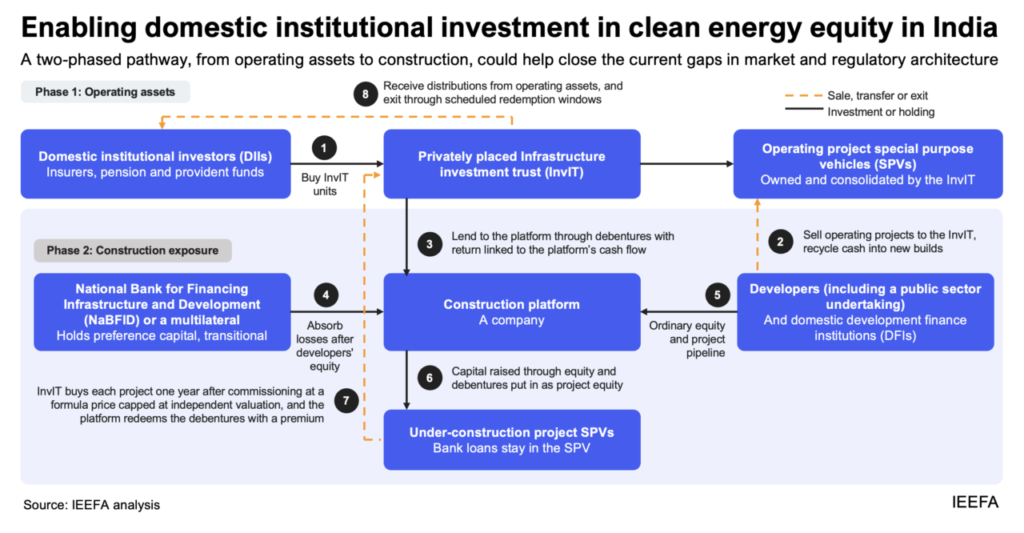
Under the proposed model, InvITs would acquire operational solar projects from developers, while DIIs would provide capital by investing in InvIT units. Developers could then deploy the proceeds from asset sales towards new projects.
“InvITs can facilitate capital recycling by acquiring operational solar projects from developers, with DIIs providing capital by investing in InvIT units, allowing developers to reinvest the sale proceeds in new capacity,” the analyst said.
Furthermore she said that scaling this model would require privately placed, exchange-listed InvITs with minimum credit ratings of AA, sufficient operational assets to generate predictable cash flows and regular distributions to investors.
The proposed structure would also need redemption windows at fixed intervals to provide institutional investors with liquidity and exit options. Exits could be facilitated by matching outgoing investors with new investors, selling stakes in underlying operational projects or using available cash reserves.
Independent valuations would be required at each redemption window and following material changes affecting asset values, including tariff renegotiations and operational setbacks, to ensure that investors exiting their positions receive a fair price.
Greater DII participation through InvITs could also help developers recycle capital from operating solar projects into new capacity, reducing the need to raise fresh equity for every project.
First-loss support proposed for construction-stage projects
Extending domestic institutional investment beyond operational assets will require mechanisms to address the additional risks associated with construction-stage projects.
The IEEFA analysis proposes a transitional first-loss support mechanism through which a government-owned development finance institution (DFI), such as the National Bank for Financing Infrastructure and Development (NaBFID), or a multilateral organisation could absorb an initial portion of potential losses.
This would reduce the risks borne by DIIs investing through a pooled construction-stage investment platform.
“The mechanism is viable as a transitional measure because the perceived risks of investing at the construction stage may be higher than the actual likelihood of project failure,” Rana said.
Rana said the mechanism was viable as a transitional measure because perceived construction-stage risks could be higher than the actual likelihood of project failure.
The proposed support could initially be extended to projects with signed power purchase agreements (PPAs), while developers would remain responsible for project delivery.
As more projects are completed and establish a track record of performance, the first-loss support could be gradually reduced and eventually withdrawn, allowing domestic institutional investors to finance construction-stage projects independently.
The approach is also intended to strengthen domestic capital flows, reduce dependence on foreign equity and deepen India’s renewable energy financing market.
Smaller developers may need additional policy support
Greater domestic institutional participation could expand the pool of capital available for solar development, although the proposed financing structure is not a direct solution to the funding constraints faced by smaller developers.
Channelling DII capital through pooled investment platforms backed by a first-loss buffer could help investors build experience in construction-stage financing, reduce perceived risks and gradually lower the risk premium demanded on such investments.
However, directing institutional capital towards smaller domestic developers would require additional policy support, including appropriate investment mandates, regulatory provisions and targeted incentives to encourage financing of smaller projects.
Over time, a broader domestic institutional investment base could reduce developers’ dependence on foreign-backed investors and help retain a greater share of project development value within India.
The proposed phased approach would begin with institutional investment in operational solar assets through InvITs, followed by measured exposure to construction-stage projects supported by transitional public-sector risk-sharing mechanisms.