
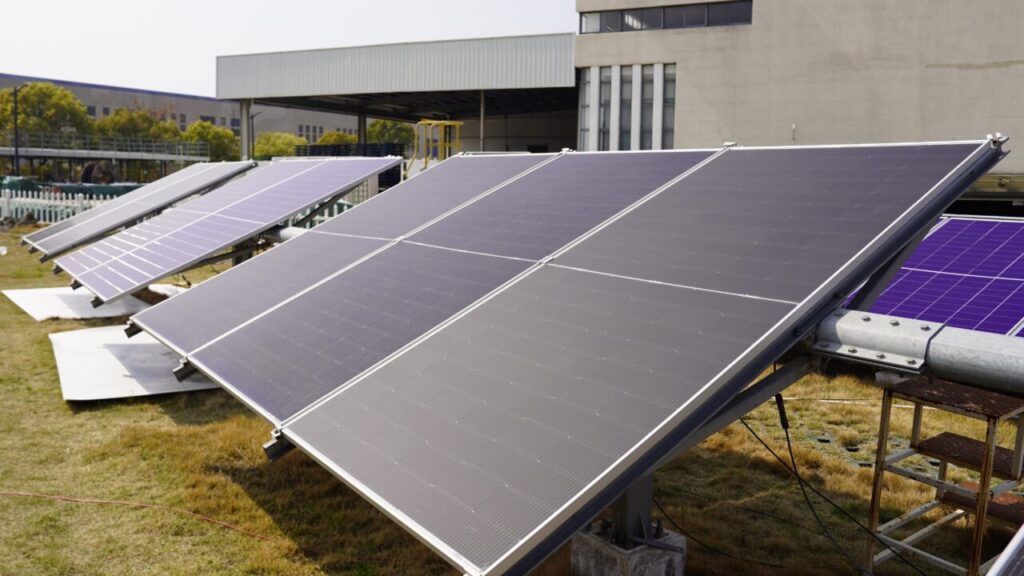
The deployment of PV power plants in traffic-sensitive areas such as airports and highways poses potential risks of component glare to flight and driving safety. For a long time, the industry has lacked unified glare assessment standards, making it difficult to quantitatively compare the performance of anti-glare products and restricting the large-scale application of photovoltaics in critical scenarios.
In 2025, the ‘Test Method for Glare Rating of Photovoltaic Modules’ (T/CPIA 0119—2025) was officially released, spearheaded by Risen Energy. This standard incorporated “glare rating” as a core metric into the standardized testing system for the first time, providing the industry with a scientific and quantifiable evaluation basis. Leveraging the Hyper-ion high-efficiency HJT technology platform and this standard, Risen systematically developed a new generation of anti-glare modules, achieving a technological leap from passively reducing reflection to actively eliminating harmful light.
Traditional anti-glare solutions mostly focus on glass surface treatment, making it difficult to avoid internal halos formed by secondary reflection from cells. Risen innovatively adopts a dual-layer optical collaborative design of “external glass diffused scattering + internal cell light absorption”, constructing a micro-scale textured structure on the glass surface, combined with a nano-scale anti-reflection coating, to achieve efficient diffuse reflection of incident light. The surface gloss is as low as 6.7 GU (60° angle), with a haze of 89%, presenting a pure matte texture that eliminates specular reflection and rainbow patterns. Targeting the surface characteristics of HJT cells, a dedicated anti-reflection and light-absorption coating is developed to significantly reduce internal reflectivity and suppress secondary halo generation at the source.
Measured data shows that the glare rating of Hyper-ion anti-glare modules is reduced by over 80% compared to traditional modules, meeting the visual safety requirements of strict scenarios such as airports. Meanwhile, the glass light transmittance reaches 93.2%. Combined with the high conversion efficiency and low temperature coefficient of the Hyper-ion HJT platform, the power generation performance remains uncompromised.
As the industry’s first anti-glare product developed based on unified standards, the Hyper-ion series has not only passed the rigorous verification of the CPIA standard ‘Test Method for Glare Rating of Photovoltaic Modules’, but also achieved a triple unity of safety, efficiency and aesthetics through systematic technological breakthroughs. Currently, this product is applicable to scenarios with extremely high requirements for light environment, such as areas surrounding airport runways, along highways and urban public buildings.
