Aiko Solar enters volume production of mono-PERC cell with 22% conversion efficiency

Facebook
Twitter
LinkedIn
Reddit
Email
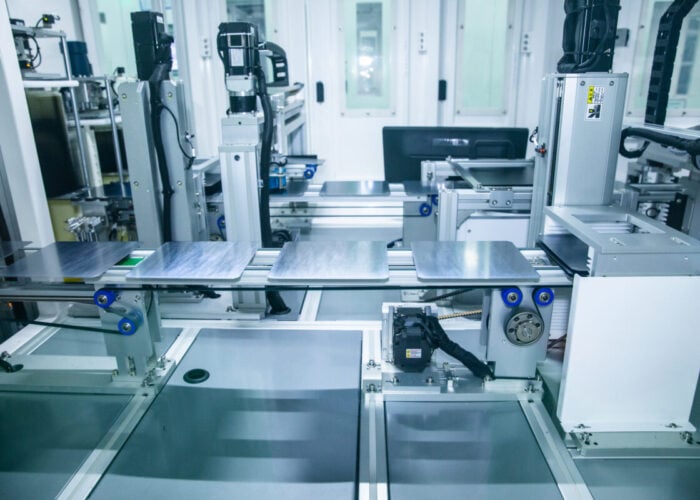
Aiko Solar has increased production cell efficiencies by 0.5% in less than a year. Image: Aiko Solar

China-based merchant solar cell producer Guangdong Aiko Solar Energy Technology Co (Aiko Solar) said that it had entered volume production of its P-type monocrystalline PERC (Passivated Emitter Rear Cell) solar cells with conversion efficiencies of 22%. 

Aiko Solar has increased production cell efficiencies by 0.5% in less than a year, having been producing mono-PERC cells with 21.5% in 2017, which increased to 21.8% in May, 2018 and 22% in September, a month ahead of schedule, according to the company. 

This article requires Premium SubscriptionBasic (FREE) Subscription

Try Premium for just $1

  • Full premium access for the first month at only $1
  • Converts to an annual rate after 30 days unless cancelled
  • Cancel anytime during the trial period

Premium Benefits

  • Expert industry analysis and interviews
  • Digital access to PV Tech Power journal
  • Exclusive event discounts

Or get the full Premium subscription right away

Or continue reading this article for free

On a PV module basis, Aiko Solar said that standard 60-cell formatted modules would achieve around 315Wp output, around a 5W increase, compared to its cells with 21.8% efficiency. In respect to 72-cell formatted modules, 375Wp performance can be expected, up from 370Wp, previously.

The company also noted that its annual nameplate production capacity had recently reached 5.5GW, including 5GW of P-type mono PERC cells (including bifacial), while retaining 500MW of high-efficiency multicrystalline solar cells. 
Read Next

September 3, 2026
In this week's PV Chart of the Week, we look at disparity between announced and operational cell and module manufacturing capacity in the US across PERC, TOPCon and HJT.
Premium
September 3, 2026
Heterojunction is emerging as the n-type technology of choice as US PV manufacturers seek to minimise IP-related risks.
September 2, 2026
In the third part of this week’s series exploring the US solar supply chain, we track how quickly announced manufacturing capacity is translating into real production.
September 1, 2026
US module production is at a near saturation point, but significant capacity gaps persist further up the supply chain, writes head of PV Tech Research, Moustafa Ramadan.
August 28, 2026
Importing solar modules to the US will “no longer make any economic sense” under new Section 232 tariffs for polysilicon-based products, according to Intertek CEA.
Premium
August 27, 2026
Domestically produced solar glass is a key gap in the US PV manufacturing ecosystem. Tom Kenning reports on efforts to kick-start local production of this vital material

Upcoming Events

Solar Media Events
October 13, 2026
San Francisco Bay Area, USA
Solar Media Events
November 3, 2026
Málaga, Spain
Solar Media Events
November 24, 2026
Warsaw, Poland
Solar Media Events
February 2, 2027
London, UK