Amid unchecked capacity expansion, rapid technological upgrades and fierce market competition, China’s PV industry is undergoing a profound restructuring. To curb the sale of substandard products driven by short-term profit motives—which pose severe safety risks such as fire hazards, electric shocks, and structural failures—China has introduced five mandatory national standards to regulate market order.
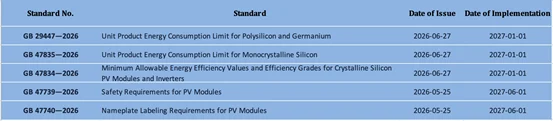
These standards are divided into two categories: PV safety and labelling, and energy consumption and efficiency. All were issued at the national level and are either in a transition period or about to be implemented. The complete list includes:
Try Premium for just $1
- Full premium access for the first month at only $1
- Converts to an annual rate after 30 days unless cancelled
- Cancel anytime during the trial period
Premium Benefits
- Expert industry analysis and interviews
- Digital access to PV Tech Power journal
- Exclusive event discounts
Or get the full Premium subscription right away
Or continue reading this article for free
- Safety Requirements for PV Modules (GB 47739-2026)
- Nameplate Labelling Requirements for PV Modules (GB 47740-2026)
- Minimum Allowable Energy Efficiency Values and Efficiency Grades for Crystalline Silicon PV Modules and Inverters (GB 47834-2026)
- Unit Product Energy Consumption Limit for Polysilicon and Germanium (GB 29447-2026)
- Unit Product Energy Consumption Limit for Monocrystalline Silicon (GB 47835-2026)
Released in May and June 2026, these standards serve as core technical guidelines for regulating market competition and optimising industrial capacity governance. Implementation will be phased. The three energy-related standards will take effect on 1 January 2027, while the safety and labelling standards will be enforced starting 1 June 2027.
Last week, the Ministry of Industry and Information Technology (MIIT) published the first batch of official FAQs addressing these standards.
Covering 17 questions across three key areas—standard applicability, core technical specifications and implementation rules—the document provides authoritative guidance on critical industry concerns. These include the disposal of existing inventory, contract fulfillment, product exports, energy efficiency calculations, nameplate traceability and regulatory spot checks, thereby establishing clear and enforceable compliance frameworks for the entire PV sector.
Interpretation of scope and technical specifications
The official FAQs clarify compliance boundaries for key scenarios, including export-grade products, decentralised PV projects, test samples and existing inventory.
In accordance with the Standardisation Law, export products may adhere to contractually agreed technical specifications and are exempt from domestic mandatory standards. However, products originally intended for export but later resold domestically must fully comply with China’s mandatory PV standards. The production and domestic sale of non-compliant products are strictly prohibited. Furthermore, all PV products deployed within China, whether for centralised or decentralised projects, are subject to the new mandatory requirements. R&D test samples, non-commercial exhibition displays and spare parts reserved for power plant maintenance are not considered marketable products and are therefore excluded from the scope of these mandatory standards.
Regarding non-compliant inventory manufactured prior to implementation, authorities emphasised that all externally sold products must meet the latest mandatory requirements once the standards take effect, regardless of their production date. Enterprises are encouraged to utilise the transition period to adjust production plans and clear existing inventory. For long-term contracts with technical specifications falling below the new thresholds, companies are advised to proactively review their agreements and negotiate adjustments with customers for contracts spanning the implementation date. Notably, even Grade B modules are subject to mandatory regulatory oversight if sold in the domestic market.
The official FAQs provide in-depth interpretations of key technical clauses, covering wafer energy consumption calculations, module mechanical load resistance, nameplate power labelling and value traceability. Specifically, regarding the monocrystalline silicon energy consumption quota, the document defines the calculation methodology for comparing full and half-cut wafers and explains the rationale behind the 0.65 secondary conversion coefficient applied to half-cut wafers. As half-wafer cutting introduces additional processing steps, its actual energy consumption is not simply half that of full wafers.
GB 47834-2026, which targets PV end products, significantly raises the market entry bar for PV modules and inverters. Crystalline silicon PV modules are classified into three energy efficiency grades, with Grade 1 representing the highest performance. The standard also establishes clear baseline entry requirements: the minimum energy-efficiency threshold is set at 23.2% for TOPCon and HJT modules and 23.5% for back contact modules. Beyond conversion efficiency, the standard introduces two critical evaluation metrics: environmental degradation resistance and bifaciality. It mandates minimum bifaciality rates of 75% for TOPCon modules, 85% for HJT modules and 70% for BC modules, comprehensively upgrading quality benchmarks for high-efficiency PV modules.
For inverters, the new standard categorises products by power rating and specifies minimum thresholds for weighted-average efficiency and maximum conversion efficiency. This provision is expected to accelerate the phase-out of low-efficiency inverters and drive high-efficiency models to become the mainstream choice for centralised PV projects.
To address the long-standing industry issue of inaccurate power labelling, the MIIT clarified that the Nameplate Labelling Requirements for PV Modules edict establishes standardised power-deviation rules, setting distinct maximum permissible power tolerances for high- and low-power modules. Additionally, the standard unifies the value traceability system for both mandatory nameplate and energy-efficiency standards, requiring full traceability to national measurement benchmarks to ensure consistent and comparable test results across different laboratories.
The document also specifies that the QR code link printed on PV module nameplates must remain accessible throughout the product’s entire service lifecycle. Any invalidated link will render the product non-compliant, with manufacturers held fully responsible for ongoing link maintenance.
Supervision and enforcement rules
The implementation and supervision chapter of the FAQs clarifies regulatory requirements for product testing and market spot checks. While the mandatory energy efficiency standards incorporate environmental stress degradation testing, manufacturers are not required to test every shipment. Instead, enterprises may determine their own testing frequencies based on internal quality control systems.
Regulatory supervision and random spot checks will be conducted hierarchically by market regulation authorities at the national, provincial, municipal, and county levels. Routine spot checks for mandatory energy consumption and energy efficiency standards will officially commence on 1 January 2027, while inspections for mandatory module safety and nameplate labelling standards will begin on 1 June 2027.
Following the official implementation dates, the production, sale and import of non-compliant PV modules, as well as the provision of non-compliant products, will be strictly prohibited.
Industry analysts note that the rollout of these five mandatory national standards aims to rectify prevalent irregularities, including substandard products, cutthroat price wars and falsified parameter labelling. In particular, the mandatory nameplate labelling standard unifies module labelling specifications and testing methodologies, enabling full-process authenticity verification and traceability of module performance data. This mechanism is designed to curb misleading marketing practices, foster a high-quality, value-based pricing ecosystem, and support the PV industry’s high-end transformation and orderly capacity governance.