Researchers from the Georgia Institute of Technology have developed n-type tunnel oxide passivated contact (TOPCon) solar cells that use copper paste instead of silver with a maximum conversion efficiency of 24.3%.
The paper, ‘Characterization of 24.3% screen-printed Cu-contacted n-type tunnel oxide passivated contact solar cell with laser enhanced contact optimization’, was published in the journal Solar Energy. The researchers, led by PhD student Ruohan Zhong, produced the solar cells using a prototype copper paste developed by Kentucky-based Bert Thin Films, which can be deployed using “standard industrial screen-printing and firing equipment”, according to the academics.
Try Premium for just $1
- Full premium access for the first month at only $1
- Converts to an annual rate after 30 days unless cancelled
- Cancel anytime during the trial period
Premium Benefits
- Expert industry analysis and interviews
- Digital access to PV Tech Power journal
- Exclusive event discounts
Or get the full Premium subscription right away
Or continue reading this article for free
Cells that used both silver and copper delivered an efficiency of less than 20% without an optimisation process, and both were subjected to laser-enhanced contact optimisation (LECO) to push efficiencies over 24%. Research from the University of Oxford last year found that the use of the LECO process in the production of TOPCon cells, in particular, could improve the performance of these cells by “orders of magnitude”.
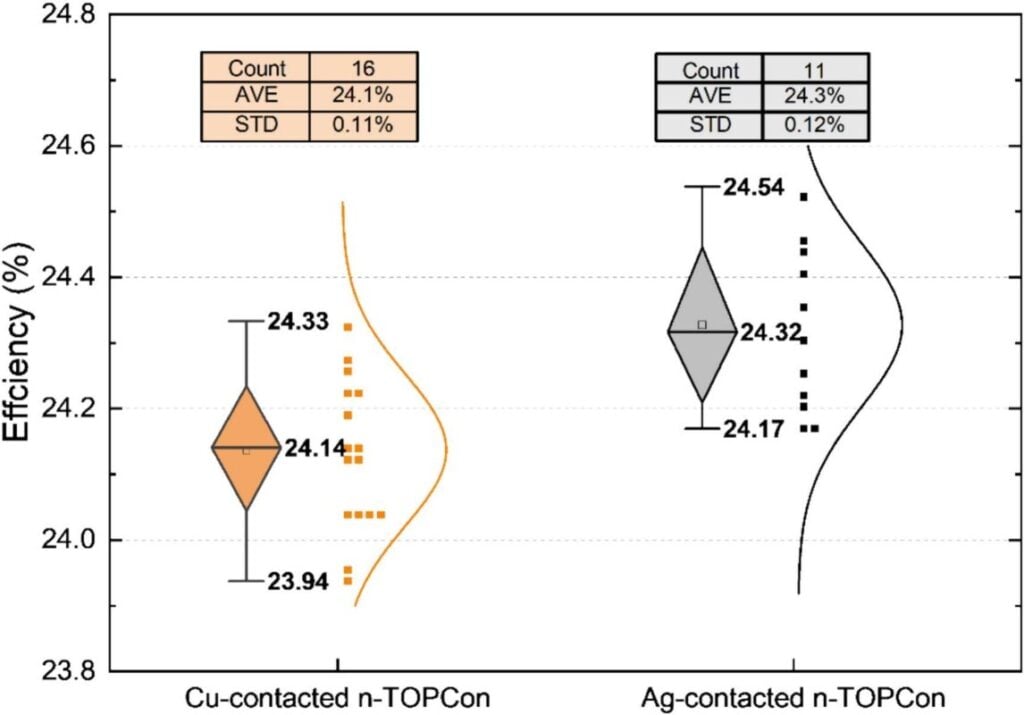
The cells made using copper paste delivered an average conversation efficiency of 24.14%, with the highest efficiency reported at 24.33% and the lowest at 23.94%. This is comparable, albeit slightly lower, than the range of efficiencies for the cells that use silver paste, which returned a maximum value of 24.54%, an average value of 24.32% and a low value of 24.17%. These results are shown in the graph above.
The cells were also tested by the National Laboratory of the Rockies (NLR), which yielded slightly higher conversion efficiencies than the in-house testing, but with the same trend. The NLR tests showed the silver paste cells to have an efficiency of 24.6%, while the copper paste cells had an efficiency of 24.4%.
Minimising the impact of high silver prices
The results show that the cells using silver had a generally higher conversion efficiency, due to the lower contact resistivity of silver. This is no surprise, and so to improve the efficiency of the cells that used copper to the maximum efficiency of 24.3%, the researchers increased the coverage of copper on those cells from 7% to 18%.
While this does mean that a comparable cell would need more copper than silver to reach similar efficiencies, the fact that the average silver price is around 145 times that of copper means this replacement is viable.
Indeed, silver prices have increased considerably in the last year—going up 147% in 2025 to reach a peak of 288 times the price of copper in January 2026—and the Georgia Tech report begins with a description that high silver prices have encouraged “efforts to reduce metallisation costs”, which includes the replacement of silver. Zhong, whose paper won an award from the Institute of Electrical and Electronics Engineers (IEEE) in August, said that her research could “help make solar panels more affordable”.
“This will help make solar panels more affordable and accelerate the transition to clean energy,” said Zhong, upon winning the award for best student paper at the 54th IEEE Photovoltaic Specialists Conference. “This innovation also greatly simplifies the manufacturing process and brings copper electrodes closer to large-scale industrial solar cell production.”
This year, silver recycling has been touted as an alternative to replacement to reduce reliance on expensive silver products in cell production.
Scientists from the University of Newcastle in Australia developed a pilot programme to recover nearly 100% of the silver found in end-of-life PV modules, and a report from the International Energy Agency Photovoltaics Power Systems Programme (IEA PVPS) concluded that more robust recycling methods of critical minerals, such as silver, would be “key” to sustainable growth in the solar industry.
Innovations in cell design will be a topic of conversation at our annual PV CellTech USA conference in San Francisco on 13-14 October. The event covers the full US solar supply chain, from polysilicon to modules, and will tackle topics including the current policy landscape and the opportunities for US cell manufacturers. For full details and booking, click here.