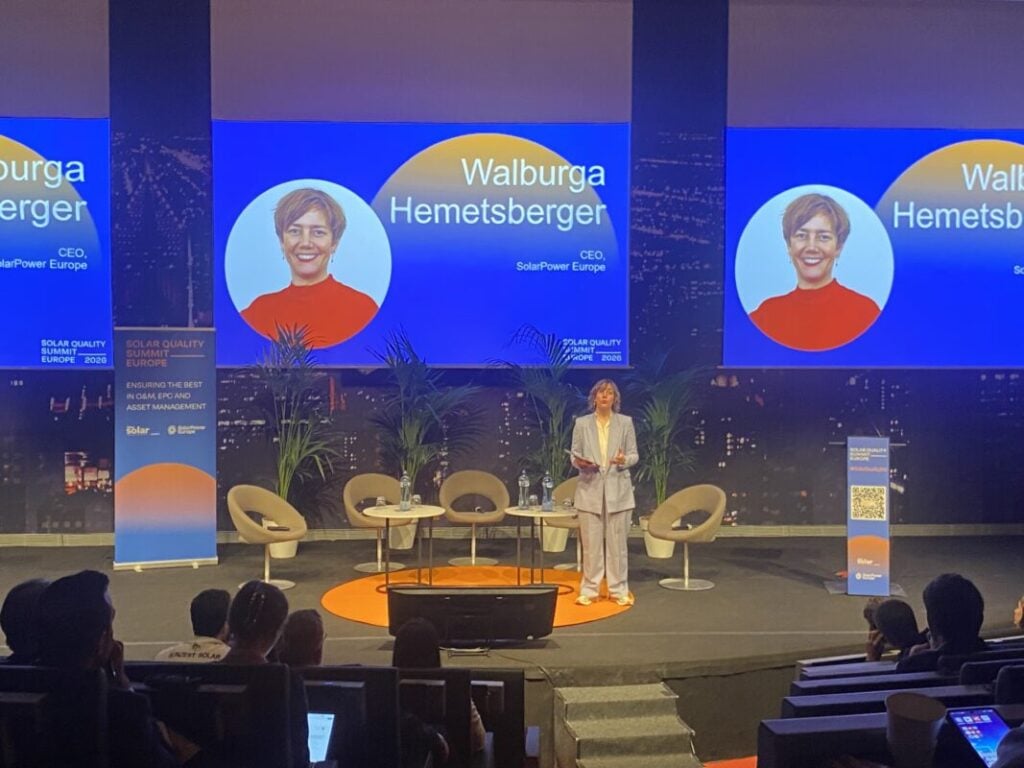
There is ‘no way around AI’ for solar companies or Europe’s solar industry as a whole, according to Walburga Hemetsberger, CEO of SolarPower Europe.
Hemetsberger chaired the opening panel of the Solar Quality Summit in Barcelona, which focused on the opportunities and risks of AI in European solar PV. The discussion saw representatives of IPPs, technical consultancies and other European PV firms broadly enthusiastic about the integration of AI into the solar industry.
Try Premium for just $1
- Full premium access for the first month at only $1
- Converts to an annual rate after 30 days unless cancelled
- Cancel anytime during the trial period
Premium Benefits
- Expert industry analysis and interviews
- Digital access to PV Tech Power journal
- Exclusive event discounts
Or get the full Premium subscription right away
Or continue reading this article for free
In opening remarks, David Moser, managing partner at the Becquerel Institute, said his main message to the industry was: “Are you ready for AI?” Moser leads the Becquerel Institute’s AI programme from its Italian offices.
There was broad support for AI models and integration in solar among the speakers and the audience at the conference, with particular focus and excitement reserved for the way that new technology could provide hitherto untold operational and financial efficiencies. A video package at the start of the discussion saw speakers expecting AI modules to allow them to streamline data collection from PV plants and handle the ever-increasing volume of information that flows from heavily digitised PV and BESS systems.
The growth of analytics and granular data from PV systems is well-known by now, and speakers on the panel – including Moser, Hemetsberger, Gofran Chowdhury, head of innovation at 3E, Alessandra Ferrara, technical manager at WiseEnergy and Alvaro Garcia, head of asset management at Velto – accepted that bringing AI models into the collection, consolidation and analysis of data will soon – if not already – be an operational necessity for European PV firms to remain competitive. In fact, the event hosts ran a poll among the audience asking what they expected to use AI for most in their jobs – data analysis was the top answer.
But this competitiveness comes down to the quality – and quantity – of the data fed into AI models. “Data quality is key,” said Ferrara, adding: “We need to trust AI outputs,” both in where and how their data and conclusions arise. This is because AI models rely entirely on already available historical data to produce conclusions or analysis.
“If you do not have enough data sets, AI is not God,” added Chowdhury. It cannot create data sets or arrive at analyses independently.
As Garcia had it: “Garbage in, garbage out.”
But there are significant risks inherent in Europe’s adoption of AI in its solar industry, which range in severity. Moser said that the pace of change and AI adoption in Europe is slower than in other regions, which could become a problem for solar companies developing or deploying AI models; they may spend massive amounts of time and money on a model, only for it to be developed faster and cheaper by someone else in another part of the world. Chowdhury called for more “hungry entrepreneurs” in Europe, looking to develop innovations and scale AI.

As well as slower progress, Moser said that there is a lack of ‘native’ AI development in Europe, which has left the continent’s AI infrastructure is currently in the hands of “Made in the US models and algorithms.” As geopolitics shifts and the US seems to turn away from Europe, as per its National Security Strategy, reliance on US tech companies and platforms – some of which are aligned or enmeshed with the US government to varying extents – could make things complicated for European companies.
This reliance also raises the issue of liability in the case that a problem arises, Moser explained, whether that is a data error, system failure or something more severe. “One of the biggest risks is liability; if something happens, who is liable?”
The final risk, which could be a major shift for the solar industry, is the impact of increasing AI and automation on jobs in the sector. Answering another poll, the audience at the Summit said they expected their operations to be between 40%-75% automated by 2030, which, on the surface, could mean cutting up to three quarters of the jobs in the sector.
This is a “very difficult element to address”, Moser said. Speaking to PV Tech after the panel discussion, he said that if Europe’s solar market is stagnant, jobs will be lost, but that if it expands that loss could be mitigated. While overall solar capacity will grow, 2025 marked the first time in a decade that Europe’s solar market contracted year-on-year. SolarPower Europe expects that to continue for another two years, and 2025 installation levels are not expected to return until 2030.
Over the same period, automation and AI integration will not slow down. Some companies are even trialling automated plant construction, which has traditionally been the most labour-intensive part of the solar industry. Moser suggested that the issue will ultimately fall at the feet of individual companies to decide their levels of automation and how to treat their employees – will ‘non-essential’ staff be reskilled, or let go?