Two organic photovoltaics development companies have taken steps forward on the road to commercialization. Ten Plextronics’ test modules have been deployed at the National Renewable Energy Laboratory for outdoor monitoring and performance testing–the first set of OPV modules under sun at NREL–while Solarmer Energy has won a $450,000 contract from the FlexTech Alliance to design and synthesize high-efficiency donor polymer materials for OPV uses.
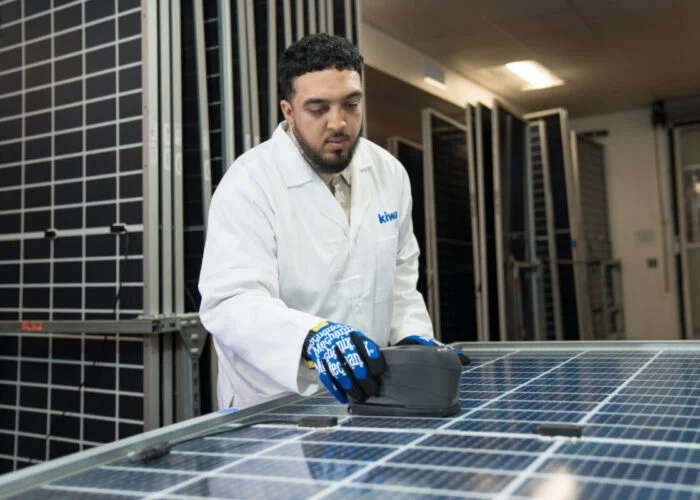
The Plextronics test modules, which were created using the company’s Plexcore PV ready-to-use printed electronics ink system, are installed on the roof of NREL’s outdoor test facility. The performance of the test modules will be continuously monitored and compared with identical modules being tested in Pittsburgh (the company’s hometown) as well as with other modules under sun at the national lab.
Try Premium for just $1
- Full premium access for the first month at only $1
- Converts to an annual rate after 30 days unless cancelled
- Cancel anytime during the trial period
Premium Benefits
- Expert industry analysis and interviews
- Digital access to PV Tech Power journal
- Exclusive event discounts
Or get the full Premium subscription right away
Or continue reading this article for free
The data over the next few months will be used to improve outdoor stability of the company’s OPV technology, paving the way for testing more modules, refining the method, and building an outdoor performance database and refinement of the method, according to Plextronics.
“Our customers want to understand the real-world performance of our solar technology, and this testing with NREL will allow us to provide them those data,” said CEO Andy Hannah.
Bolko von Roedern, senior project leader at NREL and Plextronics’ technical monitor for the PV Technology Incubator award that the company won in 2007, said that the company’s achievements “made in working on the incubator program have allowed us to take this next step with outdoor testing. I expect this kind of testing will be able to help move OPV technology generally closer to commercialization.”
Discussing Solarmer’s award from the FlexTech Alliance, MIke Idacavage, principal research fellow at Cytec Industries and a member of the alliance’s technical council, noted that “although the efficiency of OPVs is low compared to other solar cells, Solarmer’s development work will enable the industry to address this challenge in order to deliver the necessary higher efficiency devices.”
“The technical approach for this project builds on a design to synthesize new active layer materials that can be used in polymer solar cells,” he continued. “This new generation of active materials is targeted to deliver improved key properties, such as a low band gap, appropriate molecular energy levels, good mobility, and excellent processability.”
Gang Li, Solarmer’s VP of technology development, pointed out that “the current state-of-the-art efficiency for OPV is ~6.8% for lab-scale cells and 3.9% module efficiency for 6 x 6 square-inch modules. We plan to demonstrate high-performance OPVs with efficiency up to 8% for lab-scale cells, and up to 6% efficiency for 6 x 6 square inch solar panels, an over 30% improvement.”
Although OPV products have just begun to enter the commercial realm and have reliability, lifetime, and efficiency hurdles to overcome, the technology’s supporters cite many advantages over most other solar cell technologies.
These include broader color range and tunability, better performance in low intensity and indirect light, low raw material costs and consumption, high materials utilization, light weight, ease of manufacturing through high-throughput printing and coating processes, nontoxic materials used in manufacturing, easy scalability, and very low initial capital investment.