OTB Solar and Arise Technologies say they have made “significant progress” in the development and deployment of OTB’s inkjet deposition-based single-pass selective emitter process, in combination with a conventional diffusion furnace, to produce high-efficiency silicon-based photovoltaic cells. The process enables the deposition of the area emitter and selective emitter dopants in a single-pass sequence, thus reducing and eliminating the need for additional costly emitter forming equipment, processes, and materials.
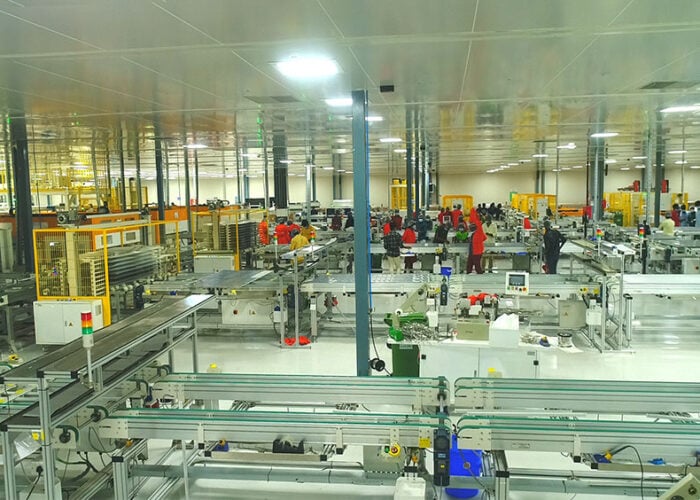
The emitter-forming process under development at OTB Solar’s Eindhoven Technology Center and Arise’s PV cell production fab in Bischofswerda, Germany (pictured), uses OTB’s industrial-scale Elements inkjet printing deposition platform, which can be adjusted toward the different throughput requirements of cell makers.
Try Premium for just $1
- Full premium access for the first month at only $1
- Converts to an annual rate after 30 days unless cancelled
- Cancel anytime during the trial period
Premium Benefits
- Expert industry analysis and interviews
- Digital access to PV Tech Power journal
- Exclusive event discounts
Or get the full Premium subscription right away
Or continue reading this article for free
“Recent developments indicate that a significant improvement in cell effect can be attained by way of a single-pass selective emitter process,” says OTB Solar CEO Paul Breddels. “The process is simple, cost effective and can be easily integrated into existing cell production operations.”
Ian MacLellan, vice chairman and president of Arise’s systems division and corporate CTO, explains that the Waterloo, Ontario-based company has “been looking at various selective emitter approaches and like this one because it is simpler to implement in production while keeping existing throughput on our production lines.
“These low-volume results also demonstrate that we can implement this technology on our existing production lines,” he continues. “We look forward to working with OTB to develop a high-volume solution to complement our strategy of a step-by-step approach to delivering on our high-efficiency program for our customers and shareholders.”
Earlier this year, OTB Solar finished installing a turnkey inline cell production line at Arise’s factory in Germany. The equipment company also had a high-throughput inkjet printing toolset installed at Innovalight’s fab in Sunnyvale, CA—said to be the first industrial-scale IJP system of its kind in a solar PV facility.