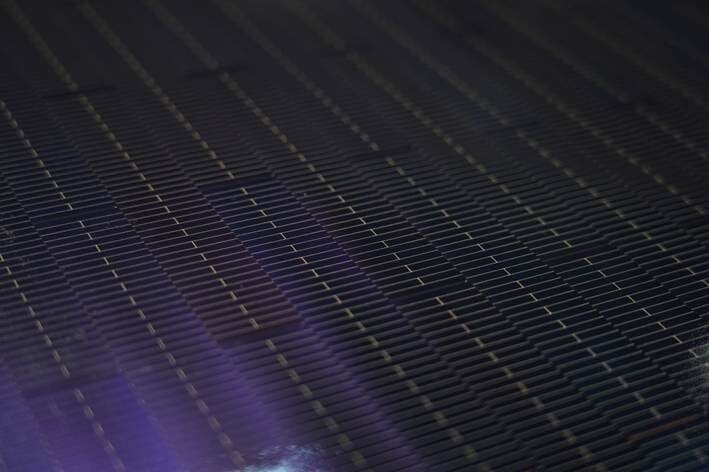
Perovskite PV specialist Oxford PV and German research institute Fraunhofer ISE have unveiled a new module prototype combining Oxford PV’s tandem perovskite-silicon cells with Fraunhofer’s matrix shingle interconnection technology.
Ahead of Intersolar Europe in Munich next week, where the new design will be showcased, the two organisations said they had achieved a 25.6% efficiency across two prototype versions of the module.
Try Premium for just $1
- Full premium access for the first month at only $1
- Converts to an annual rate after 30 days unless cancelled
- Cancel anytime during the trial period
Premium Benefits
- Expert industry analysis and interviews
- Digital access to PV Tech Power journal
- Exclusive event discounts
Or get the full Premium subscription right away
Or continue reading this article for free
Stefan Glunz, head of photovoltaics at Fraunhofer ISE, explained that in the new design, Oxford PV’s tandem cells are cut into shingles, electrically connected using conductive adhesive and encapsulated. The tandem modules are glass-glass with edge sealing to protect the moisture-sensitive solar cells.
“We are delighted to be able to combine two high-tech approaches from Europe in this PV module,” added Glunz.
Ed Crossland, chief technology officer at Oxford PV, highlighted the two organisations’ complementary technologies. “Our tandem technology and the shingle interconnection work well together technologically,” he said. “Due to the lower current densities of the perovskite-silicon solar cells, they can be cut into wider strips, which increases productivity.”
Crossland explained that tandem solar cells achieve higher voltages and efficiencies than conventional cells, while the current is lower due to its distribution across two sub-cells. This lower current density helps reduce resistive losses within the PV module.
“At the same time, the adhesive interconnection of the Matrix shingle technology is a low-temperature process and requires no copper connectors,” he added. Reducing the usage of copper connectors can reduce operating costs and reduce stresses in the module construction.
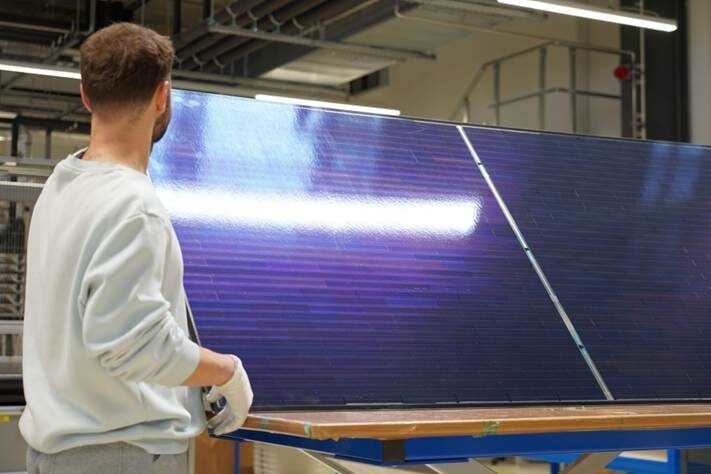
The new design has been deployed in two prototype modules—a 491W rooftop version with an area of 1.92 square metres and a 546W bifacial model covering 2.13 square metres. Both achieved an efficiency of 25.6% across the entire module area, the organisations said.

In resnpose to a question from PV Tech, Crossland said the prototype module had been constructed in a way “fully compatible with mass production”.
“Oxford PV’s HyPERcell cell technology is compatible with multiple interconnection approaches. Our current released product is 25% with a ten-year lifetime but continual improvements in production cell and module technology will deliver our roadmap of 27% with a 20-year lifetime in 2027, independent of module design. We will release a product with 26% efficiency this year,” he said.
Tandem modules combining perovskite and especially silicon PV technologies are widely seen as the next evolutionary leap in the solar technology roadmap. Adding a perovskite layer to a silicon cell can significantly boost conversion efficiency beyond the theoretical limits of silicon-only cells. Oxford PV has been a leading actor in developing tandem technology and moving it towards commercial deployment through its pilot production facility in Brandenburg an der Havel, Germany.
Fraunhofer’s Matrix Shingle technology bonds solar cell strips together with electrically conductive adhesives in an overlapping, staggered pattern like roofing shingles. This enables complete coverage of the entire module surface and high tolerance to partial shading. The matrix arrangement allows current to flow around the shaded areas, resulting in up to twice the power to be generated compared to conventionally connected PV modules, depending on the level of shading, Fraunhofer said.
The new PV modules were developed as part of the ‘HoTSun’ research project, funded by Germany’s Federal Ministry for Economic Affairs and Energy. Both will be on display in Munich next week.
Innovations in solar cell design will be a topic of conversation at Solar Media’s PV CellTech USA Conference in San Francisco, on 13-14 October 2026, with a session on trends in global cell research and development on the first day of the event. Read the full agenda here and book tickets on the event website.