Many companies working in the Australian utility-scale solar sector are exploring opportunities to integrate agricultural production into projects, writes Lucinda Tonge, a senior policy officer at the Clean Energy Council.
With France’s rooftop and ground-mount solar tenders featuring a sub-family for agrivoltaics, Xavier Daval of France Agrivoltaïsme details routes to market for new projects.
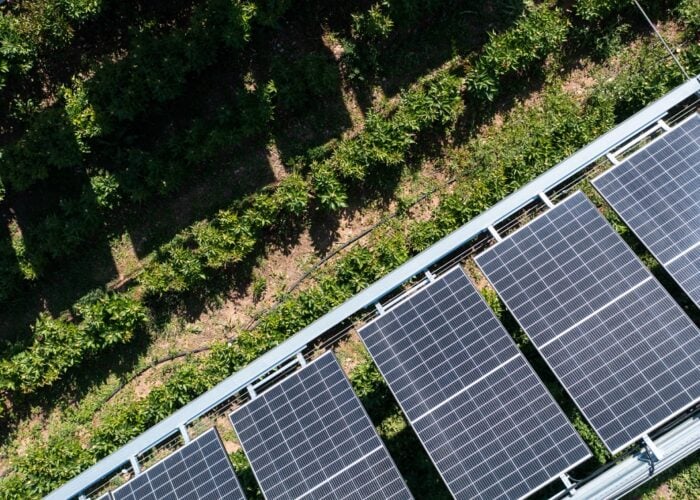
In general, solar panels mounted over vegetation demonstrate surface temperature drops compared to arrays mounted over bare ground due to evapotranspiration from vegetation.
To make agrivoltaics a widely available option for developers in the US, questions about cost, liability and other business, legal and regulatory issues need to be addressed, writes Michele Boyd of the US Department of Energy’s Solar Energy Technologies Office.
This article will cover both the rooftop and large-scale PV segments in more detail, with the shift from net-metering to net-billing and the stagnancy over pricing in large-scale auctions.
Max Trommsdorff of Fraunhofer ISE and Jens Vollprecht, a lawyer at Becker Büttner Held, detail the legal aspects of agrivoltaics deployment in Germany.
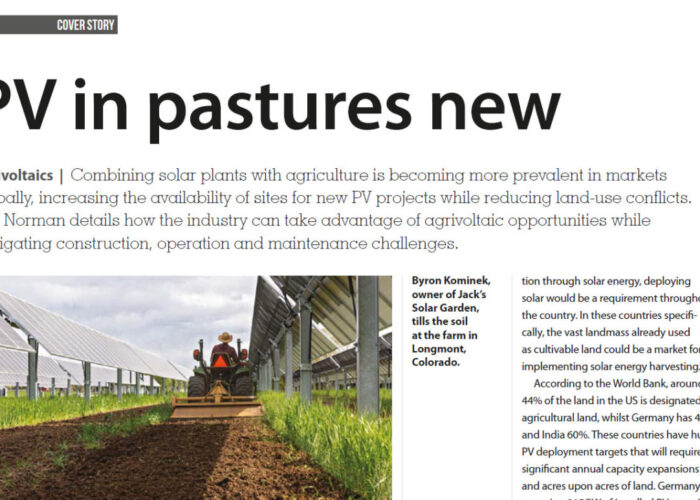
Combining solar plants with agriculture is becoming more prevalent in markets globally, increasing the availability of sites for new PV projects while reducing land-use conflicts. Will Norman details how the industry can take advantage of agrivoltaic opportunities while navigating construction, operation and maintenance challenges.
With just 2GW of solar installed at the end of 2019, Poland has seen a meteoric rise towards becoming the third largest solar PV market in Europe in terms of installations.