Sineng Electric has introduced a new central distributed inverter for bifacial solar modules. Bifacial modules are expected to become a leading force in the industry due to the significant improvement in energy yields and reduction in cost but their high-performance characteristics are not served well with current inverter technologies.
Problem
Try Premium for just $1
- Full premium access for the first month at only $1
- Converts to an annual rate after 30 days unless cancelled
- Cancel anytime during the trial period
Premium Benefits
- Expert industry analysis and interviews
- Digital access to PV Tech Power journal
- Exclusive event discounts
Or get the full Premium subscription right away
Or continue reading this article for free
Bifacial Solar modules not only collect sunlight on the side facing the light source, but they also collect light on the back side that is reflected from the surface beneath the solar panel and from the environment. Bifacial modules can generate an additional yield between 10 to 30%, compared with mono-facial modules. However, due to the increased current of each string and serious string mismatch, bifacial modules do not always perform perfectly due to the limitations of traditional inverters when light conditions are optimal.
Solution
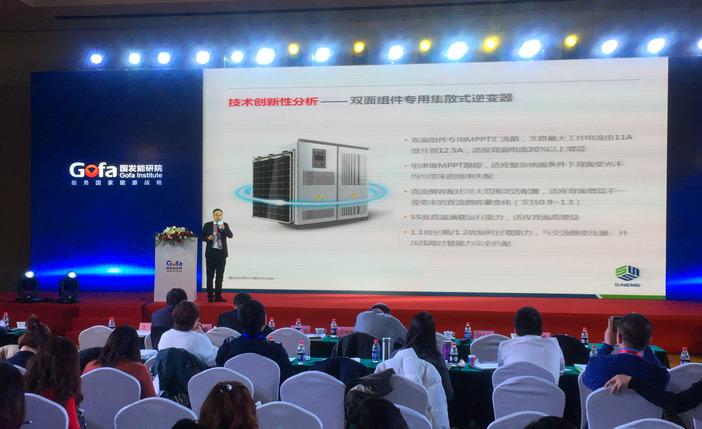
With the higher yields and lower system costs, Sineng Electric's central distributed inverter system (with multi MPPT inputs) has been widely applied in various scenarios. The new central distributed inverter comes equipped with the MPPT combination box designed specially for bifacial modules, capable of supporting an increase in the maximum operating current up to 12.5A and a current gain of over 30 percent on the back side of the panel. The string-level MPPT technology solves issues related to string mismatch caused by an uneven exposure to light on the back side, despite the complex conditions of the surface beneath the solar panel. The power-capacity ratio on the DC side supports extensive and flexible configurations and adapts to the change in capacity (0.9 – 1.3) on the DC side, which is caused by the difference in current gain on the back side.
Applications
Utility-scale PV power plants specifically using bifacial modules.
Platform
The unit is capable of operating at full capacity at 55 degrees C and addresses the issues related to the high current gain on the back side. In addition, the ability to handle long periods of 1.1X and short periods of 1.2X overload capability evenly matches the overload capabilities of the AC-side transformer and boost circuit. The power supply for the tracking bracket integrated with the delivery system delivers a cost-effective combination of a tracking bracket and bifacial solar modules.
Availability
February 2018 onwards.