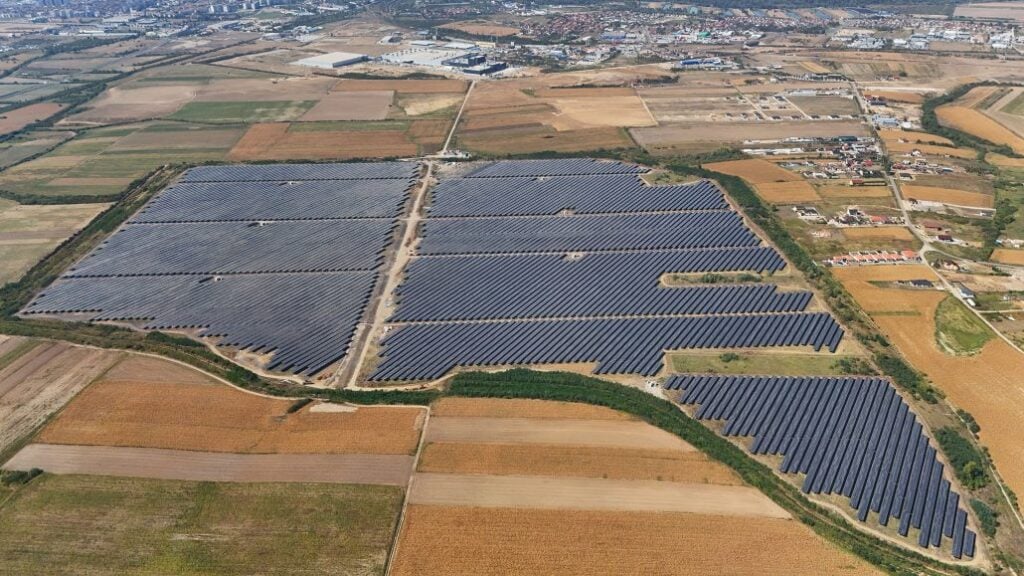
For an investor buying Romanian solar, the most useful comparison may be between an existing project and the time and capital needed to develop an alternative. Romania’s new grid-capacity allocation process makes that comparison more tangible.
My view is that projects with valid grid rights and a credible route to near-term operation deserve particular attention. Their value lies in the development time they can save and the uncertainties they have already resolved.
Try Premium for just $1
- Full premium access for the first month at only $1
- Converts to an annual rate after 30 days unless cancelled
- Cancel anytime during the trial period
Premium Benefits
- Expert industry analysis and interviews
- Digital access to PV Tech Power journal
- Exclusive event discounts
Or get the full Premium subscription right away
Or continue reading this article for free
A large pipeline does not mean easy replacement
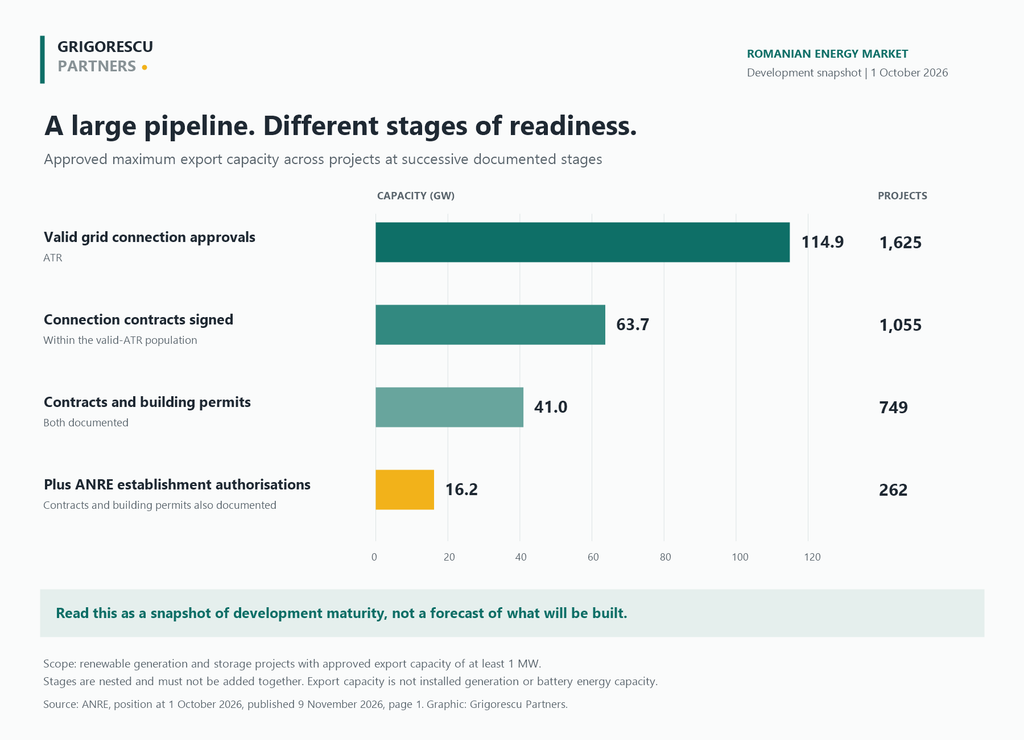
An October 2026 report from ANRE, Romania’s energy regulatory authority, records 114.9GW of approved maximum export capacity across renewable energy projects with valid grid connection approvals. Within that pipeline, 41.0GW had connection contracts and building permits; 16.2GW also had ANRE establishment authorisations.
These are development-stage figures covering renewable generation and including storage, with approved export capacity of at least 1MW. They do not represent operating plants or committed construction.
The volume of existing approvals should therefore be read alongside the conditions facing new entrants. Buying an existing project and securing fresh capacity can involve very different timetables and financial commitments.
For developers, this makes preserving existing rights a commercial priority. For investors, it creates a reason to look beyond portfolio size and examine the quality of individual opportunities. The most attractive project may be the one with fewer unresolved dependencies, even where another offers more megawatts for the same initial payment.
New capacity has a date and a price
Romania has introduced competitive grid-capacity allocation under ANRE Order 53/2024, as amended. The framework applies to defined categories of new projects and expansions at or above 5MW, subject to its scope and transitional rules. Transelectrica, Romania’s national electricity transmission and system operator, announced auction sessions starting on 30 October 2026.
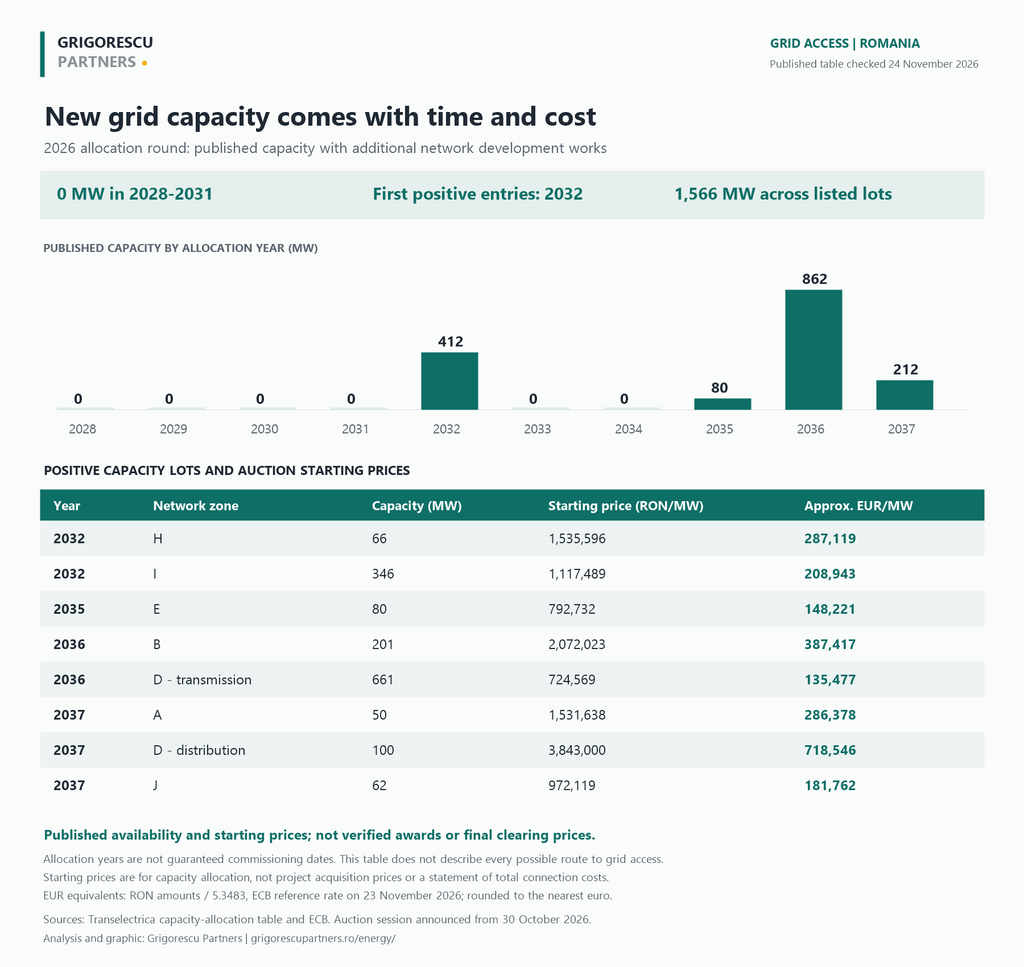
Its published table for capacity requiring additional network development shows zero capacity for 2028-2031. The first positive entries are 412MW in 2032, followed by 80MW in 2035, 862MW in 2036 and 212MW in 2037.
The 2032 lots have starting prices of RON1,117,489–1,535,596/MW (approximately €209,000–287,000/MW or US$228,811-314,420). Across all positive lots, starting prices range from approximately €135,000 to €719,000/MW. Euro equivalents use the ECB reference rate of RON5.3483/EUR on 23 November 2026.
These are published availability and starting prices, not verified auction awards or final clearing prices. They are capacity-allocation prices, rather than project acquisition values or all-in connection costs. The table is specific to this process and does not establish that every other connection route is closed.
Even with those qualifications, the comparison matters. An investor seeking earlier operation should examine the cost of waiting for new capacity alongside the price of acquiring a viable existing project. Later allocation years also bring exposure to future equipment costs, market prices and financing conditions. The practical comparison is therefore between two complete investment programmes. An acquisition requires a purchase price and remaining development expenditure. A fresh development requires its own grid-access budget, development spending and time before revenue. Both should be assessed against the same return requirements and realistic delivery assumptions.
Existing rights can support a premium
That does not give every valid grid approval an automatic premium. The buyer needs to establish what the approval supports, whether its conditions remain satisfied and which network works still stand between acquisition and revenue.
In our Romanian energy transaction work, this is where legal status and commercial value meet. An existing project is more compelling when the investor can substantiate its operating date, export capability and remaining expenditure.
A project whose solar equipment can be completed before the network works needed for full export may still carry significant timing risk. A smaller project with a clearer connection programme could offer a better investment, even at a higher acquisition price per megawatt.
The seller’s asking price should therefore be tested against an alternative development route, adjusted for time, capital committed and execution risk. Published allocation prices provide a useful reference, but cannot be treated as a direct valuation formula.
The premium is strongest where existing rights translate into demonstrable savings or earlier cash flow. Buyers should quantify that advantage under both their base case and a delayed commissioning scenario before accepting it in the price.
Power prices and storage still determine returns
Earlier grid access has value only if the operating economics work. OPCOM reported a volume-weighted day-ahead price of RON1,265.96/MWh (€237.19/MWh) in October 2026, compared with RON917.36/MWh (EUR 174.35/MWh) in September. The euro figures are OPCOM’s published equivalents.
These whole-market averages do not establish a solar plant’s achievable selling price. Acquisition models should test generation-weighted revenue, balancing costs and the delivery profile and counterparty quality of any power purchase agreement.
Storage may improve the investment case by changing when electricity is sold or enabling other services. Its value depends on charging permissions, export limits, dispatch arrangements and revenues after losses, degradation and operating costs. A battery added to a presentation should not be valued as an operating opportunity until that route is evidenced.
The same discipline should shape acquisition terms. Buyers can accept some remaining development work, with responsibilities clearly assigned and payments linked to verifiable milestones. Fundamental uncertainties about grid access or deliverability may need to be resolved before ownership transfers.
Romania’s allocation figures strengthen the commercial case for protecting and completing viable existing projects. For buyers, the opportunity is to identify those that can deliver earlier, on credible costs and realistic revenues. That is a more useful measure of value than either the ready-to-build label or the headline price per megawatts alone.
Horia Grigorescu is managing partner at Grigorescu Partners, a Bucharest law firm advising investors and developers on Romanian renewable energy projects and transactions, including project acquisitions, due diligence, grid access and solar and battery storage investments.