Inverter cybersecurity is both a genuine structural risk and, in part, a vehicle for protectionism. The underlying vulnerability is real, but the policy response is moving faster and further than the technical risk alone would justify, and understanding that gap is key to anticipating what comes next.
For most of the solar industry’s history, the inverter was a commodity power-conversion box. Inverters and power conversion systems (PCS) are now networked, remotely controllable, grid-interactive devices at the heart of critical energy infrastructure. Once a device can communicate with the grid, it becomes a national security question as much as a hardware one, and regulators have recognised this faster than most of the industry expected.
Try Premium for just $1
- Full premium access for the first month at only $1
- Converts to an annual rate after 30 days unless cancelled
- Cancel anytime during the trial period
Premium Benefits
- Expert industry analysis and interviews
- Digital access to PV Tech Power journal
- Exclusive event discounts
Or get the full Premium subscription right away
Or continue reading this article for free
This article draws on data from the PV InverterTech Bankability Ratings Report, which tracks manufacturing capacity, ownership structure and headquarters location across 32 of the world’s largest inverter suppliers and underpins every regional and company-level figure referenced below.
Why inverters became a cybersecurity issue
The industry built this risk into the product by design. Remote communication, control, sensing and monitoring are the features that make modern inverters valuable, but they also make a large fleet of devices dangerous in the wrong hands. A compromised inverter fleet represents a potential lever for coordinated grid disruption rather than a conventional data breach, and framing the issue as an IT compliance matter rather than a critical infrastructure one understates the risk.
A moving definition: the wireless-to-wired expansion
The speed at which the rules change is the best indicator of where regulation is heading. The FCC’s (Federal Communications Commission) foreign-produced inverter ban, announced in July 2026, originally targeted wireless connectivity only. Within months, following input from the US Department of War, it was expanded to cover wired, Ethernet-type connections, an admission that the first version of the rule did not capture the full threat.
This has the greatest impact on utility-scale developers, who relied on wired communications on the assumption that they were the safer option. Regulators are not writing a fixed rulebook but responding to the threat as it develops, so the current compliance line is unlikely to be the final one and is expected to move again within a year.
Divergent regional responses
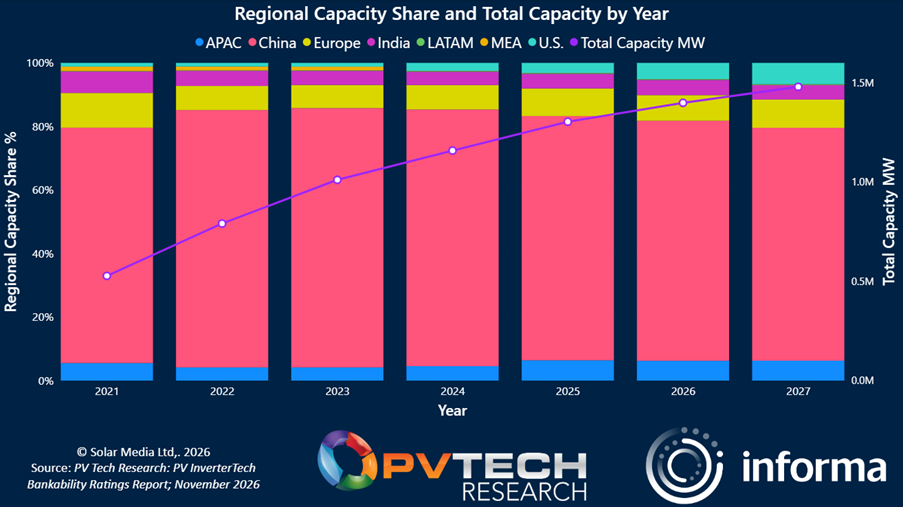
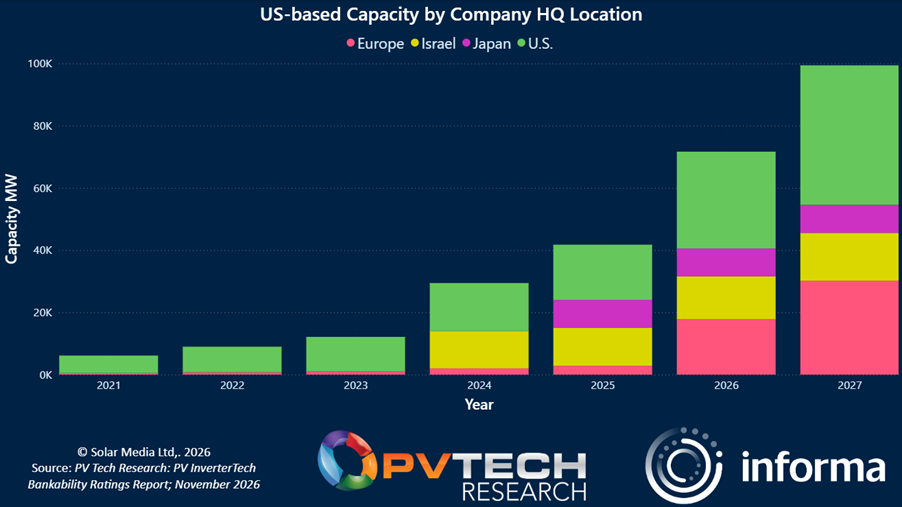
The US and the EU are addressing the same risk in different ways, largely because of differences in scale. Europe has overtaken every region outside China, reaching over 100GW of annual manufacturing capacity earlier this year, while India stands at 60GW and the rest of APAC at around 85GW. The US sits at roughly 60GW, but this figure is rising quickly and could reach 100GW by the end of 2027, which would put the US on comparable footing with Europe within two years.
The difference is therefore one of timing rather than capacity. Europe can legislate assertively because its manufacturing base already supports the policy, whereas the US is tightening policy ahead of the capacity intended to underpin it. The main risk over the next 18 to 24 months is not a long-term supply shortfall but a shorter window in which domestic capacity has not yet caught up with domestic policy. Developers sourcing during this period are likely to face the tightest conditions the US market will see, before the 2027 build-out eases the squeeze.
The US. The FCC’s approach ties risk to manufacturing location and corporate structure, reinforced by the Foreign Entity of Concern (FEOC) restrictions under the Inflation Reduction Act (IRA), which took effect on 1 January 2026 and tighten each year. However, the domestic manufacturing base is less exposed than the policy rhetoric implies.
US-headquartered companies have held the largest share of domestic capacity every year since 2021, growing from around 6GW to over 55GW by 2027, with Europe-, Japan- and Israel-headquartered manufacturers making up the balance and no Chinese-headquartered capacity in the mix. If the FCC’s aim is to close a Chinese-ownership gap in domestic manufacturing, the data suggest that gap barely exists on the production side.
The exposure the FCC is targeting sits further upstream, in imports and component sourcing rather than in the ownership of factories on US soil. The involvement of the Department of War is therefore better understood as pre-empting a vulnerability before import dependency takes root than as correcting an existing one.
European Union. Europe has arguably made the stronger structural choice by focusing on headquarters location rather than manufacturing site. This closes a loophole that a location-based model would otherwise create, as a Chinese-headquartered company manufacturing in Europe does not gain an automatic exemption simply by building locally. The European Investment Bank’s May 2026 restrictions on financing for “high-risk country” equipment, and the exclusion of Chinese-inverter projects from EU subsidies, both follow from this logic. With over 60% of European inverter imports historically sourced from China, the issue was never purely one of competitiveness, as it represented a single point of failure within critical infrastructure.
Beyond the US and EU
India is taking a different route again. The Central Electricity Authority’s Cyber Security in Power Sector Regulations, 2026, come into force on 1 April 2027 and introduce a considerably stricter statutory framework for grid-connected equipment. Bureau of Indian Standards (BIS) certification is now mandatory for all solar inverters sold domestically, and inverters benefiting from India’s rooftop solar support scheme are required to transmit data only to servers hosted within the country. With 60GW of manufacturing capacity in the dataset, India’s data-localisation requirement is a materially different lever from the US ownership-based ban or the EU’s headquarters-based financing restrictions, and may become a third model that other regions follow.
The limits of “domestic” as a security proxy
Both the US and EU frameworks rely on domestic assembly as their main proxy for security, but assembling a product domestically does not in itself make it secure. The semiconductors, capacitors and control boards most capable of enabling remote communication functions are still overwhelmingly sourced from Asia, regardless of where final assembly takes place or who owns the factory.
Sungrow’s new facility in Poland illustrates this gap on the European side. Once fully operational, it is expected to raise the Chinese-headquartered share of European manufacturing capacity from under 10% to roughly 20%, while remaining fully compliant with domestic-manufacturing rules.
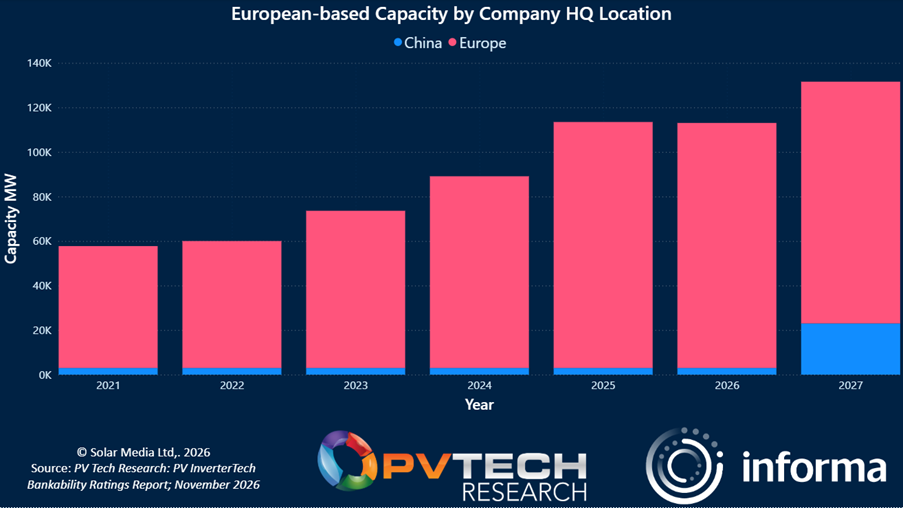
European companies will still hold roughly 80% of regional capacity after this shift, so it does not represent a crisis, but it shows that “built domestically” and “controlled independently of geopolitically sensitive suppliers” are two different tests. The US avoids this particular issue at the ownership level, with a capacity base diversified away from Chinese headquarters, but the component-sourcing question remains open on both sides of the Atlantic. Until it receives the same scrutiny as final assembly and corporate ownership, domestic manufacturing is best viewed as a necessary condition for security rather than a sufficient one.
Commercial consequences
In the near term, the cost of compliance falls on developers. New inverter and PCS models are expected to see development cycles extended by six to twelve months as compliance review is built in, with the impact greatest in BESS inverters, where technology moves fastest, and the most advanced features are more likely to sit in model generations still awaiting approval.
Developers with projects at an advanced stage face a decision between purchasing the currently grandfathered model now and waiting for a compliant next-generation product while absorbing the schedule risk. Given that the compliance bar has risen at every stage so far, procurement decisions are best built on the assumption that it will continue to do so, rather than waiting for clarity that is unlikely to arrive.
Outlook
This is likely to be a permanent feature of the market rather than a temporary adjustment that settles once approval backlogs clear. The FCC expanding its own definition within months of the original rule, and the EU tying financing and subsidies directly to equipment origin, are not the actions of regulators treating this as a one-off compliance exercise.
The EU is also continuing to evolve its approach, with proposed amendments to the Cybersecurity Act 2 that would shift the “high-risk supplier” test from a country-based approach toward a supplier-by-supplier evaluation, suggesting that even Europe’s current headquarters-location logic is a starting point rather than a finished framework.
The area still to be addressed is upstream sourcing. The US has largely resolved the ownership question in domestic manufacturing, but the semiconductor and control-board dependency beneath every “domestically manufactured” or “domestically owned” inverter has yet to be seriously tackled on either side of the Atlantic. Until it is, the industry will have addressed the most visible layer of the security problem rather than the problem itself, and upstream sourcing is where the next round of regulation is most likely to land.
Mollie McCorkindale is a senior analyst at PV Tech Research.
All data and analysis shown in this article come from our in-house market research. Full details on how to subscribe to our PV InverterTech Bankability Ratings Report can be found here.