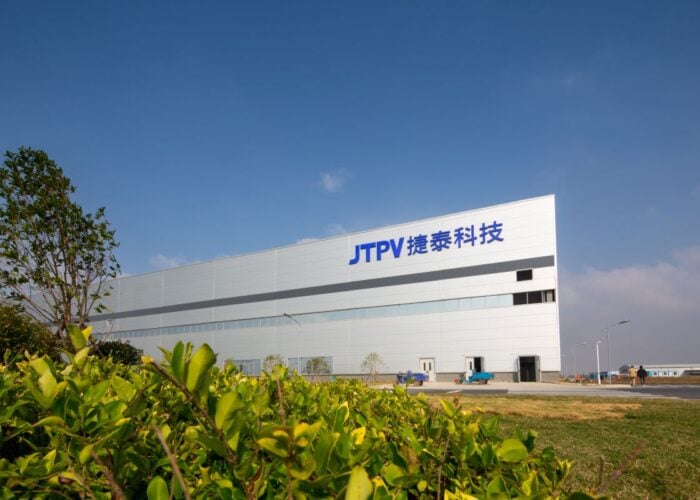

Chinese major PV producer JinkoSolar has set a new cell efficiency record of 35.24% for a TOPCon-based perovskite tandem cell.
Certified by the Shanghai Institute of Microsystem and Information Technology, Chinese Academy of Sciences, the new cell efficiency comes five months after the module manufacturer achieved a cell efficiency of 34.82% for similar tandem cells.
Try Premium for just $1
- Full premium access for the first month at only $1
- Converts to an annual rate after 30 days unless cancelled
- Cancel anytime during the trial period
Premium Benefits
- Expert industry analysis and interviews
- Digital access to PV Tech Power journal
- Exclusive event discounts
Or get the full Premium subscription right away
Or continue reading this article for free
According to the company, the cell efficiency increase was achieved by multiple core technological innovations, including selective passivation technology for textured silicon surfaces in N-type TOPCon, a perovskite multi-component crystallisation synchronisation control strategy, and nanoscale interface passivation materials and light-management enhancement technologies.
JinkoSolar added that the new cell efficiency also marks a “key progress in perovskite-silicon tandem cells’ transition from laboratory efficiency toward industrial application.” The company did not disclose details on the size of the cell.
Increasing perovskite tandem solar cell efficiency
Jinko’s latest cell efficiency achievement for a perovskite tandem solar cell is the latest in a series of companies improving the barriers of cell efficiency for tandem solar. Last year fellow Chinese solar PV manufacturer Huasun reached a 34.02% conversion efficiency for a 1cm² HJT-perovskite tandem solar cell. At the time, Huasun said was a new record for HJT-perovskite tandem products.
Over the summer, fellow Chinese major PV producer LONGi achieved a power conversion efficiency of 35.5% for a crystalline silicon-perovskite tandem solar cell, while scientists from the Helmholtz-Zentrum Berlin (HZB) and Humboldt-Universität achieved a record 25.5% power conversion efficiency for a tandem solar cell combining a perovskite top layer and copper indium gallium selenide (CIGS) thin-film bottom layer.
As solar manufacturers achieve new efficiencies in perovskite tandem solar cells, researchers have also been developing solutions to improve perovskite solar cells in recent months. This includes German researchers at the Technical University of Munich (TUM), who have identified and developed a solution to prevent weather-induced deterioration of perovskite solar cells; while researchers at Daejeon, South Korea-based Hanbat National University (HNU) developed a predictive framework that enables more precise design of 2D perovskites by separating the effects of dielectric screening from structural distortion.