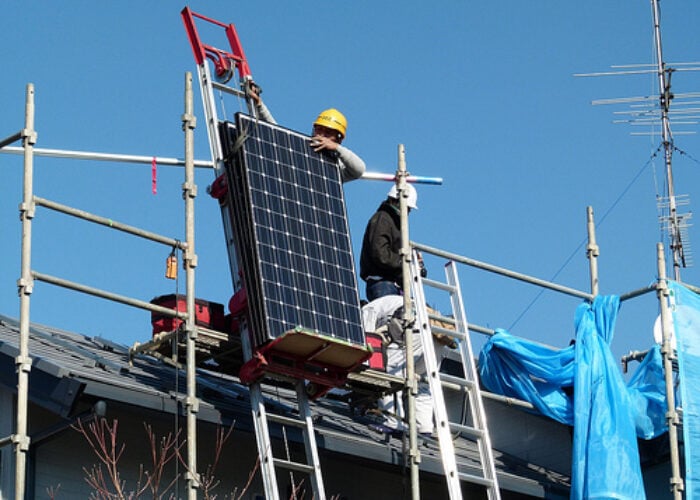
Japan installed 1,559MW of PV capacity between 1 April 2012 and 28 February 2013, according to statistics compiled by Japan’s Agency for Natural Resources and Energy and published by the Japanese Ministry of Economy, Trade and Industry.
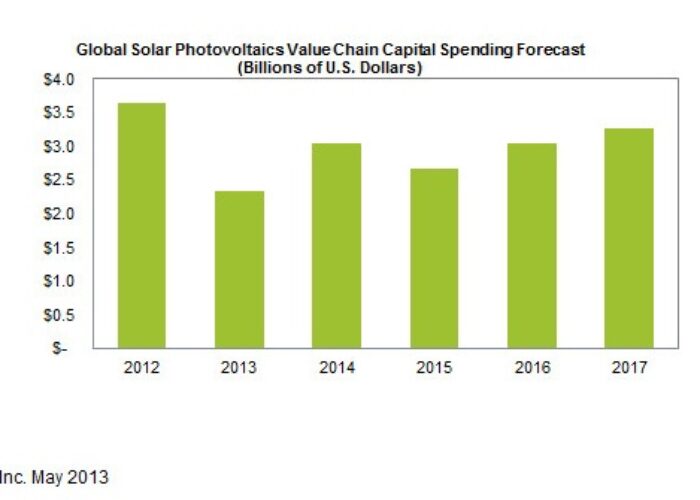
Consolidation and oversupply in the PV industry has forced capital expenditure to their lowest levels since 2006, information and analytics company IHS said this week.
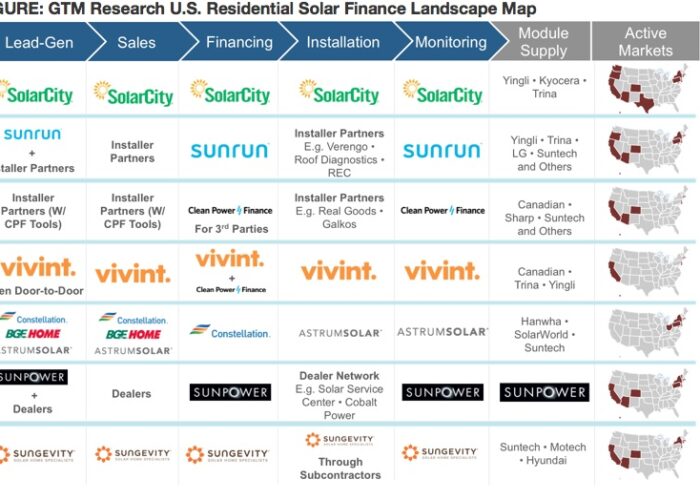
Third party leasing has become the dominant model for financing residential solar in the US. But as new sources of capital emerge and consumer confidence grows, Felicity Carus asks for how much longer this will remain the case.
A report commissioned by the group lobbying for trade duties on Chinese solar products has described claims made in an earlier study that tariffs would cost the European solar industry €27.8 billion as “highly questionable".
Leading PV energy provider (PVEP), First Solar reported first quarter revenue of US$755 million in the quarter, a decrease of US$320 million from the fourth quarter of 2012 but exceeded slightly the top range of guidance.
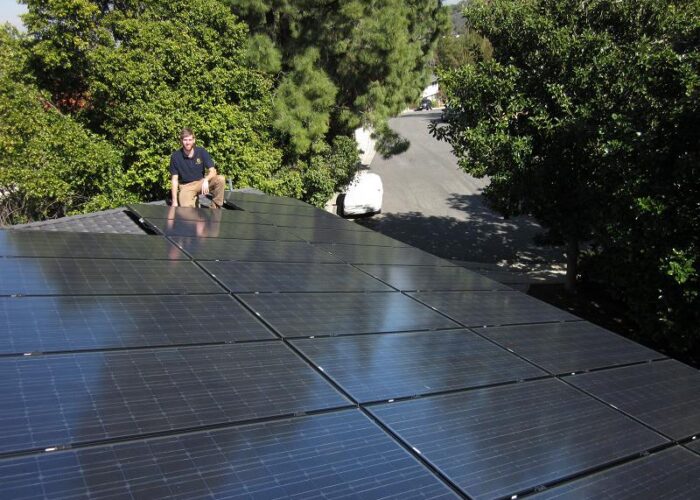
RGS Energy, a division of Real Goods Solar, and Smart Energy Capital (SEC) are to jointly install 5.1MW of solar power in 18 schools in the Stockton Unified School District (SUSD) in California.
Counterfeit safety markings have been found on modules from Advanced Solar Photonics (ASP), according to independent global certification company Underwriters Laboratory (UL).
Importers of Chinese cells into the US may be evading anti-dumping (AD) and countervailing duties (CVD), according to the Coalition for American Solar Manufacturing (CASM).
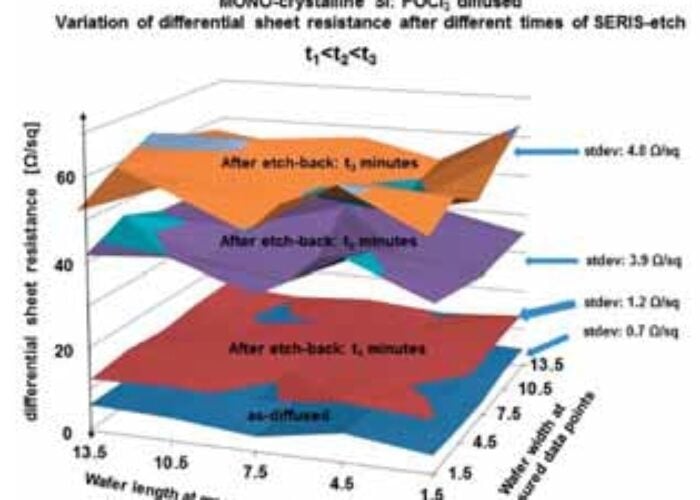
Emitter formation is one of the most critical processes in the fabrication of silicon wafer solar cells. The process for standard emitter formation adopted in the photovoltaic industry is tube-based diffusion, using phosphorus oxychloride as the dopant source. A potentially low-cost alternative that typically results in lower solar cell efficiencies is in-line diffusion, using phosphoric acid as the dopant source. The Solar Energy Research Institute of Singapore (SERIS) recently developed a technique called the ‘SERIS etch’, a non-acidic etch-back process technology that provides a controllable, uniform and substantially conformal etch-back suitable for solar cell processing. By using the SERIS etch, efficiencies of up to 18.7% have been demonstrated for omogeneous-emitter silicon wafer cells; a 0.4%abs efficiency improvement has also been achieved for a unique selective-emitter approach exploiting this novel etch. All work was carried out on industrial-grade p-type Cz wafers with conventional screen-printed metallization and a full-area aluminium back-surface field (Al-BSF). With Al local BSF (LBSF) homogeneous-emitter solar cells, efficiencies of 19.0% were achieved using in-line emitter diffusion and the SERIS etch, a 0.7%abs efficiency increase over the baseline efficiency at the time. To the authors’ knowledge, these are the highest solar cell efficiencies ever reported for in-line-diffused silicon solar cells. Moreover, the SERIS etch is a costeffective alternative to generating pyramid-textured surfaces without using conventional metal-assisted siliconetching processes.