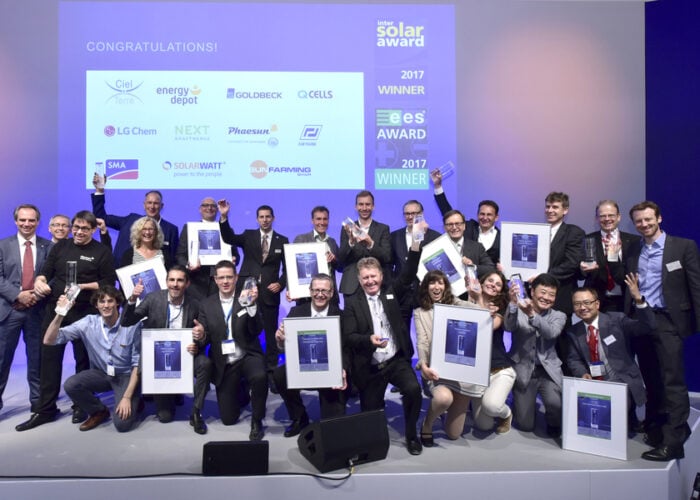
In its tenth year of organisation, the Intersolar AWARD proceedings reflected a niche but high-profile sector of the downstream PV industry, floating solar. The coveted prize in the ‘Photovoltaics’ category went to project developer Ciel & Terre International, regarded as a pioneer of floating solar with around 43 projects completed.
‘Silicon Module Super League’ (SMSL) member Hanwha Q CELLS said its key strategic focus was to diversify its regional and market segment sales in 2017, while reiterating full-year PV module shipment guidance to be in the range of 5.5GW to 5.7GW in 2017.
News in Brief: Vivint Solar is taking advantage of Rhode Island's optimal residential solar conditions and expanding into the state, BBOX and Aeris are partnering to provide plug-and-play solar systems with IoT connectivity in East and Central Africa, Sri Lankan energy ministers are allocating funding to install solar systems in selected public buildings and India's Space Research Organisation has developed a new solar app for Android.
In this week's Movers & Shakers segment, PV Tech focuses in solar jobs in the US, with the UK's Lightsource embarking on its pilot expansion into North America, and Panasonic's Coronal Energy likewise strengthening its North American operations with new strategic leaders. An early-stage investor exits India's Azure Power and The Solar Foundation launches a new online career platform, in other news.
PV CellTech 2017 takes place in Penang, Malaysia, on 14-15 March 2017, and we were delighted when we caught up with Qi Wang at JinkoSolar, who is delivering one of the keynote presentations on the morning of 15 March, titled: Record efficiency of industrial screen-printed multi c-Si solar cells.
With the industry’s leading PV manufacturing event, PV CellTech 2017, just a few weeks away on 14-15 March 2017 in Penang, Malaysia, PV-Tech took the opportunity to speak with the Chairman of the Technical Advisory Board, Finlay Colville, on what we can expect to learn from the event this year.
At the start of each year, when market observers do their annual look at the year ahead, there is normally always a vague statement about some type of widespread consolidation of companies set to unfold.